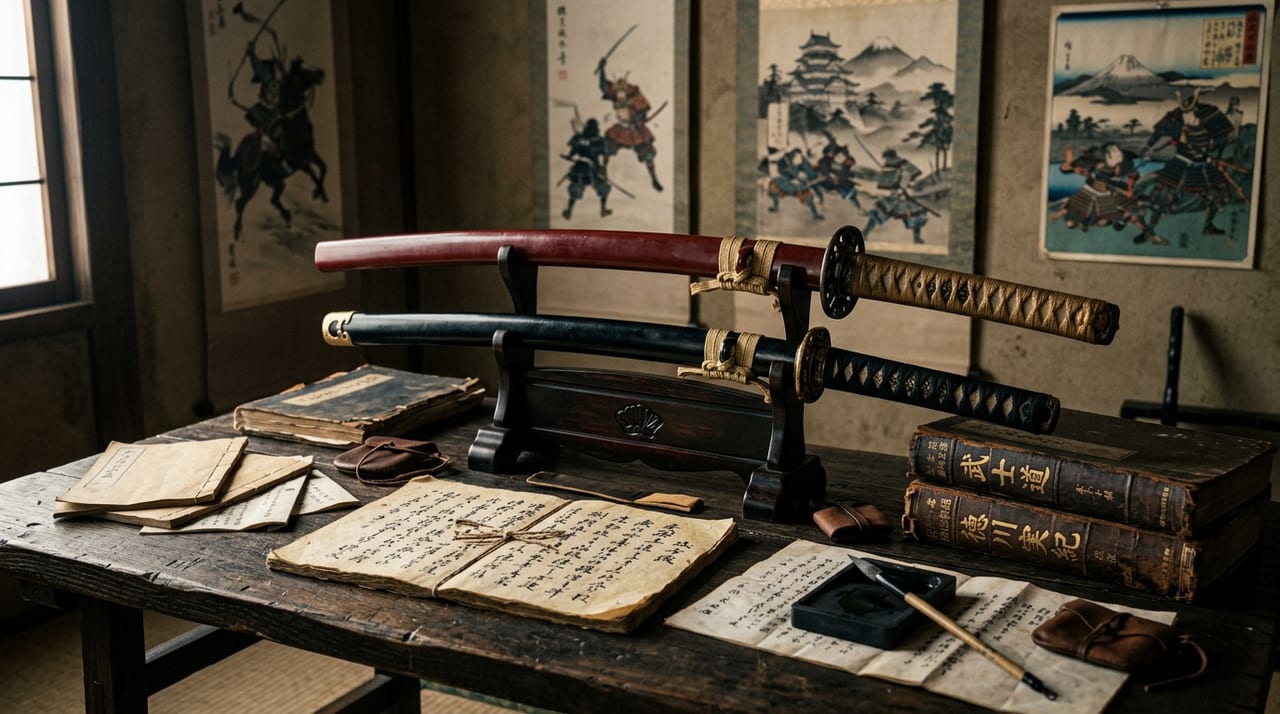
 * Image is for illustrative purposes only.
Taiga Drama: One-Eyed Dragon Masamune
大河ドラマ 独眼竜政宗
The 25th NHK Taiga drama, broadcast in 1987 (original work: Yamaoka Sōhachi; starring: Watanabe Ken). It depicts the life of Date Masamune and recorded an average viewership rating of 39.7% (the highest ever for a Taiga drama) and a peak rating of 47.8%. Many famous swords connected to Masamune, including the "Shokudaikiri Mitsutada," "Taikogane Sadamune," and "Ōkurikara," continue to be passed down to later generations.
Description
Work Overview
"Dokuganryū Masamune" was the 25th NHK Taiga drama, broadcast from January 4 to December 13, 1987. Its source material was Yamaoka Sōhachi's "Date Masamune." Watanabe Ken played Date Masamune. Its average viewership rating of 39.7% remains the highest on record for any Taiga drama as of 2026 (the peak rating was 47.8%). In the opening, Watanabe Ken appears on horseback wearing the helmet of the black-lacquered five-plate cuirass armor (kuro-urushi gomai-dō gusoku) worn by Date Masamune, and Masamune's armor and weapons were used symbolically. The Japan Armor and Weapons Research and Preservation Society cooperated on the title.
Date Masamune: The "One-Eyed Dragon" and Japanese Swords
Date Masamune (1567–1636) lost his right eye to smallpox in childhood and was a powerful lord of Ōshū known by the nickname "One-Eyed Dragon." He survived under both the Toyotomi (Hideyoshi) and Tokugawa (Ieyasu) regimes and laid the foundation for the Sendai Domain (620,000 koku). Masamune was also known as a collector of swords, and swords connected to him have been passed down at the Sendai City Museum and elsewhere. "Dokuganryū Masamune" is a Taiga drama that depicts the full picture of this Sengoku warlord, including the aspect of Masamune as a sword enthusiast.
Shokudaikiri Mitsutada: Masamune's Greatest Beloved Sword
Among Date Masamune's swords, the most famous is the "Shokudaikiri Mitsutada." It is a work by Mitsutada, regarded as the de facto founder of Bizen Osafune, and its name is said to come from the fact that when Masamune cut down a retainer, the blow also severed the candlestand (shokudai, a candle holder) behind the retainer. One theory holds that it was presented to Masamune by Toyotomi Hideyoshi, and it is said to have later passed to Tokugawa Yorifusa, the first lord of the Mito Domain. Long believed to have been destroyed in the Great Kantō Earthquake, it was reconfirmed in 2015 to survive in charred condition in the storehouse of the Tokugawa Museum (Ibaraki Prefecture), which attracted attention.
Taikogane Sadamune: A Famous Sword of the Sōshū Tradition
"Taikogane Sadamune" is a tanto by the Sōshū-den smith Sadamune, active from the Kamakura to Nanboku-chō period. It was passed down to the Sendai Date family and designated an Important Cultural Property, and it is currently in private hands. It is said to have originally been owned by the Sakai merchant house "Taikogane," and later passed through the Tokugawa shogunal family before reaching the Date family. It is also said to have been bestowed on Date Tadamune, the second generation of the Date family, and it was handed down through generations as a treasured possession of the Sendai Date family.
Ōkurikara: Hiromitsu Passed Down in the Date Family
"Ōkurikara" is a work by Sōshū Hiromitsu and is a sword (Important Art Object) that the Tokugawa shogunal family presented to the Date family as a reward for the stone wall construction at Edo Castle. It is also widely known to modern sword fans through the game Touken Ranbu. The name derives from the fact that the blade is carved with a Kurikara dragon, said to be an incarnation of Fudō Myōō.
Habaki Kuniyuki: A Tachi Favored by Masamune
"Habaki Kuniyuki," which the Sendai City Museum acquired in 2019, is a tachi that Toyotomi Hideyoshi bestowed upon Masamune and holds significant value as a historical document. Not only the blade but also the habaki (blade collar) were made by Rai Kuniyuki, which is why it is called "Habaki Kuniyuki." Masamune is said to have favored it as the sword he carried when going to castle (donated by the family of Ogasawara Nobuo).
Ratings Records and Cultural Impact
The average rating of 39.7% has still not been broken as the highest record for a Taiga drama. Thanks to the great hit of this work, Watanabe Ken became a star overnight, and nationwide interest in Date Masamune and the history of the Tōhoku region rose sharply. Through this work, the name recognition of "Dokuganryū Masamune" became nationwide, and interest in swords connected to Masamune also grew.
Real Swords Featured
Shokudaikiri Mitsutada — Masamune's Beloved Sword, in the Tokugawa Museum Collection
A sword traditionally attributed to Bizen Osafune Mitsutada, and one theory holds that Date Masamune received it from Toyotomi Hideyoshi. The name derives from the story that when Masamune cut down a retainer, the blow also severed the candlestand behind him. It is now held by the Tokugawa Museum in Mito, Ibaraki Prefecture, and as the model for the "Shokudaikiri Mitsutada" character in Touken Ranbu (the game), it is widely known to younger generations today as a famous sword.
Taikogane Sadamune — Important Cultural Property, Passed Down in the Date Family
A tanto by the Sōshū-den smith Sadamune, active from the Kamakura to Nanboku-chō period. Designated an Important Cultural Property. It is said to have passed from the Sakai merchant house "Taikogane" through the Tokugawa shogunal family to the Date family, and to have been bestowed on Date Tadamune, the second generation. Handed down through generations as a treasured possession of the Date family, it holds an important place in sword history as a masterpiece showing the technical refinement of the Sōshū tradition.
Habaki Kuniyuki — Sendai City Museum Collection, Tachi Confirmed as Used by Masamune
A tachi said to have been bestowed upon Date Masamune by Toyotomi Hideyoshi. It is a work of Rai Kuniyuki, and because the habaki were also made by Kuniyuki, it is called Habaki Kuniyuki. Masamune is said to have favored it as the sword he carried when going to castle. In 2019 it was donated to the Sendai City Museum by the family of Ogasawara Nobuo.
See authentic Japanese swords
See authentic Japanese swordsThis page is intended to introduce Japanese sword culture and is not affiliated with any of the works mentioned.