 * Image is for illustrative purposes only.
Bushido Sixteen
武士道シックスティーン
A youth kendo novel by Tetsuya Honjō (2007) and its film adaptation (2010, directed by Tomoyuki Furumaki). A youth ensemble drama set in a high school kendo club, centered on two contrasting girls: Kaori Isoyama, a talented swordsperson devoted entirely to kendo, and Sanae Nishiogi, who has continued kendo almost casually. Through the conflict between the spirit of bushidō and kendo as a modern sport, it reexamines the essence of the sword's 'mind-technique-body' (shin-gi-tai) from a contemporary perspective. An important pop-culture work for understanding how kendo, functioning as the cultural heir to the Japanese sword, is transmitted in modern Japan.
Description
Bushido Sixteen: A Coming-of-Age Novel Questioning the Spirit of Bushidō in Modern Kendo
Bushido Sixteen (Tetsuya Honjō, 2007) is a novel set in a modern high school kendo club that explores the questions "What is kendo?" and "Does the spirit of bushidō live in the present?" through the coming-of-age drama of 16-year-old girls. In 2010, it was adapted into a film directed by Tomoyuki Furumaki, starring Riko Narumi and Kii Kitano, and was highly praised as "a story of girls living kendo in the modern age." With sequels "Bushido Seventeen" and "Bushido Eighteen," it forms a trilogy centered on high school kendo.
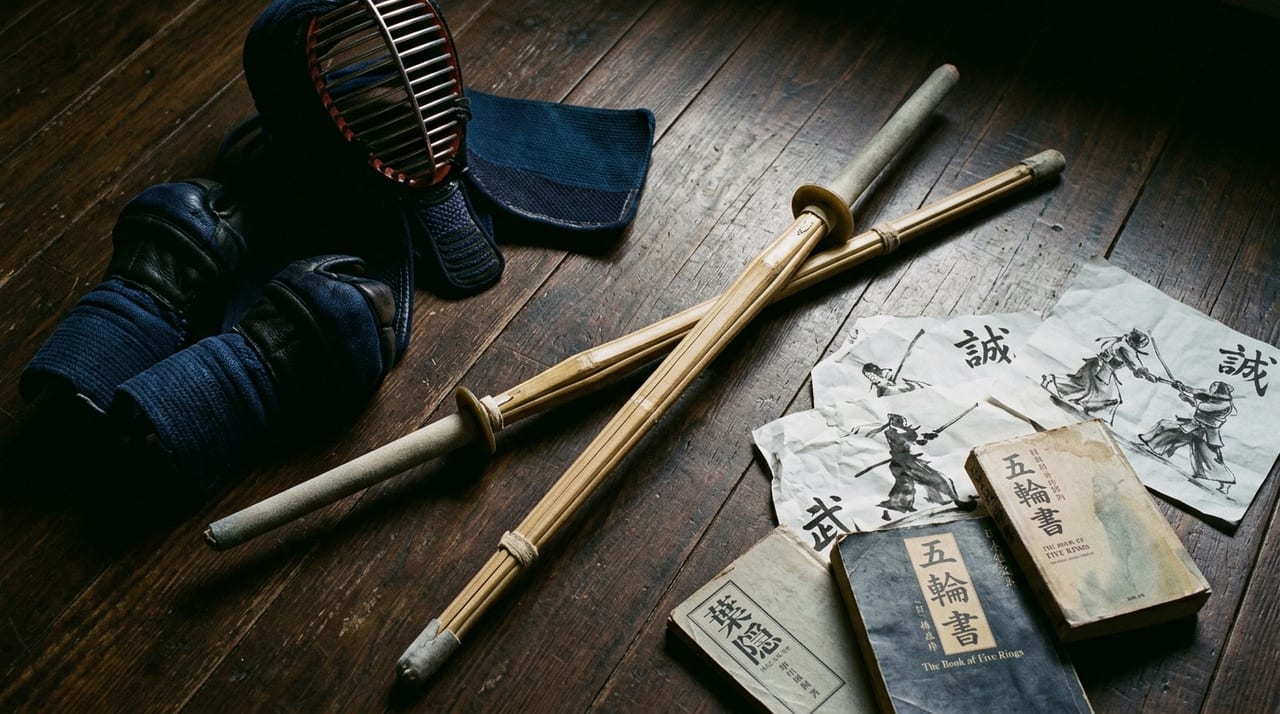
What makes this work important to sword enthusiasts is that it presents the question of "cultural continuity between kendo and the Japanese sword" in its most accessible form. Although kendo is not a martial art that directly employs the Japanese sword (shinken), it is a sport and martial way that transmits "body control, distance, and striking philosophy conceived with the sword in mind" through the use of bamboo swords and protective gear, and represents the cultural form through which "the spirit of the Japanese sword" is most widely inherited in modern Japan.
The Contrast of Two Protagonists: Divergent Approaches to Bushidō
The defining feature of this work lies in the contrast between two protagonists who hold fundamentally different attitudes toward kendo. Kaori Isoyama is portrayed as a talented kendoka who has devoted herself wholly to kendo since childhood, possessing a pure dedication to "scoring ippon" and an intense commitment to embodying bushidō. For Kaori, kendo is "the totality of life," and the spirit of bushidō—the weight of a single strike, spiritual training, and etiquette—becomes the governing principle of her existence.
In stark contrast, Sanae Nishiogi is a girl who has continued kendo "without real conviction," and through Kaori's eyes appears as someone who "does not grasp the spirit of kendo." Yet the reversal and increasing complexity of this contrast as the narrative unfolds is the thematic heart of the work. The questions "Can the spirit of bushidō be reached only through one particular approach?" and "Can kendo exist as a purely competitive sport?" are explored through the evolving relationship between these two characters.
The 'Etiquette' of Kendo: The Modern Inheritance of Japanese Sword Bushidō Philosophy
The clearest expression of how kendo transmits the bushidō philosophy of the Japanese sword to the present day is embodied in the culture of "rei" (etiquette). Bows performed before and after matches, respect for one's opponent, and the maintenance of composure after scoring ippon—these represent a modern sporting reinterpretation of the philosophy of "respectful combat" that governs actual shinken duels. Through concrete episodes, this work depicts how the "spirit of etiquette" lives in the daily lives of contemporary high school students, or has become merely formal.
The "culture of etiquette" in kendo constitutes a direct inheritance of the spiritual legacy of Japanese sword culture, and understanding kendo is one of the shortest paths to comprehending "sword culture as bushidō" in the modern world. Bushido Sixteen, as a work presenting this lineage of transmission in the most accessible form of coming-of-age drama, has become an important cultural reference point for those beginning to explore sword culture.
The Philosophy of 'Ippon': Kendo and the Japanese Sword's 'One Decisive Strike'
The concept of "ippon" (一本) in kendo is a direct continuation of the Japanese sword philosophy of "one decisive strike" (ichigeki hissatsu). The criteria for a valid strike—complete spirit and energy, correct posture and sword technique, striking the opponent's target with precision using the striking part of the bamboo sword—embody the rigorous standard that "without complete and perfect sword technique, there is no ippon." If Bushido Blade embodied this concept of "one decisive strike" as a video game, Bushido Sixteen depicts this same concept as it lives within modern sport through the lens of everyday coming-of-age drama.
Film Adaptation and the Visualization of Kendo
The 2010 film version (starring Riko Narumi and Kii Kitano) was produced through interviews with experienced kendo practitioners and technical consultation from licensed instructors. The precision of movements in scenes striking the face mask, wrist guards, and torso; the accurate depiction of referee movements and flag signals during ippon judgments—these elements earned praise from kendo practitioners for being "meticulously researched." As a film, the kendo sequences (particularly Kaori's match scenes) achieve high production value as images through which the inherent martial way character of kendo—the "distance and body control as conceived with the bamboo sword embodying the Japanese sword"—is visually conveyed.
Perspective for the Sword Collector
Bushido Sixteen stands as one of the finest pop-culture works for understanding how Japanese sword philosophy remains vital in modern Japan. Through an accessible coming-of-age narrative centered on 16-year-old girls, it allows one to experience kendo's concrete transmission of the Japanese sword's "weight of a single strike, mastery of distance, and culture of etiquette" to the present age. Though the Japanese sword itself does not appear in the work, understanding the "cultural continuity" wherein "the spirit of the sword lives on in the modern bamboo sword" broadens the perspective of actual Japanese sword collecting. For sword enthusiasts drawn to kendo dojos and traditional sword practice, this work serves as an ideal gateway into "the contemporary way of the sword."
See authentic Japanese swords
See authentic Japanese swordsThis page is intended to introduce Japanese sword culture and is not affiliated with any of the works mentioned.