 * Image is for illustrative purposes only.
Berserk
ベルセルク
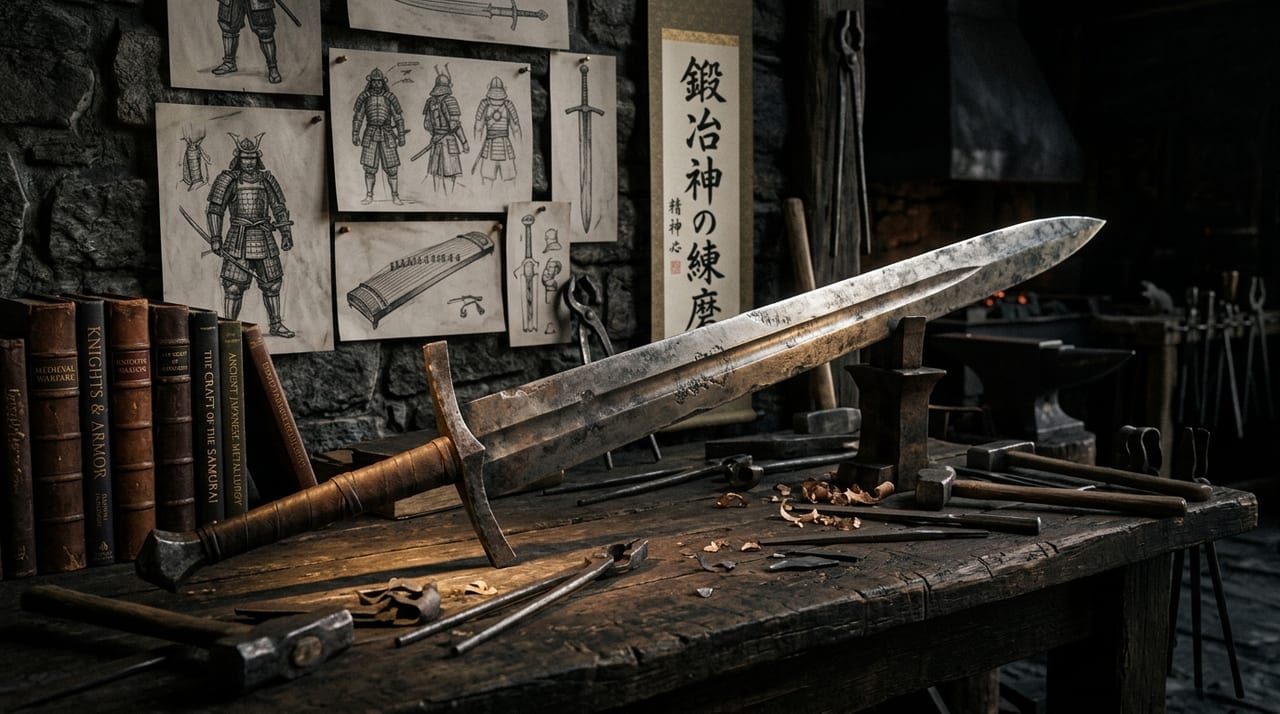
Kentaro Miura's landmark manga. The Dragon Slayer wielded by the protagonist Guts is a giant greatsword whose length exceeds the height of an adult man, and its enormity overlaps in part with the Japanese culture of nodachi and ōdachi. Although set in a medieval Western-style world, the work carries a deeply Japanese spirituality in its views on swordsmiths, the philosophy of weapon-making, and the relationship between a warrior's spirit and the blade.
Description
Kentaro Miura's Legacy
Berserk is one of the greatest masterpieces in the history of Japanese manga. Kentaro Miura began serializing it in 1989, and even after Miura's sudden death in 2021, the serialization has continued with Studio Gaga (art) and Kōji Mori (supervision). Drawn in the grammar of dark fantasy, the work is set on the surface in a world modeled on medieval Europe, but beneath it run the currents of Japanese bushidō, Zen, and the philosophy of the sword. Guts's relationship with his sword deeply resonates with the Japanese theory of the relationship between swordsmith and blade.
The Dragon Slayer and Japan's Great Sword Culture
The Dragon Slayer, Guts's signature weapon, is an unrealistically huge greatsword. Its length exceeds the height of an adult man, and its weight is set so high that ordinary people could not even lift it. Yet this concept of a blade beyond the size humans can wield is not unrelated to Japanese weapon culture. The zanbatō (Chinese zhanmadao) was originally a long-hafted weapon or large sword used in China against cavalry. Japan, however, had a culture from the medieval period onward of swords with blade lengths far exceeding ordinary uchigatana, such as nodachi and ōdachi. Legends of heroes wielding great swords in battle also appear in Japanese war chronicles, and the enormous presence of the Dragon Slayer overlaps in part with this Japanese lineage of great-sword heroes.
The Smith Godo and the Spirit of the Swordsmith
Godo, the smith who plays an important role in the story, is an old craftsman who once forged the Dragon Slayer. The bond between Godo and his forge, and his philosophy of facing the iron, resonate remarkably with the spirit Japanese swordsmiths show when forging blades. In Japanese sword-making, forging is not mere metalworking but a spiritual act of facing flame and steel, and the tradition that the swordsmith infuses the sword with a soul lives on. Berserk depicts a sword Godo forged that is tempered by the grudges of the Apostles and evil spirits it has cut down, becoming effective even against spiritual beings. This can be read as the Japanese idea of a blade in which a soul dwells, portrayed beneath a Western exterior.
The Philosophy of Blade and Soul
A theme Kentaro Miura repeatedly depicts is the idea that the sword is a mirror of the person. As Guts becomes ever more possessed by the sword as he wields it, and the sword becomes part of his very being, this can be called a manga expression of the Japanese view of swords, in which the blade is a symbol of the soul and more than a mere weapon. In Japan, the custom of giving swords names, keeping them carefully, and passing them down through generations took root in warrior society. It reflects a philosophy that treats the sword as a being with a personality. The depiction of the Dragon Slayer accumulating wounds together with Guts can be called the Western fantasy version of this philosophy.
Global Influence and Interest in Japanese Swords
Berserk has also been published in collected volumes overseas and has won support around the world. The detailed depictions of metalworking in Godo's forge and the finely crafted armor, helmets, and weapons are drawn in meticulous detail, and they continue to stimulate readers' intellectual curiosity.
Real Swords Featured
nodachi and ōdachi (great swords of the battlefield)
Nodachi and ōdachi are long Japanese swords with blade lengths of three shaku or more (over 90 cm). From the Nanboku-chō period to the Azuchi-Momoyama period, they were used on the battlefield, originally as weapons wielded by mounted warriors from horseback. Some were handed down as treasured possessions of daimyo families, and most extant ōdachi remain as swords dedicated to shrines. Ōdachi taller than a person actually exist, such as the ōdachi (7 shaku 4 sun 2 bu) that Yahiko Shrine in Niigata Prefecture holds as an Important Cultural Property, and they bring to mind the Dragon Slayer in Berserk.
zanbatō (Chinese zhanmadao)
The zanbatō is a long-hafted anti-cavalry weapon used in China, or a large sword known by that name. It began with the zhanmajian of the Former Han dynasty, and in the Song dynasty it became common to call large, long-bladed swords zanbatō. In practice it was not powerful enough to cut a horse in two. It was used to unhorse riders with its long reach or to target the horse's legs. In Japan the term zanbatō is sometimes applied to nodachi and ōdachi, but this is said to be a confusion spread by fiction such as recent manga. The Chinese zanbatō and the Japanese ōdachi are separate weapons.
This page is intended to introduce Japanese sword culture and is not affiliated with any of the works mentioned.