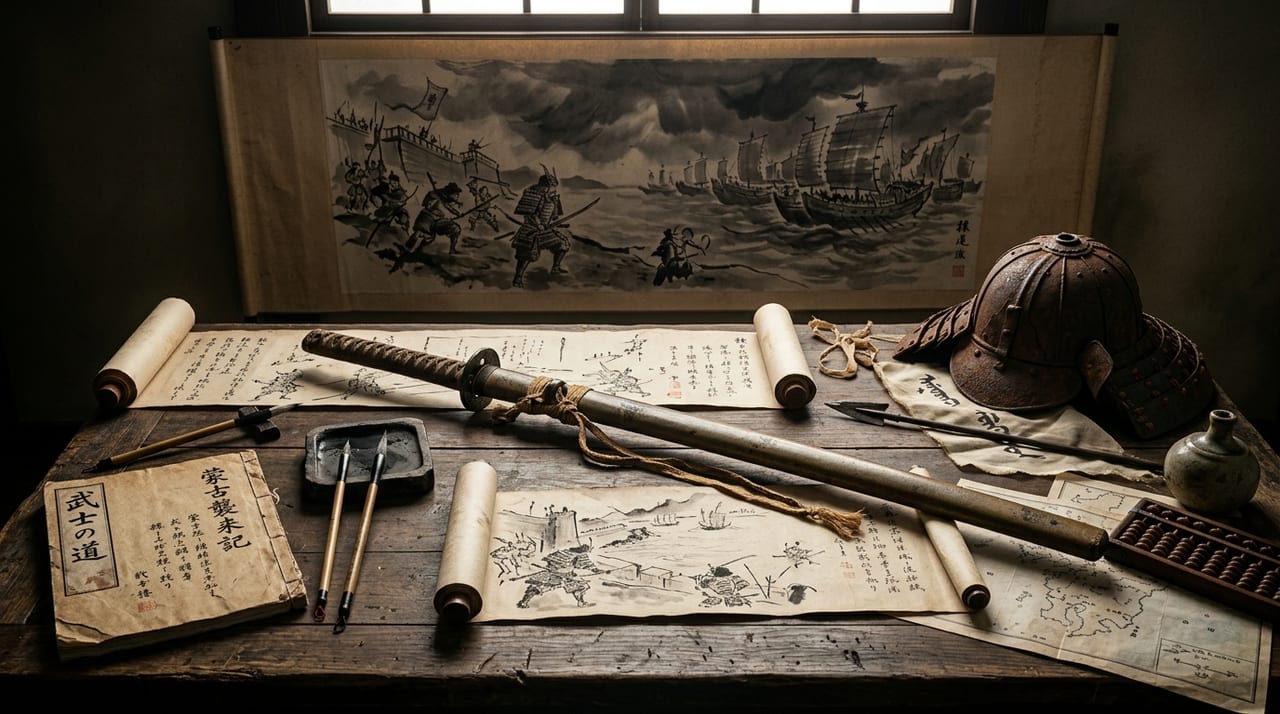
 * Image is for illustrative purposes only.
Angolmois: Record of Mongol Invasion
アンゴルモア 元寇合戦記
A manga (from 2013) and anime (2018) depicting the 1274 Mongol invasion of Tsushima Island. Praised for its historical rigor and visceral swordfighting, it shows how Japanese warriors actually fought against the world's largest military force.
Description
The Genkō Historical Event
The Bun'ei invasion of 1274 and the Kōan invasion of 1281, the so-called "Genkō" (Mongol Invasions), are recorded in Japanese history as the largest foreign invasions the country has faced. The combined forces of the Mongol Empire (Yuan) and its vassal state Goryeo mobilized roughly 30,000 troops in the Bun'ei invasion and roughly 140,000 in the Kōan invasion, unprecedented armies for their time, and attacked northern Kyushu, Tsushima, and Iki. These battles gave Japanese warriors their first experience of a true large-scale pitched battle and made them painfully aware of the limits of their combat style, which centered on one-on-one duels. Angolmois depicts the Battle of Tsushima, the first battlefield of the Genkō, with careful historical research.
Japanese Swords Against the Mongol Army in Practice
Regarding the actual combat use of Japanese swords in the Genkō, contemporary picture scrolls and records provide valuable historical sources. The famous "Mōko Shūrai Ekotoba" (Scroll of the Mongol Invasions) depicts Takezaki Suenaga charging on horseback, the Mongol army's group tactics, poisoned arrows, and attacks with explosive projectiles called "tetsuhau," conveying the shock of the organized group combat that Japanese warriors experienced for the first time. Based on such sources, Angolmois meticulously depicts the asymmetric clash between the individual swordsmanship of the Japanese warriors, in particular the overwhelming superiority of the Japanese sword in close combat, and the Mongol army's organized group tactics and the mobility of its mounted archers. The work portrays, as an interplay of strategy and individual skill, the actual situation on the Japanese side: the Japanese sword performs superbly once combat reaches close range, but the Japanese are clearly at a disadvantage in long-range attacks, poisoned arrows, and firearms.
Tsushima as the Setting
Since ancient times Tsushima has been a key transit point between the Korean Peninsula and the Japanese archipelago, and in the Genkō it was the site of the first fierce fighting. In the Bun'ei invasion, Sō Sukekuni, the shugo-dai (deputy constable) of Tsushima, is said to have fought with about 80 of his retainers against the tens of thousands of combined Mongol and Goryeo forces and been wiped out. This desperate fight against an overwhelming disparity of forces is an extreme embodiment of the warrior spirit of fighting for honor. Angolmois reinterprets this historical fact from the viewpoint of its protagonist, Kuchii Jinzaburō, a warrior in exile. Tsushima still retains many Genkō historic sites, and Komoda-hama Shrine enshrines Sō Sukekuni as its principal deity.
Realism in Swordsmanship Depiction
Angolmois's depiction of swordsmanship embodies how Japanese swords were actually used on the battlefield. Beyond individual technique, it emphasizes the tactical side of battlefield swordsmanship, including the use of terrain, ambushes, and maneuvering against many enemies. Particularly striking are its realistic elements: the use of the sword from horseback, the handling of the sword in night battles, and the changes in swordsmanship after an injury. The author, Nanahiko Takagi, approaches his research and material investigation with care, and the historical study of Kamakura-period weapons, swords, and armor supports the persuasiveness of the entire work.
Impact on the Present Day
With the 2018 anime adaptation, Angolmois conveyed to many fans in Japan and abroad the historical event of the Genkō and the warriors who survived it. For fans overseas in particular, the world-historical confrontation between the Mongol Empire and Japanese warriors has sparked intense interest, making the work a gateway to Japanese bushidō, swordsmanship, and sword culture. The Battle of Tsushima was a rare historical event in which a small number of warriors fought head-on against the world's largest empire, and Angolmois is one of the finest works that vividly conveys that memory to the present day.
Real Swords Featured
Kamakura tachi (real battle swords of the Genkō era)
Japanese swords of the Kamakura period (late 12th to early 14th century) were mainly tachi, used by mounted warriors from horseback. Tachi from the mid-Kamakura period, around the time of the Genkō, had wide blades and a robust form with an ikubi-kissaki ("boar-neck" point), built to cut through sturdy armor. The Kamakura tachi used in the Battle of Tsushima during the Genkō is exactly this type of sword, and it forms the basis of Angolmois's sword-fight depictions. Surviving Kamakura-period tachi are held as National Treasures and Important Cultural Properties in museums across the country, and the integration of their elegance and practicality is one of the pinnacles of Japanese sword history.
Bizen Osafune Kanemitsu (masterpieces of the Nanboku-chō period)
Kanemitsu of the Bizen Osafune school is a master smith representative of the Nanboku-chō period that followed the Genkō, and he left behind many masterpieces with robust proportions and complex hamon. He forged many bold works, such as ōdachi (great swords), during the turmoil of the Nanboku-chō period, which gives him great historical significance. Many of Kanemitsu's swords still survive today as Important Cultural Properties, embodying the changes in Japan's sword culture after the Genkō.
This page is intended to introduce Japanese sword culture and is not affiliated with any of the works mentioned.