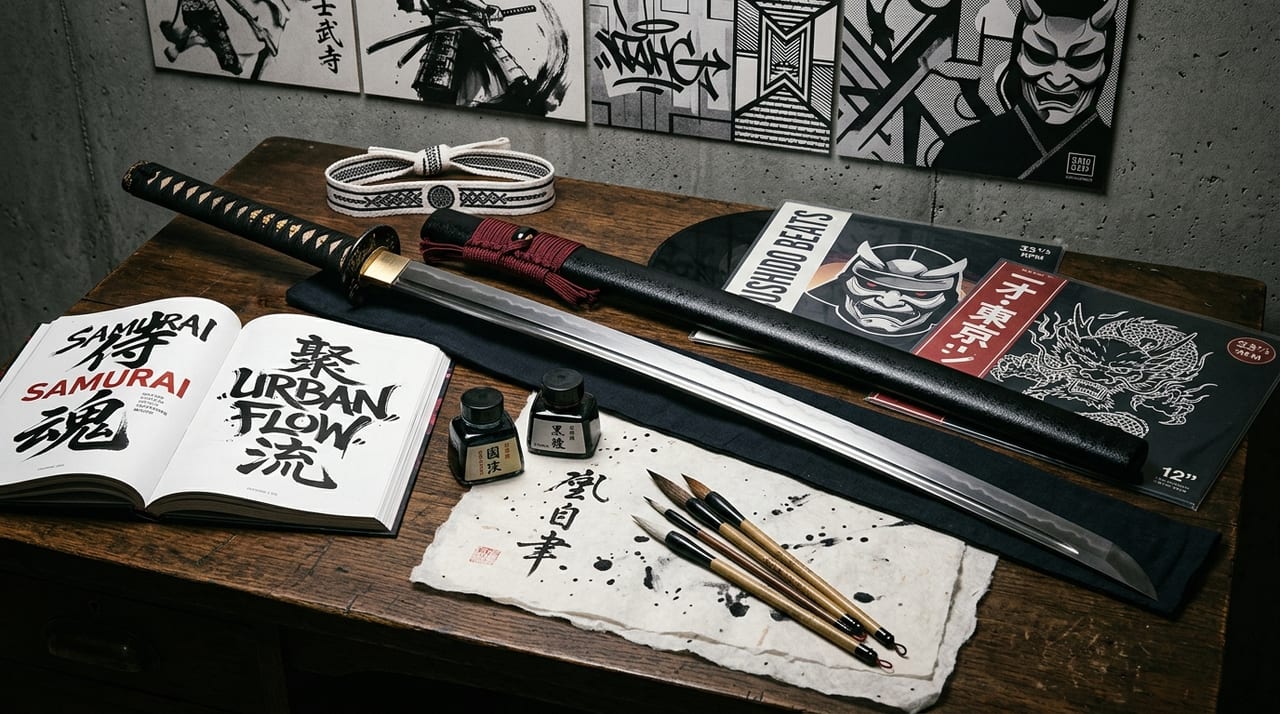
 * Image is for illustrative purposes only.
Afro Samurai
アフロサムライ
An anime series based on the manga by Okazaki Takashi, produced by Japan's GONZO and first broadcast in the United States in 2007. Starring and produced by Samuel L. Jackson, it is an innovative work that fuses hip-hop music with hyper-stylish swordplay. Set in a world where "whoever holds the Number One headband rules the world," it follows an afro-haired Japanese swordsman on a journey of vengeance. By fusing the beauty of the Japanese sword with American Black culture, it drew worldwide attention.
Description
The Birth of Afro Samurai and Culture Crossing Borders
Afro Samurai is an unconventional work: adapted into anime by Japanese animation studio GONZO from a manga by Okazaki Takashi, which he had published as a dōjinshi in the 1990s, and broadcast in the United States on Spike TV in 2007. Samuel L. Jackson participated in the production as lead actor and producer, not only voicing the protagonist Afro but also doubling as the voice of Ninja Ninja, the cheerful ninja who follows Afro around. What makes this work especially notable worldwide is its bold, revolutionary attempt to fuse the swordsmanship culture of Japan and the aesthetics of the Japanese sword with American hip-hop and Black culture. The soundtrack, handled by RZA (Wu-Tang Clan), is original and hip-hop-based, and strongly reinforced the world of Afro Samurai from a musical standpoint.
Sword Setting and the Aesthetics of the Japanese Sword
At the core of the story is the simple yet cruel rule that whoever holds the Number One headband gains the power to rule the world. To avenge his father, who was killed by "Justice," Afro keeps fighting in pursuit of the Number One headband, the proof of being the strongest swordsman. On this journey, Afro's Japanese sword is not a Western-style "magic sword" but a "Japanese sword as a tool," depicted as wielded purely through swordsmanship and mental strength. The sword-fighting scenes are staged in an extremely stylish way: violent depictions of spraying blood and severed limbs, along with the sharpness of the Japanese sword cutting through a human body almost instantly, are expressed with strong visual impact. The shape of the swords Afro uses faithfully follows the basic form of a Japanese sword (sori, shinogi, and kissaki), and rather than being a mere fantasy weapon, the design is based on a real understanding of the Japanese sword.
Significance as Global Cultural Hybridization
Afro Samurai is a highly intriguing work from the perspective of cultural hybridization. Its setting is a fictional "Age of Samurai" Japan, yet it freely combines motifs from hip-hop, Westerns, science fiction, and kung fu films. This cross-cultural approach made it possible to present the Japanese sword and the image of the "samurai" not as the product of a fixed ethnic culture, but to the world as a universal "aesthetics of the swordsman." Afro Samurai had a particularly strong appeal among young African American audiences, and became a new bridge linking hip-hop culture with Japanese anime and sword culture. With a cultural impact significant enough that its sequel, Afro Samurai: Resurrection, won an Emmy Award in 2009, Afro Samurai proved that the Japanese sword remains a living, iconic presence even in 21st-century global popular culture.
The Myth of the Japanese Sword's "Cutting Sharpness"
Afro Samurai's depiction of the Japanese sword visualizes, in exaggerated form, the real characteristics of the Japanese sword: the combination of superior sharpness, flexibility, and hardness. In fact, the cutting sharpness of the Japanese sword stands far above the swords of the world. In the Edo period, Yamada Asaemon and others, who served as otameshi goyō (official sword-testing office) for the shogunate, conducted test cuts, and the sharpness of each swordsmith was graded based on the results. The secret behind the Japanese sword's superior sharpness lies in the properties of a steel called tamahagane, produced through tatara smelting, and in a homogeneous steel structure of several thousand layers, created by folding forging that the smith repeats more than ten times. The more Afro Samurai exaggerates, the more the sharpness and performance of genuine Japanese swords continue to astonish weapon enthusiasts and swordsmen around the world.
Sequel and Global Influence
In 2009, Afro Samurai: Resurrection (Revival) was produced and broadcast, earning high acclaim as a series. Afro Samurai is positioned as a work with especially international impact among the "Cool Japan" content of the 2000s. Among anime and games with motifs drawn from the Japanese sword, Afro Samurai stands out as the work with the most global outlook, and is a pioneering presence that embodies the fact that "the Japanese sword is a global cultural icon."
The Swords of Afro Samurai
The "longing for the Japanese sword" that Afro Samurai delivered to younger generations around the world is also a valuable catalyst leading to real interest in collecting and the culture of Japanese swords. The weight, feel, and gleam of the hamon of a real Japanese sword offer a real experience that no visual expression on screen can match. We hope you will take the chance to confirm, through genuine swords, the essence of the "legend of the Japanese sword" that Afro Samurai delivered to younger generations around the world.
Real Swords Featured
Bizen Osafune Kiyomitsu (Practical Blade of the Sengoku Period)
Bizen Osafune Kiyomitsu is a representative practical sword produced in large numbers during the Sengoku period. Many mass-produced swords called kazuuchi were also made and were widely used on the battlefield. It is one of the categories most fitting for the image of a "practical sword of those who live by the sword" as depicted in Afro Samurai. Many still survive today, and it is beloved as a staple for collectors new to the Japanese sword. Its plain sincerity, conversely, is valued as something that conveys the way of life of Sengoku warriors.
Echizen Yasutsugu (Renowned Practical Blade of the Early Edo Period)
Echizen Yasutsugu was a distinguished swordsmith who worked as an official smith to the Tokugawa family in the early Edo period and was permitted to use the aoi (hollyhock) crest. Yasutsugu's swords, which combine practicality and dignity, resonate with the world of Afro Samurai in the sense of "a sword worthy of one who has proven strength." Highly regarded as battle blades actually used by samurai, this line of smiths is also popular among modern collectors.
Koyama Munetsugu (Master of the Bakumatsu Period)
Koyama Munetsugu, a swordsmith representing Edo in the late Edo period (bakumatsu), is a master of the Shin-shintō period known for superior cutting sharpness. The myth of sharpness that Afro Samurai exaggerates, defeating multiple enemies in a single cut, has a certain basis in the performance of real Japanese swords, particularly the works of smiths known for sharpness such as Munetsugu.
Higo Dōtanuki (Synonym for a Sword That Cuts)
The Dōtanuki school of Higo Province has been known from the Sengoku period to the present as synonymous with "swords that cut," and has consistently earned high praise in records of test cuts. The extreme sharpness depicted in Afro Samurai can be understood as an exaggeration of the performance of the finest practical swords such as Dōtanuki. Favored by Sengoku warlords including Katō Kiyomasa, this line embodies the pure "completeness as a tool" of the Japanese sword and deeply resonates with the world of Afro Samurai, which portrays sword fighting head-on.
Masamune of Sagami Province (Pinnacle of the Japanese Sword)
Masamune (Gorō Nyūdō Masamune), a master smith of the late Kamakura period, is widely recognized as the greatest swordsmith in the history of the Japanese sword, and his name has become known around the world as a synonym for "the supreme sword." Like the headband contested as proof of strength in the world of Afro Samurai, Masamune's swords have been passed down as the ultimate treasures among powerful rulers and heroes throughout history. Swords by Masamune are extremely rare to survive, and many are designated Important Cultural Properties, including nine swords designated as National Treasures (four katana and five tantō). He is a smith who embodies, in its purest form, the concept of "the sword as proof of supremacy" that Afro Samurai depicts.
See authentic Japanese swords
See authentic Japanese swordsThis page is intended to introduce Japanese sword culture and is not affiliated with any of the works mentioned.