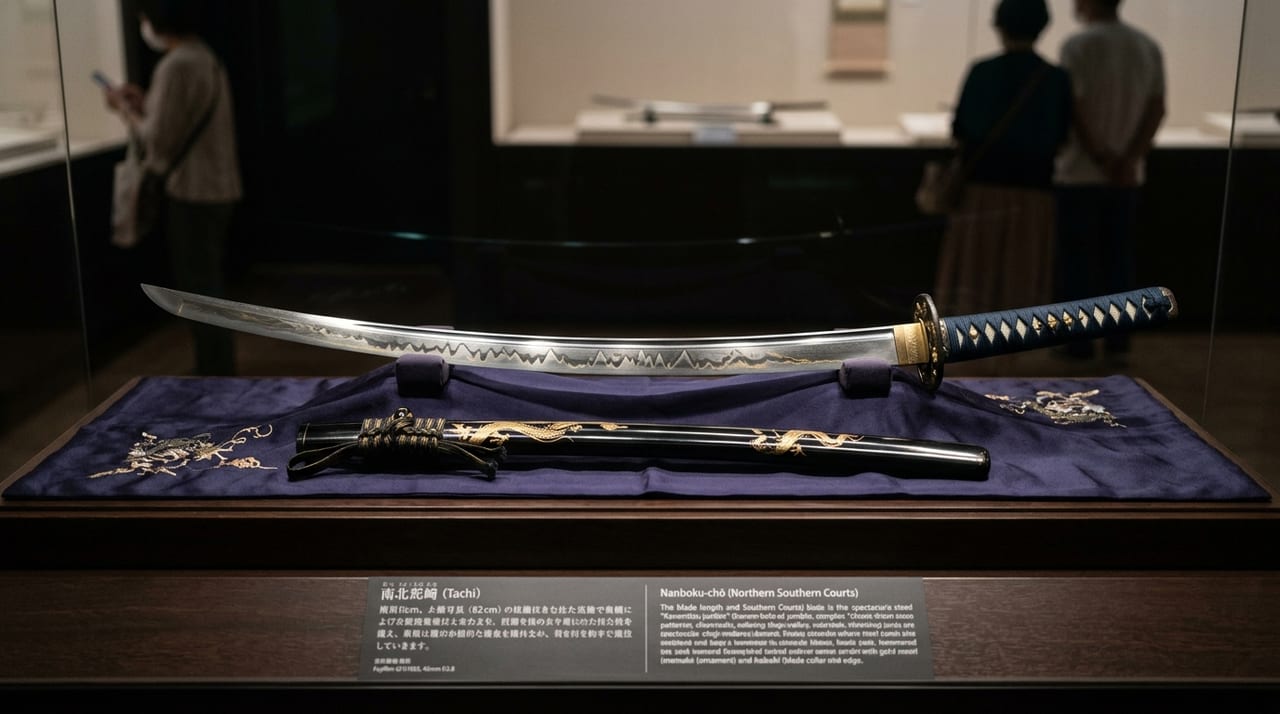
 * Image is for illustrative purposes only.
Takenomata Kanemitsu
竹俣兼光
Also known as: Teppō-giri Kanemitsu (Gun-cutter) / Ichiryōzutsu / Azuki Kanemitsu
Description
Osafune Kanemitsu beloved by Uesugi Kenshin
The Takenomata Kanemitsu is a tachi forged by Kanemitsu, the smith who represented the Osafune school of Bizen in the Nanbokuchō period. Its inscription is recorded as "Bishū Osafune Kanemitsu, Enbun 5, sixth month, day not given," and the blade is said to have had an imposing, long form, around 2 shaku 8 sun (about 85 cm) in length. The oshigata by Honami Kōetsu also contain records in which the dimensions and dates differ. It is said, however, that bō-hi grooves were cut on both the front and back, and that a relief carving of a sanko-tsuka ken was applied.
Origin of the name and its provenance
The name comes from the fact that the sword was owned by Takenomata Mikawa-no-kami Yoshitsuna, a retainer of the Uesugi. It is said that Yoshitsuna bought this sword, which had been in the hands of a farmer, and that his lord Nagao Kagetora (Uesugi Kenshin) later took it and made it his favourite blade. After Kenshin's death it passed to his adopted heir Uesugi Kagekatsu, who presented it to Toyotomi Hideyoshi when he went up to the capital in Tenshō 14 (1586). It was then handed down to Toyotomi Hideyori as a treasure sword of the Toyotomi house, but it disappeared when Osaka Castle fell in the Summer Campaign of Osaka in Keichō 20 (1615). Tokugawa Hidetada is said to have offered an extraordinary reward of 300 gold pieces and ordered a search, but it was never found, and its whereabouts remain unknown to this day.
The "Gun-Cutter" Epithet
This sword is known by several alternate names, including Teppō-giri Kanemitsu, Ichiryōzutsu, Raikiri and Azuki Kanemitsu. All of them derive from legends about its cutting power. Although the blade itself has been lost, it is still passed down as the sword that raised the name of the smith Kanemitsu into the realm of popular legend. Note that it is a different sword from the "Raikiri (Chidori)" known as the sword carried by Tachibana Dōsetsu.
Kanemitsu and the Legends of Sharpness
The maker Osafune Kanemitsu was the leading smith of Osafune in Bizen during the Nanbokuchō period, and is said to have been the son of Kagemitsu. He is regarded as the foremost representative of sōden Bizen, which adopted the Sōshū tradition into Bizen work, and he left many long tachi from the Nanbokuchō period. Among Kanemitsu's works, besides this blade, there are many famous swords whose names are tied to their sharpness, such as the Nami-yu Kanemitsu (Wave-Swimming Kanemitsu), said to have split in two a man who had been cut down and then swam across a river, and the Suijingiri Kanemitsu, said to have cut a water god during a flood. The gun-cutter legend of the Takenomata Kanemitsu belongs to this lineage. Now that the blade itself is lost, these traditions are themselves the substance of this tachi.
Legends & Stories
Cutting through a matchlock at Kawanakajima
The most famous story attached to the blade comes from the battles of Kawanakajima. When a Takeda gunner named Wagatsuki Heidayū took aim at Kenshin, the Uesugi lord is said to have struck him down with a single blow of this tachi. When the body was examined afterwards, both his armour and the matchlock in his hands had been cut clean in two. From this came the name Teppō-giri Kanemitsu, "the gun-cutter," and the alternate name Ichiryōzutsu, after the type of matchlock it severed.
The sword that cut lightning
An older legend concerns the farmer who owned the blade before the Takenomata family. Caught in a thunderstorm and about to be struck by lightning, he held the sword above his head; the bolt passed him by, and when he examined the point afterwards he found blood dripping from it — he had, the story says, cut the thunder god himself. From this came the name Raikiri.
Beans, and a test of authenticity
The same farmer is said to have been carrying a sack of beans when they spilled through a hole and split in two merely by brushing against the edge, which earned the blade its early name Azuki Kanemitsu. Years later, when a forgery was passed off as the sword, its former owner identified the genuine blade by a tiny hole in the ridge line about one sun five bu from the habaki — small enough for a single horsehair to pass through.