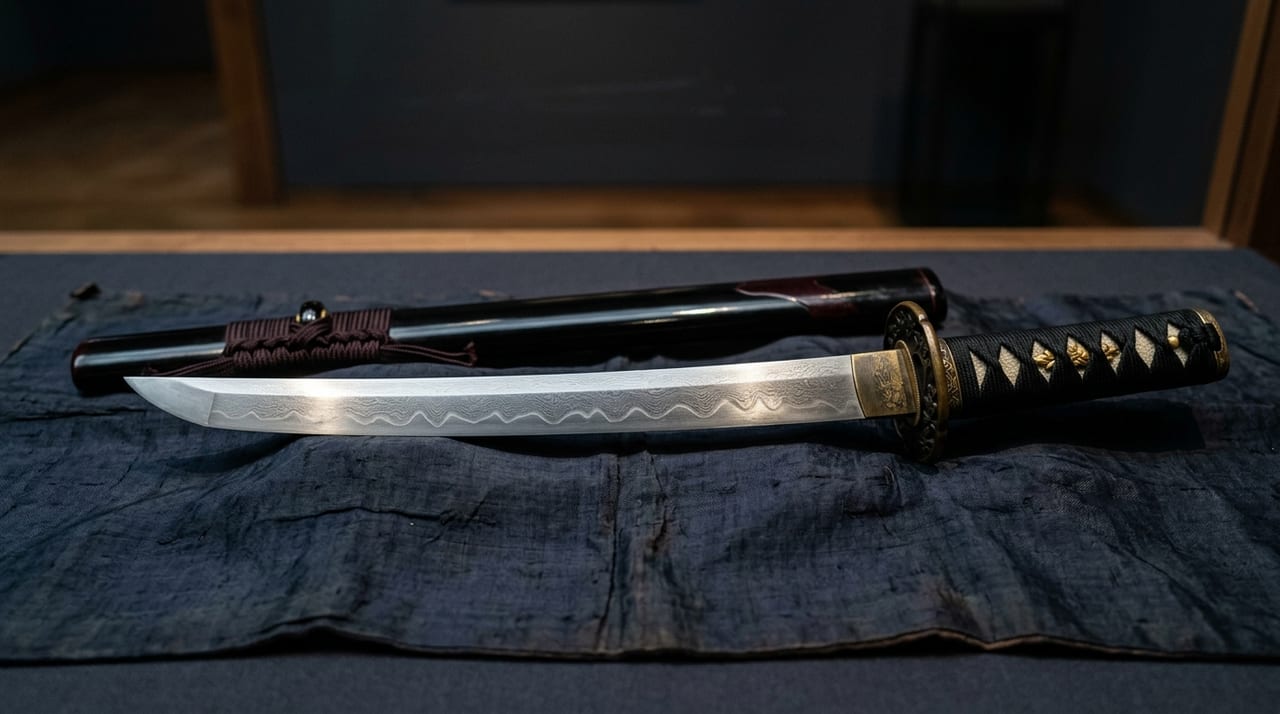
 * Image is for illustrative purposes only.
Ōmihara
大三原
Also known as: Ōmihara; the only Mihara-school work in the Kyōhō Meibutsu-chō
Description
Masahiro of the Mihara School
Ōmihara is a tachi attributed to Masahiro, a swordsmith of the Mihara school active in Bingo Province (present-day Onomichi, Hiroshima Prefecture) during the Nanbokuchō period, traditionally held to be the son of Masaie, the school's founder. Measuring roughly 80.9 cm in blade length with a curvature of 2.6 cm, it is called "Ō" (great) Mihara for its unusually long blade, and it is the only work of the Mihara school recorded in the Kyōhō Meibutsu-chō.
From Toyotomi Hideyoshi to the Asano Family
The blade once belonged to Toyotomi Hideyoshi; upon his death in 1598, it is said to have been given as a memento to Asano Yoshinaga, Lord of Kii. The Asano family was later transferred from Kii to the Hiroshima domain, and preserved the blade as a family heirloom throughout the Edo period.
The Gold-Inlaid Inscription
The tang bears a gold-inlaid inscription by Hon'ami Kōtoku reading "Ōmihara, futatsu-dō, bestowed upon Asano Kii-no-kami." The term "futatsu-dō" indicates the result of a test-cut through two stacked bodies, though the identity of the tester is not recorded.
Designation and Present Location
It was designated an Important Cultural Property on June 22, 1955, and is now held by the Tokyo National Museum.
Legends & Stories
The "futatsu-dō" recorded in the gold-inlaid inscription is understood to document a test-cut through two stacked bodies, proof of the blade's ability to cut clean through both — yet who performed the test has gone unrecorded, leaving only the inscription itself as testimony to the blade's formidable edge.
Related Famous Swords
藤島友重の太刀
Important Cultural Property and Important Sword (Multiple Designations)Fujishima Tomoshige's Tachi
Fujishima Tomoshige
短刀 銘備州長船住長重
National TreasureTanto Signed Bishū Osafune-jū Nagashige
Nagashige (Bizen Osafune, Chōgi school)
分部志津
Important Cultural PropertyWakebe Shizu
Shizu Kaneuji (Shizu Saburō Kaneuji)
山城信国
Important Cultural Property (several works)Yamashiro Nobukuni
Nobukuni