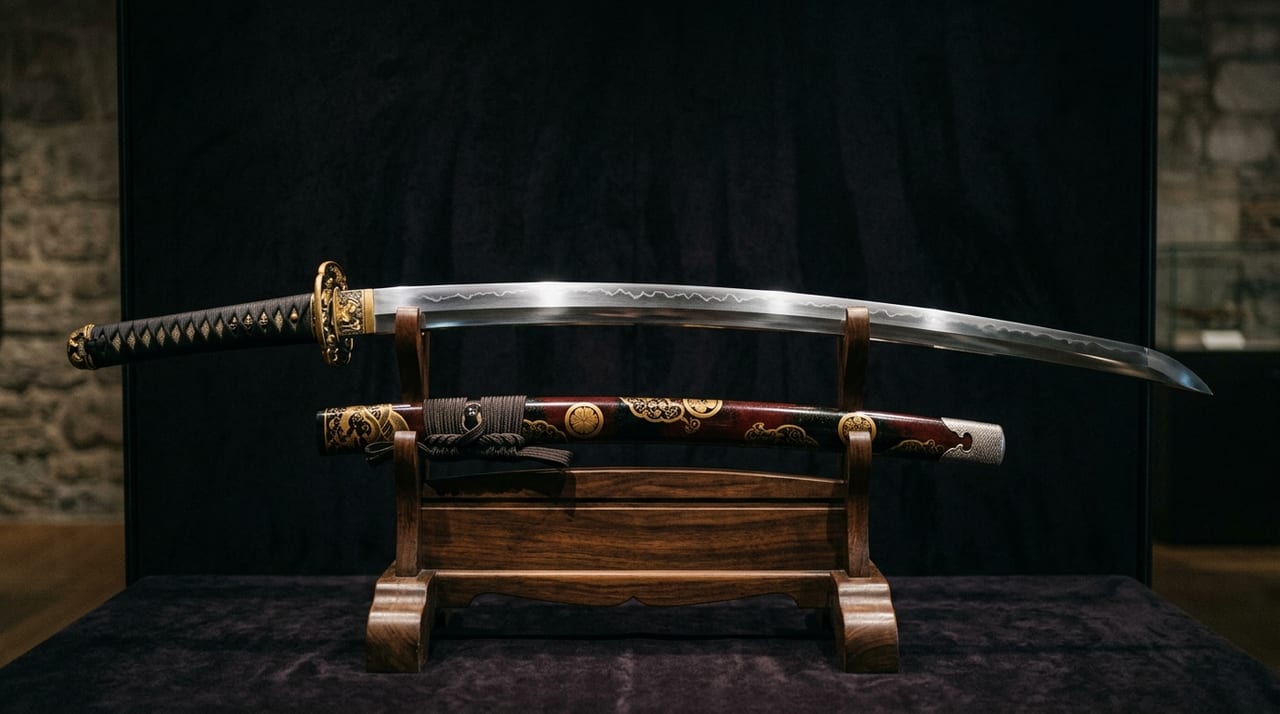
 * Image is for illustrative purposes only.
Chikushū-jū Yukihiro
筑州住行弘
Also known as: Tantō signed Chikushū-jū Yukihiro, dated Kannō 1 (1350); heirloom of the Tsuchiya family of Tsuchiura domain
- Smith
- Yukihiro (Chikuzen Sa school)
- Era
- Nanbokuchō period
- Type
- Tantō
- Designation
- National Treasure
- Location
- Tsuchiura City Museum (Tsuchiura, Ibaraki)
Description
A Rare Signed Work of the Chikuzen Sa School
Yukihiro was a swordsmith active in Chikuzen Province (present-day Fukuoka Prefecture) during the Nanbokuchō period, and is regarded as one of the Chikuzen Sa school smiths who descend from the renowned master Samonji. This tantō, inscribed "Tantō, mei Chikushū-jū Yukihiro Kannō gannen hachigatsu-hi", bears the date of the eighth month of Kannō 1 (1350) in its inscription. Signed works by Yukihiro are extremely few, and among them this blade is the only one known to bear a date. It was designated a National Treasure on 19 February 1957.
Craftsmanship
The blade is of hira-zukuri construction, about 23.5 cm long, with a slight inward curve (uchizori). The steel shows itame mixed with mokume and has a surface that flows somewhat toward the edge. The hamon is a small notare-style pattern mixed with gunome and pointed elements, with sunagashi and kinsuji appearing in the lower half. The boshi turns back in a rising, disordered line that ends in a sharp point, a distinctive feature of this blade.
Provenance
The blade was handed down in the Tsuchiya family, lords of the Tsuchiura domain in Hitachi Province (present-day Tsuchiura, Ibaraki Prefecture). It is said to have been presented to the second lord, Tsuchiya Masanao, by Matsudaira Wakasa-no-kami Yasunobu (lord of Tamba Sasayama), father of Masanao's principal wife, Ikuko. It was thereafter kept as a treasured heirloom of the Tsuchiya family and is now owned and exhibited by the Tsuchiura City Museum.
Significance
The Sa school lineage is generally known for its spirited hamon mixing gunome and pointed elements, but signed works that record both the smith's name and a precise date, as this tantō does, are rare even within the school. It is therefore counted among the benchmark works for understanding Chikuzen swordsmithing of the Nanbokuchō period.
Related Famous Swords
太刀 銘 元重
Important Cultural PropertyTachi Signed Motoshige
Motoshige
分部志津
Important Cultural PropertyWakebe Shizu
Shizu Kaneuji (Shizu Saburō Kaneuji)
瀬登太刀
Important Cultural PropertySenobori Tachi
Unknown (unsigned)
大三原
Important Cultural Property (designated June 22, 1955)Ōmihara
Masahiro (son of Mihara Masaie)