 * Image is for illustrative purposes only.
Tachi Signed Motoshige
太刀 銘 元重
Also known as: Tachi inscribed "Motoshige"; heirloom of the Matsudaira lords of Takamatsu domain; with an appraisal by the Hon'ami family
Description
Style
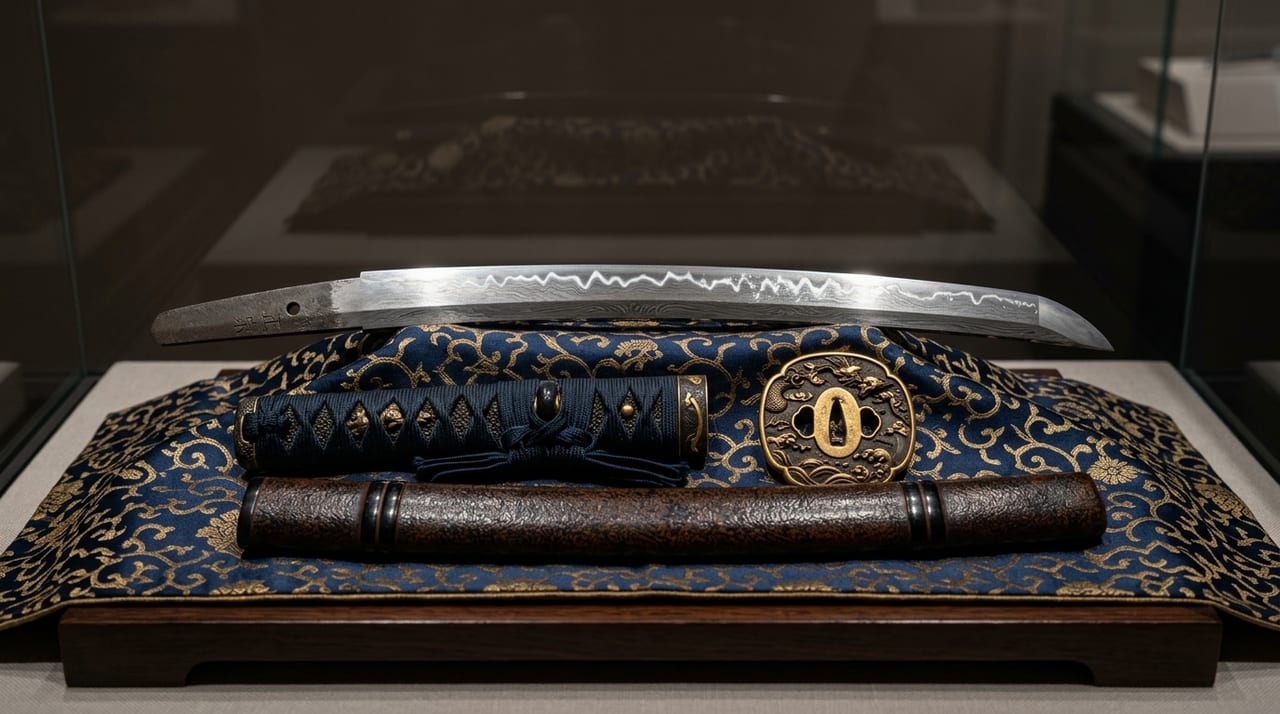
This tachi measures 74.5 cm in blade length, with broad proportions and a commanding presence that well conveys the physique typical of the Nanbokucho period. It is the work of Motoshige, a smith of the Bizen Osafune school, and is designated an Important Cultural Property as an example of the tachi the school produced during the turbulence of the Northern and Southern Courts era.
Provenance
When Matsudaira Yorishige, first lord of the Takamatsu domain, paid his condolences on the death of his uncle Tokugawa Yorinobu, first lord of the Kii domain, Yorinobu's son Tokugawa Mitsusada, the second lord of Kii, presented him with this blade as a memento of the deceased. It is accompanied by an appraisal (kiwamegaki) issued by the Hon'ami family in Shōtoku 1 (1711).
Designation and Current Custody
The blade is designated an Important Cultural Property and is today held by the Kagawa Prefectural Museum in Takamatsu. The museum holds a substantial body of cultural properties formerly owned by the Matsudaira lords of Takamatsu, and this blade is preserved with care as a piece embodying that heritage.
The Smith Motoshige
Motoshige was a swordsmith active in Osafune, Bizen Province, during the Nanbokucho period, counted as one of the "Sadamune Santetsu," the three outstanding smiths said to have studied under Sadamune of Sagami. Few of his signed works survive, but those that do are uniformly regarded as being of high quality, making them an important resource for the study of the Bizen tradition.
The Tachi Form of the Nanbokucho Period
The broad blade width and shallow curvature of this tachi reflect the demand during the Nanbokucho wars for robust tachi suited to actual combat, and testify to the high technical level of the Bizen forges of the time.
Legends & Stories
This blade was presented to Matsudaira Yorishige by Tokugawa Mitsusada, second lord of the Kii domain, as a memento of Mitsusada's father Tokugawa Yorinobu, after Yorishige had paid his condolences on the death of Yorinobu, his uncle. Swords served not merely as weapons or gifts but as a medium for expressing condolence and the bonds between daimyo houses, and the episode has been handed down to the present, together with the Hon'ami family's appraisal of Shōtoku 1 (1711), as an example of this early Edo-period custom.