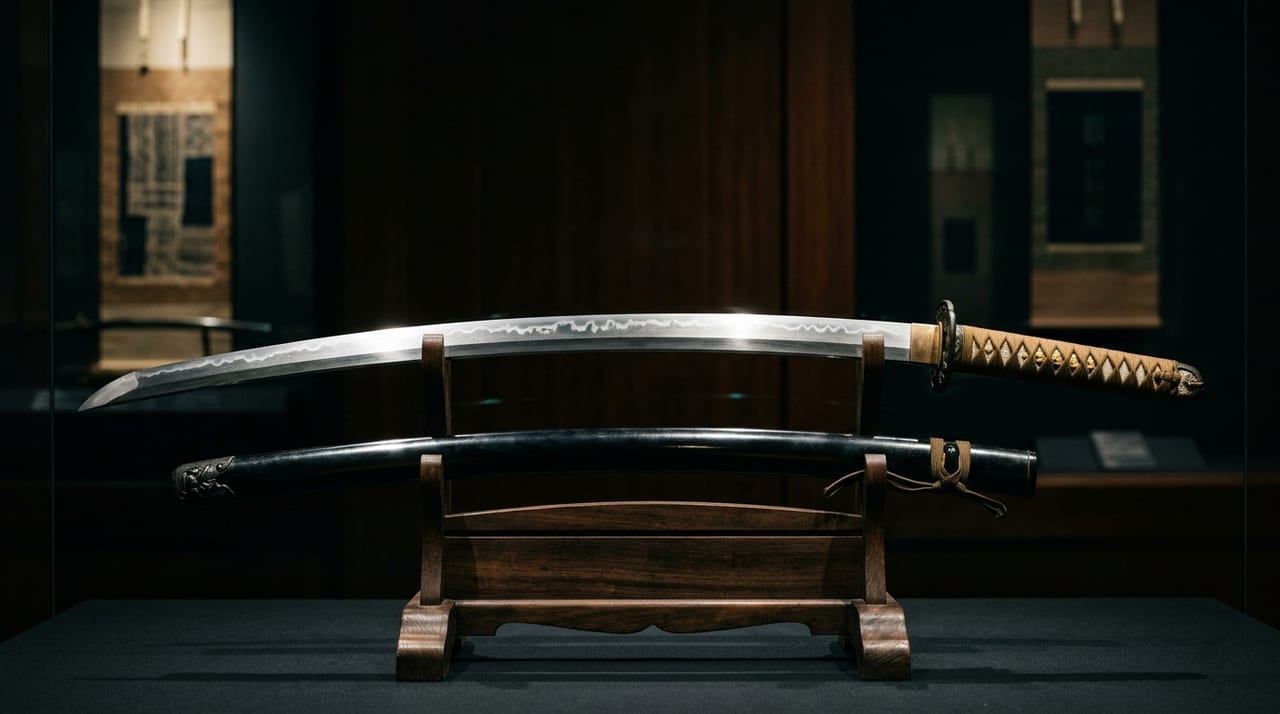
 * Image is for illustrative purposes only.
Shinogi Tōshirō
鎬藤四郎
Also known as: Shinogi Tōshirō / The Yoshimitsu tanto treasured by the Date clan
Description
A Yoshimitsu tantō that passed through the hands of the powerful
Shinogi Tōshirō is a tantō forged in the mid-Kamakura period by the master smith Awataguchi Yoshimitsu of Yamashiro Province, known by the common name Tōshirō, and is one of the celebrated blades listed in the Kyōhō Meibutsu Chō register. Its blade length is recorded as 8 sun 8 bu (about 27 cm). Most of Yoshimitsu's tantō are hira-zukuri, but this one is said to have been in shinogi-zukuri form, with a shinogi ridge line between the edge and the back, and this construction is said to have given the blade its name. Among Yoshimitsu's works, which together with Masamune and Gō Yoshihiro are counted among the "Three Great Smiths" of the realm, this blade was treated as a special case from early on because of the rarity of its construction.
From the Hosokawa to Oda, Toyotomi and Date
Its provenance begins with the Hosokawa family, kanrei (deputy shoguns) of the Muromachi bakufu. After passing through several houses, it came into the possession of Oda Nobunaga. According to the Shinchō Kōki, in 1581 (Tenshō 9) Nobunaga distributed celebrated blades from various places among his sons, and this one was given to his third son, Oda Nobutaka. It then passed to Hōjō Ujinao, and was further purchased by Kuroda Josui (Kanbei Yoshitaka), who presented it to Toyotomi Hidetsugu. It eventually became a treasured blade of Toyotomi Hideyoshi. After Hideyoshi's death in 1598 (Keichō 3), it was presented to Date Masamune as a bequest, and from then on the Date family kept it as a treasure, stored in a sumptuous maki-e box.
Presentation and destruction by fire
In 1636 (Kan'ei 13), Date Tadamune, who succeeded Masamune, presented the blade to the third shogun, Tokugawa Iemitsu. In 1650 (Keian 3), it was passed from Iemitsu to his heir, Ietsuna. However, in the Meireki fire of the first month of 1657 (Meireki 3), the blade was destroyed together with many other celebrated blades in Edo Castle, and it no longer survives. Only the maki-e dagger box that once held the blade has been handed down. It was designated an Important Cultural Property in 1952 (Shōwa 27), and as a collection item of the Homma Museum of Art it is on deposit at the Tokyo National Museum. Though the blade is lost, its container survives as a cultural property, an unusual case among meibutsu.
The smith Yoshimitsu
The maker, Awataguchi Yoshimitsu, was a smith active at Awataguchi in Yamashiro Province in the mid-Kamakura period, known by the common name Tōshirō. Very few of his tachi survive, and he received an unrivaled reputation as a master of tantō. In later ages he was counted, together with Masamune of Sagami and Gō Yoshihiro of Etchū, among the "Three Great Smiths." Many of the surviving Yoshimitsu tantō, such as the Atsushi Tōshirō and the Gotō Tōshirō, have been designated National Treasures or Important Cultural Properties. From the Sengoku period into the early Edo period, they held the highest rank among the gifts and honorary grants exchanged among daimyo households. That the Shinogi Tōshirō passed through the hands of Nobunaga, Hideyoshi, Masamune and the shogunal house is due to nothing other than the authority that the name Yoshimitsu carried.
Legends & Stories
Toyotomi Hidetsugu's last moments and the Shinogi Tōshirō
The best-known anecdote associated with this blade concerns the seppuku of Toyotomi Hidetsugu. It is said that when Hidetsugu took his own life on Mount Kōya, this tantō, which Kuroda Josui had purchased and presented to Hidetsugu, was used. Hidetsugu's page Fuwa Mansaku, who had earlier followed him in death, is said to have declared: "With the Shinogi Tōshirō I received, I cut my belly with an easy heart." It is also said that the kaishaku was carried out by Hidetsugu himself. The tantō combined the cutting sharpness of a dagger with the dignity of an art object, and this anecdote illustrates that dual nature well.
Masamune's maneuvering with the shogunal house
Date Masamune, who obtained this blade as a relic of Hideyoshi, treasured it above all else. When the shogunal house asked for it to be presented, Masamune is said to have firmly refused, citing that it was a gift he had received from the Taikō. In the end, after Masamune's death, his son Tadamune presented it to Iemitsu. It is also said that while he was alive, Masamune remarked that if this celebrated blade were relinquished, the Date family would be well treated by the shogunal house. Ironically, just over twenty years after the presentation, the Meireki fire struck Edo Castle and reduced the celebrated blades to ashes.