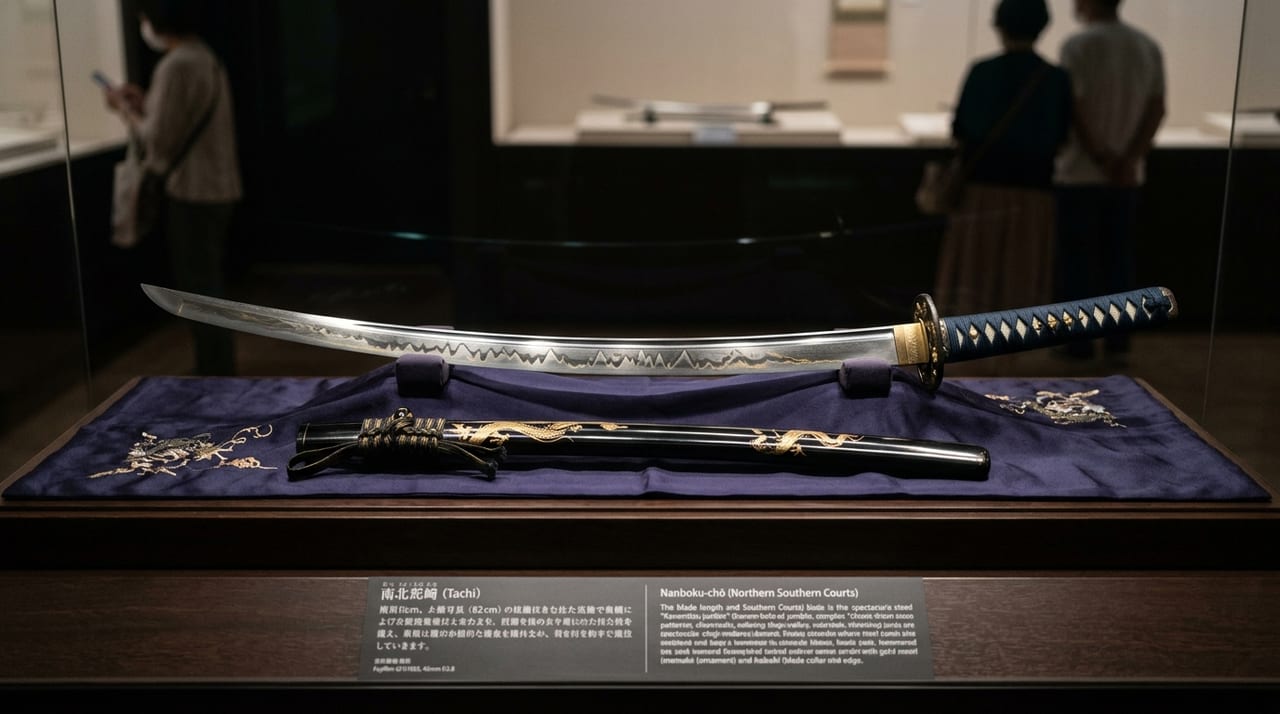
 * Image is for illustrative purposes only.
Mōri Tōshirō
毛利藤四郎
Also known as: Mōri Tōshirō — Tantō by Awataguchi Yoshimitsu, Owned by Mōri Terumoto
Description
Mōri Tōshirō is a tantō said to be the work of Awataguchi Yoshimitsu (Tōshirō Yoshimitsu), a swordsmith of Yamashiro Province (present-day Kyoto Prefecture) in the Kamakura period. Its blade length is approximately 26.5 cm, and its signature is "Yoshimitsu." The name derives from Mōri Terumoto, a sengoku daimyō of Aki Province who owned it. It is also recorded under the name "Mōri Tōshirō" in the Kyōhō Meibutsuchō, a register of famous swords compiled in the Edo period, and it is one of the meibutsu. Awataguchi Yoshimitsu has long been renowned as a master of tantō, and his works have been held in a class of their own even among the many meibutsu.
The Maker Awataguchi Yoshimitsu and the Style of This Blade
The maker, Awataguchi Yoshimitsu, was a swordsmith who worked in Awataguchi in Kyoto in the mid-Kamakura period. Alongside Sōshū Masamune and Gō Yoshihiro, he is sometimes counted among the Tenka Sansaku in later times, and he is especially renowned as a master of tantō. Mōri Tōshirō has a blade length of approximately 8 sun 7 bu 5 rin (about 26.5 cm), is hirazukuri, and has slight uchizori. The hamon is in the hoso-suguha style, and the jigane shows a beautiful ko-itame. On the omote side is carved a gomabashi, and on the ura side a bōhi. The clear jigane and the calm suguha workmanship well demonstrate the dignity unique to Yoshimitsu's tantō.
Origin of the Name
The name "Mōri Tōshirō" refers to Mōri Terumoto, the sengoku daimyō who held sway over most of the Chūgoku region, who owned this tantō. It is a meibutsu name that combines Awataguchi Yoshimitsu's common name "Tōshirō" with the owner's name "Mōri," following the traditional Japanese practice of naming swords after their owners. Some copies of the meibutsu register record it as "Mōri jūdai," and it is thought that it may have been a treasured heirloom of the Mōri house.
Provenance
It is said to have been first owned by Mōri Terumoto and later presented by Terumoto to Tokugawa Ieyasu. After that, although the details are unclear, the Ikeda family received it, and from then on it was passed down in the Ikeda family, lords of the Okayama domain in Bizen. Throughout the Edo period it was guarded as a treasure of the Ikeda family. In the Meiji era, the Ikeda family presented it to Emperor Meiji, and it became part of the imperial collection (gyobutsu). The provenance itself, passing through the hands of powerful figures from the sengoku period to modern times, from the Mōri and Tokugawa to the Ikeda family and the imperial house, speaks to the standing of this tantō.
From the Imperial Collection to the Tokyo National Museum
Mōri Tōshirō, presented to the imperial house, was transmitted for a long time as an imperial gyobutsu. After World War II, it came under state ownership, and it is now housed in the Tokyo National Museum (Taitō Ward, Tokyo). In other words, it was once an imperial gyobutsu, but after the war it became state property held by the Tokyo National Museum, and this point requires attention. When it is on display, one can closely appreciate the clear jigane and the dignified form that are unique to Awataguchi Yoshimitsu.
Legends & Stories
The maker of Mōri Tōshirō, Awataguchi Yoshimitsu, was a master of tantō who represented the Kamakura period, and he is widely known by the common name Tōshirō. Alongside Masamune and Gō Yoshihiro, he is counted among the Tenka Sansaku, and his tantō have long been the object of longing among warrior households. The name of this blade derives from Mōri Terumoto, the sengoku daimyō who established dominance over the Chūgoku region and treasured it.
This blade is said to have later been presented by Terumoto to Tokugawa Ieyasu.
It was eventually received by the Ikeda family and passed down in the Ikeda family, lords of the Okayama domain in Bizen. The Ikeda family was a daimyō house with deep ties to the Tokugawa family, and this blade was carefully preserved as a treasure of the Ikeda family. After the Meiji Restoration, the Ikeda family presented this famous tantō to the imperial house, and it was transmitted as a gyobutsu. After the war it came under state ownership, and it is now housed in the Tokyo National Museum.
Yoshimitsu's work is distinguished by a finely packed ko-itame jigane and a bright, clear suguha hamon. Mōri Tōshirō has a gomabashi carving, and its hi, hamon, and jigane are all considered worthy of Yoshimitsu's typical work, an authentic masterpiece of distinguished pedigree.