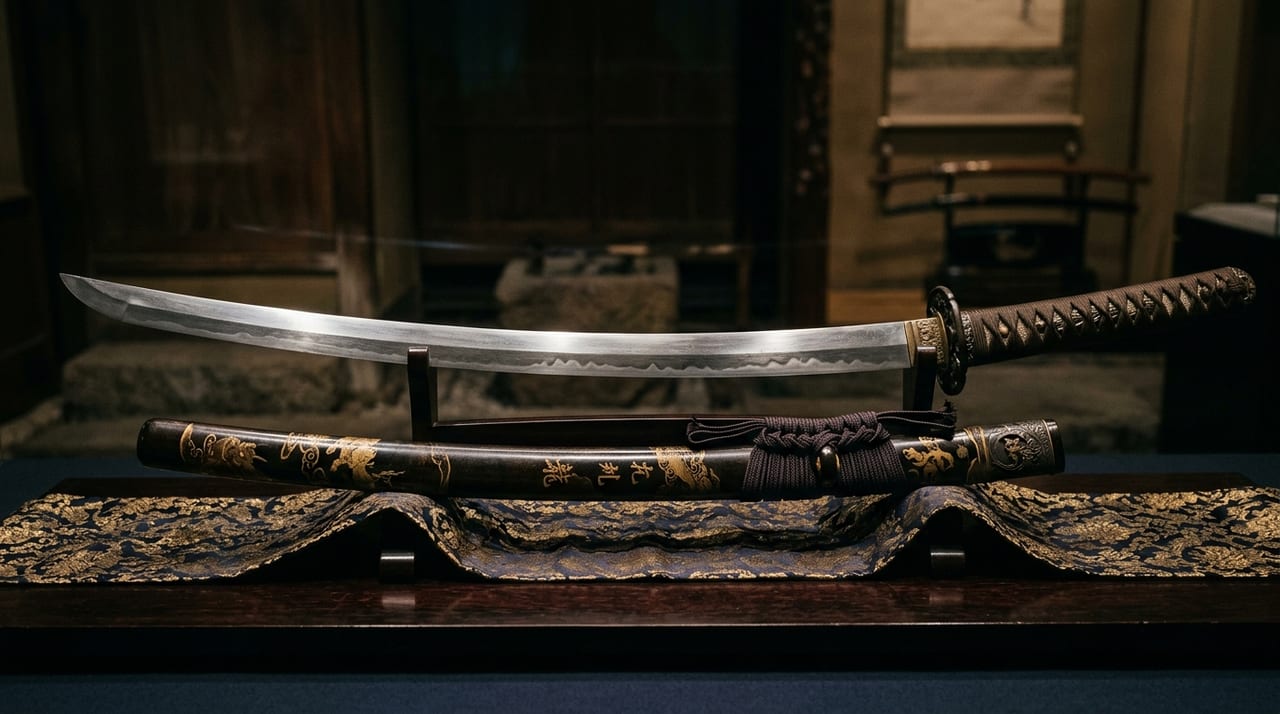
 * Image is for illustrative purposes only.
Bishū Osafune Tomomitsu
備州長船倫光
Also known as: Ōdachi signed Bishū Osafune Tomomitsu, dated Jōji 5 (1366); great sword of Futarasan Jinja
- Smith
- Tomomitsu (Bizen Osafune school)
- Era
- Nanbokuchō period
- Type
- Ōdachi
- Designation
- National Treasure
- Location
- Nikkō Futarasan Jinja Chūgūshi Treasure House (Chūgūshi, Nikkō, Tochigi)
Description
A Great Sword of the Bizen Osafune School
Tomomitsu was a swordsmith of the Nanbokuchō period, said to have been a disciple of Osafune Kanemitsu. This work, inscribed "Ōdachi, mei Bishū Osafune Tomomitsu, Jōji gonen nigatsu hi," bears the date Jōji 5 (1366). It was designated a National Treasure (with attached nodachi koshirae) on 31 March 1953 (Shōwa 28). The owner, Futarasan Jinja, is an ancient shrine enshrined within the Nikkō-sanai precinct in Nikkō City, Tochigi Prefecture.
Style and Scale
The blade is a large tachi, 126 cm long with a curvature of 5.8 cm, and belongs to the category of so-called nodachi and seoi-tachi. The steel shows itame grain with ji-nie, and the temper pattern is gunome-mixed, with chōji mixed in the lower half on both the front and back. On the front, a bō-hi groove carries a kurikara dragon carving below it, and on the back, a bō-hi groove carries two Sanskrit (bonji) characters below it, both finely carved. As an ōdachi that retains its sound form, it is regarded as among the largest extant examples, and it is highly valued as a work that transmits the standard ōdachi form popular from the late Kamakura to the Nanbokuchō period.
Provenance and Mounting
Its early history is unclear, but it is presumed to have been donated by a powerful family of the Kantō region in the medieval period. The accompanying nodachi koshirae is thought to date back to before the Muromachi period. The scabbard was originally finished in black lacquer and was later altered to vermilion.
Significance
During the Nanbokuchō period, extremely long swords known as ōdachi or nodachi were widely used among warriors, yet few surviving examples retain their original form. This blade is a precious example both as a dated work by Tomomitsu and as a model example of the ōdachi of the Nanbokuchō period.
Related Famous Swords
太刀 銘 元重
Important Cultural PropertyTachi Signed Motoshige
Motoshige
分部志津
Important Cultural PropertyWakebe Shizu
Shizu Kaneuji (Shizu Saburō Kaneuji)
瀬登太刀
Important Cultural PropertySenobori Tachi
Unknown (unsigned)
大三原
Important Cultural Property (designated June 22, 1955)Ōmihara
Masahiro (son of Mihara Masaie)