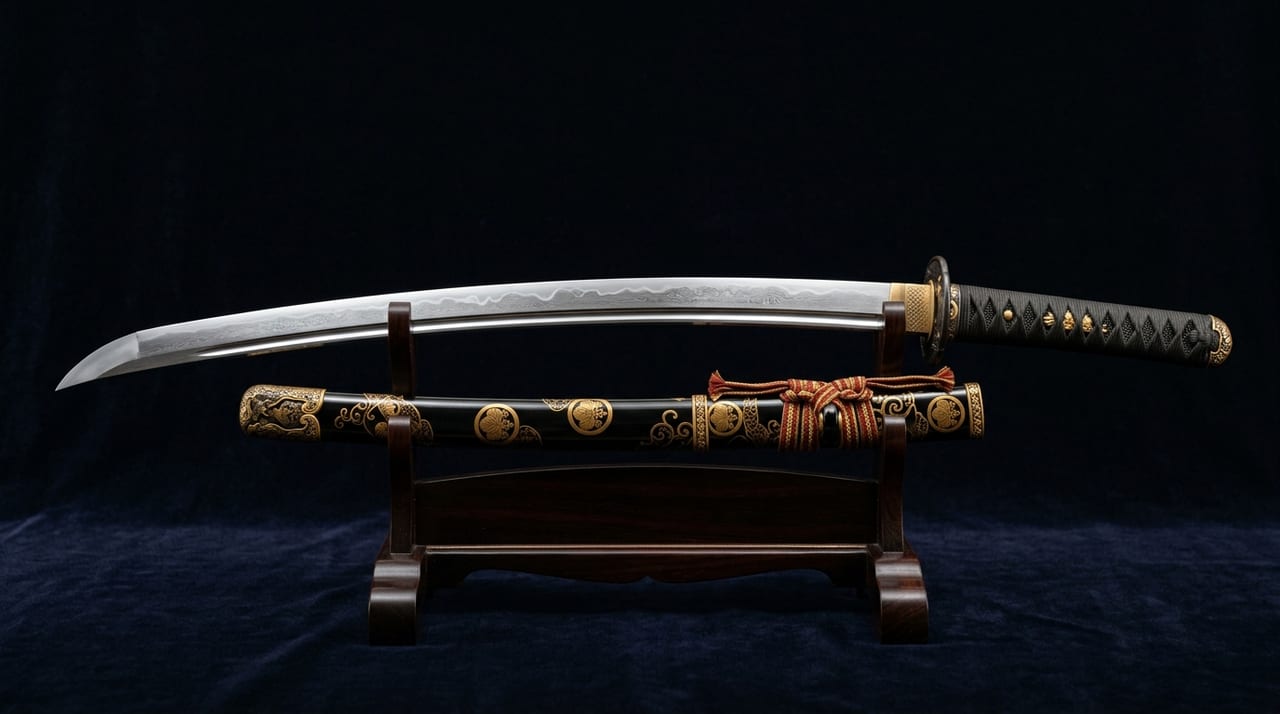
 * Image is for illustrative purposes only.
Bizen-no-kuni Osafune-jū Chikakage
備前国長船住近景
Also known as: Tachi signed Bizen-no-kuni Osafune-jū Chikakage, dated Kenmu 2 (1335); tachi of the Tokyo Fuji Art Museum
Description
Chikakage, a Smith of the Early Osafune School
Chikakage was a swordsmith of the early Bizen Osafune school, working in the lineage descended from Mitsutada, founder of the school, and his presumed son Nagamitsu. This tachi, signed "Bizen-no-kuni Osafune-jū Chikakage" and dated the fifth month of Kenmu 2 (1335), at the outset of the Nanbokuchō period, was designated an Important Cultural Property in 1950.
Craftsmanship
The blade measures 79.2 cm in length with a curvature of 2.2 cm, presenting a broad, imposing tachi form, though it has been somewhat shortened over the centuries. The steel shows a tightly forged itame pattern mixed with mokume, and the temper is a straight, suguha-toned pattern of small chōji with straight ashi. It conveys the sober, sturdy character typical of the early Osafune school and is regarded as reflecting the martial spirit of warrior bands in the late Kamakura period.
Provenance
The blade was until recently part of the collection of Hosokawa Morisada, a member of the Hosokawa family, former lords of the Kumamoto domain. It is now held and exhibited by the Tokyo Fuji Art Museum in Hachiōji, Tokyo.
Significance
The Osafune school, founded by Mitsutada and Nagamitsu, formed the mainstream of Bizen swordsmithing from the late Kamakura through the Nanbokuchō period, and Chikakage is counted among the smiths active in its formative years. Clearly dated signed works such as this one are regarded as important benchmarks for confirming the style and chronology of the school's early period.
Related Famous Swords
短刀 銘備州長船住長重
National TreasureTantō Signed Bishū Osafune-jū Nagashige
Nagashige (Bizen Osafune, Chōgi school)
藤島友重の太刀
Important Cultural Property and Important Sword (Multiple Designations)Fujishima Tomoshige's Tachi
Fujishima Tomoshige
分部志津
Important Cultural PropertyWakebe Shizu
Shizu Kaneuji (Shizu Saburō Kaneuji)
山城信国
Important Cultural Property (several works)Yamashiro Nobukuni
Nobukuni