New Arrivals — Browse our catalog for the latest authentic Japanese sword arrivals. Browse →
17th day of the 8th month, Bunkyū 3 (1863)
Gojō, Yamato Province (present-day Gojō City, Nara Prefecture); Takatori Castle; Totsukawa; Washika Pass
Forces
Tenchūgumi
Shogunate punitive forces (Kishū, Tsu, Hikone, and allied domains)
About 12 min read
In Bunkyū 3 (1863), within the court in Kyoto, the kuge and shishi of the sonnō jōi ("revere the emperor, expel the barbarians") faction, centered on Chōshū domain, briefly held strong influence. They succeeded in extracting from the court an imperial edict for a "Yamato Imperial Procession," in which Emperor Kōmei himself would visit the mausoleum of Emperor Jinmu in Yamato Province and pray for the expulsion of the barbarians. This procession plan was not a mere religious ritual. Its aim was to place the emperor himself at the forefront of the anti-foreign movement, to force the shogunate to retract its policy of opening the country, and to serve as the starting point of what was in effect a movement to overthrow the bakufu.
Riding this momentum, a group was formed with the court noble Nakayama Tadamitsu (then 19 years old, a former chamberlain) as its commander. Its directors included the shishi Yoshimura Toratarō, who had defected from Tosa domain, the Confucian scholar Matsumoto Keidō, and the painter-turned-shishi Fujimoto Tesseki. Ahead of the imperial procession, the group aimed to seize shogunate territory within Yamato Province and consolidate the court faction's base there. Calling themselves the Tenchūgumi, they proclaimed their uprising at Hōkō-ji in Kyoto on the 14th day of the 8th month (September 26, 1863), then passed through Osaka and Sakai, heading south along the Kōya Kaidō and advancing into Yamato. At the outset, the group is said to have numbered about 40, including 19 Tosa domain defectors led by Yoshimura.
On the afternoon of the 17th day of the 8th month (September 29), the Tenchūgumi attacked the Gojō magistrate's office in Gojō in Yamato Province (present-day Gojō City, Nara Prefecture), which administered the shogunate's directly held territory, and subdued it, killing the magistrate Suzuki Masanobu and four others. The next day, on the 18th, the Tenchūgumi declared that the shogunate territories around Gojō would be placed under direct imperial administration, and announced a policy of halving that year's annual tax. This was not merely an armed uprising; it also had the character of a governing experiment aimed at winning the support of local residents. Earlier, on the 16th, allies including Mizugōri Zennosuke of Kawachi Province had joined them, and their strength temporarily expanded.
The fortunes of the Tenchūgumi, however, were reversed by a political coup that broke out in Kyoto immediately after they raised their army. On the 18th day of the 8th month (September 30), the kōbu gattai (court-shogunate union) faction, centered on Aizu and Satsuma domains, regained its influence within the palace. The radical sonjō court nobles, led by Sanjō Sanetomi, were expelled from Kyoto, and the Yamato Imperial Procession itself was cancelled. The Tenchūgumi, which had raised its army as the vanguard of that procession, lost its justification overnight and became, in the eyes of the court, a band of "rebels."
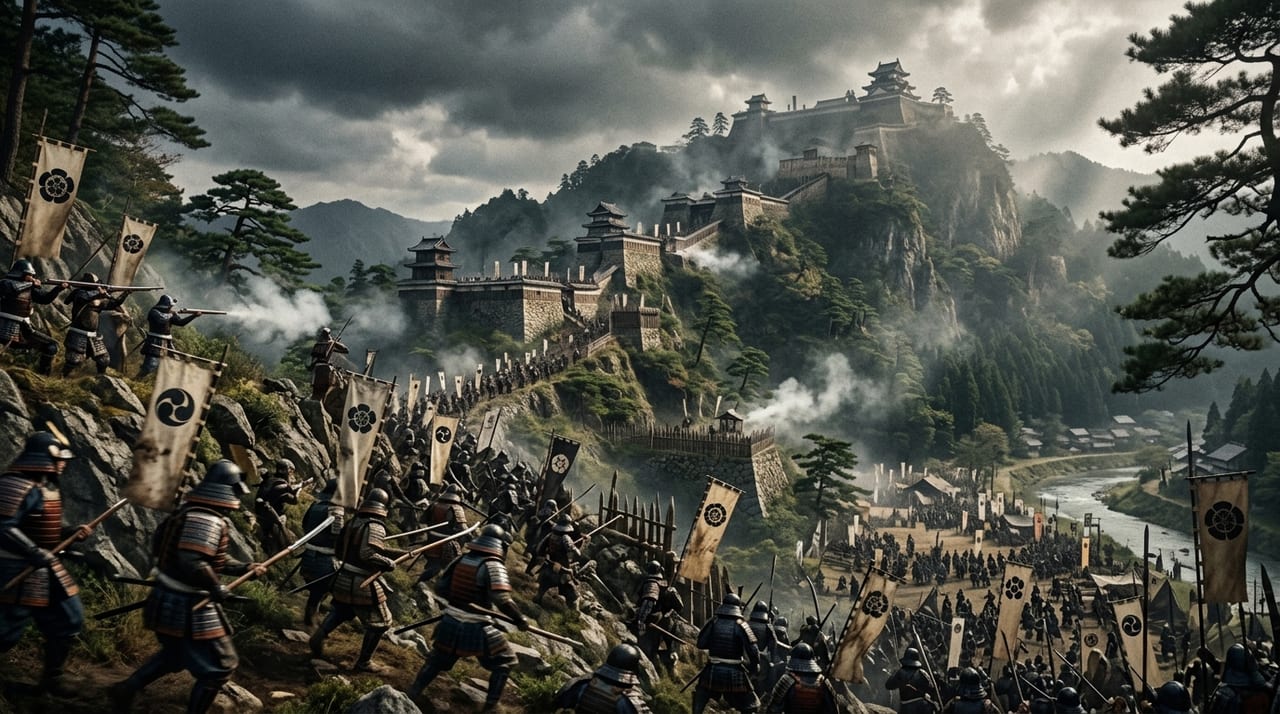
Deprived of support from the court, the Tenchūgumi nonetheless tried to expand its power within Yamato Province. From the 25th to the 26th day of the 8th month (October 7–8), it attacked Takatori Castle, the seat of Takatori domain. The castle's resistance was far stronger than expected, and the attack ended in failure, with the commander Yoshimura Toratarō wounded by gunfire.
After the failed attack on Takatori Castle, the Tenchūgumi was surrounded by a overwhelming punitive force of roughly 14,000 men, mobilized by the shogunate's order from Kishū, Tsu, Hikone, and other domains. The Tenchūgumi withdrew into the mountainous Totsukawa district, where at first about 1000 Totsukawa gōshi (local samurai) joined in resistance. As the gōshi grasped the unfavorable situation, however, they defected one after another, and organized resistance gradually became impossible.
From the 24th to the 27th day of the 9th month (November 5–8), at Washika Pass in Yamato Province (present-day Higashiyoshino Village, Nara Prefecture), the remaining Tenchūgumi forces fought their final battle against the punitive forces. In this fighting, Nasu Shingo and Shishido Yashirō were killed, Fujimoto Tesseki died in battle, and Matsumoto Keidō committed suicide. Yoshimura Toratarō, having been severely wounded, was discovered by the punitive forces on the 27th and is said to have ended his life on the spot. The commander Nakayama Tadamitsu escaped the battlefield with difficulty, protected by his retainers, and fled via Osaka to Chōshū domain. In the 11th month of Genji 1 (1864), the following year, he was caught up in a power struggle within Chōshū domain and was assassinated by the domain's retainers.
The Tenchūgumi Incident lasted only a little over forty days, from the uprising to its annihilation, yet it holds an important place as one of the earliest cases in which the sonnō jōi movement stepped beyond the stage of petitions and advocacy into the practical stage of armed uprising. In the 10th month of that year, the severed heads of the leading figures were exposed at Awataguchi in Kyoto, and the shogunate at the time handled them firmly as traitorous rebels.
After the establishment of the Meiji Restoration, however, the evaluation of the Tenchūgumi changed dramatically. The Meiji government reappraised them as shishi who had given their lives for the cause of revering the emperor. From Meiji 16 (1883) onward, enshrinement at Yasukuni Shrine and the bestowal of posthumous court ranks on survivors and bereaved families were carried forward. Today they are positioned as the "forerunners of the Restoration" in late Bakumatsu history, and Gojō City and Higashiyoshino Village in Nara Prefecture still retain multiple historic sites and gravestones related to the Tenchūgumi, which continue to be passed down as local history.
Records and traditions of the various weapons used in the Tenchūgumi Incident preserve accounts of drawn-blade close combat in the attack on the magistrate's office, the attack and defense of Takatori Castle, and the final battle at Washika Pass. Most of the swords carried by the shishi of the late Bakumatsu period were shinshintō made by smiths active around Osaka and Kyoto, and uchigatana that emphasized forging methods capable of withstanding actual combat and ease of carrying were the mainstream. The Washika Pass battle, in which the surviving Tenchūgumi members fought to the end without letting go of their swords, is also noted by later researchers as a typical example of the relationship between the samurai and shishi classes and the Japanese sword during the turmoil of the Bakumatsu period.