New Arrivals — Browse our catalog for the latest authentic Japanese sword arrivals. Browse →
November 23, 1863 (Bunkyū 3, 10th month, 12th day)
Ikuno, Tajima Province (present-day Ikuno-chō, Asago City, Hyōgo Prefecture)
Forces
Sonnō jōi rebel forces
Shogunate suppression forces (Izushi and Himeji domains, among others)
About 9 min read
In the 8th month of 1863 (Bunkyū 3), radical sonnō jōi activists formed the Tenchūgumi in Yamato Province, rallying around the court noble Nakayama Tadamitsu and attacking the Gojō magistrate's office. But almost immediately, on the 18th of that month, a coup by pro-shogunate/court-unity forces in Kyoto — the August 18 Coup — expelled Chōshū's forces and the sonnō jōi court nobles from the capital. Left isolated, the Tenchūgumi came under pursuit by shogunate-aligned domains and was nearly wiped out by the end of the 9th month. On hearing this news, Hirano Kuniomi, an activist from Fukuoka domain, planned an uprising at Ikuno in Tajima Province in order to raise a further flame of jōi resistance in response to the Tenchūgumi's fall.
Hirano was a radical sonnō jōi activist with a record of involvement in the 1862 Teradaya Incident, and he succeeded in enlisting Sawa Nobuyoshi — one of the court nobles who had fled to Chōshū in the "Flight of the Seven Nobles" — as the nominal leader of the new uprising. The rebellion also drew in more than ten men from Chōshū's Kiheitai irregulars, including Kawakami Yaichi, and a compact band of some thirty-odd core activists gathered with the aim of seizing the Ikuno magistrate's office in Tajima Province.
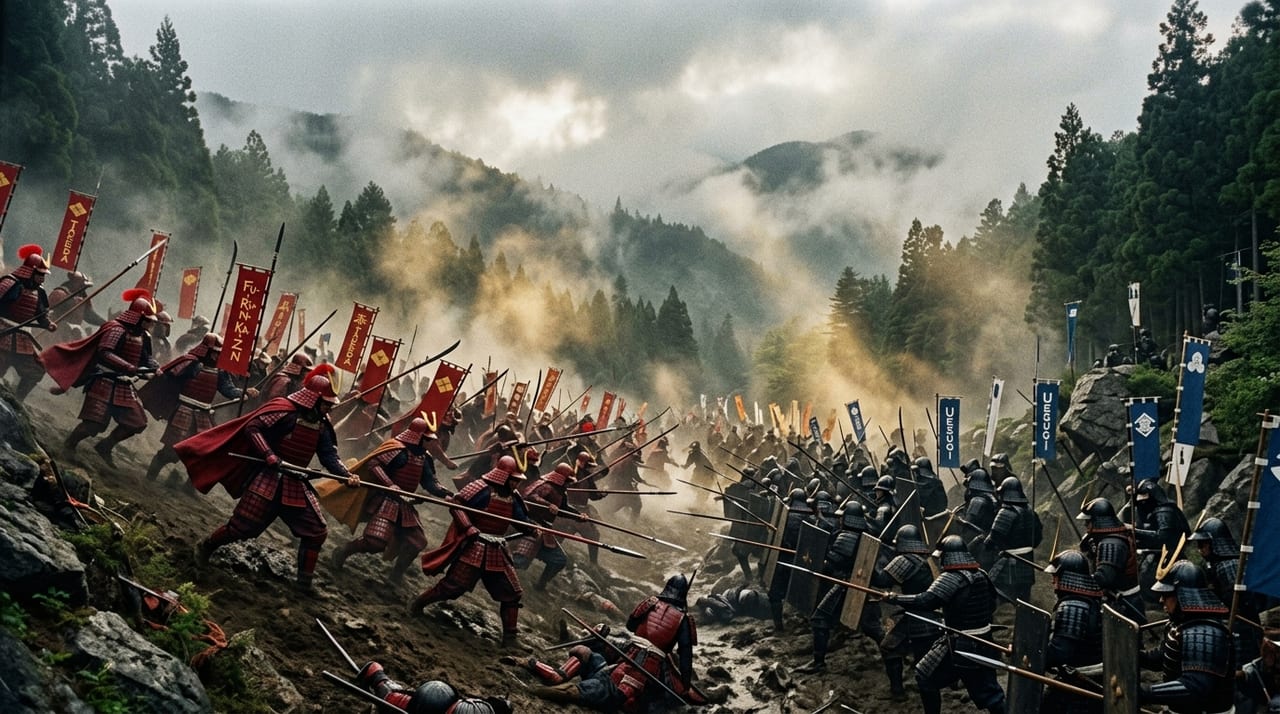
Before dawn on the 12th day of the 10th month of Bunkyū 3, Hirano Kuniomi, Sawa Nobuyoshi, and their band entered Ikuno and occupied the magistrate's office without resistance. Ikuno was a strategically important site housing a shogunate-administered silver mine, and its seizure amounted to a direct challenge to shogunate authority. Sawa Nobuyoshi issued a proclamation in his own name calling on the surrounding peasantry to join the uprising, and by around noon that day, some 2,000 farmer-recruits are said to have gathered in the town of Ikuno from the surrounding villages. This represented an early example of a new mode of struggle then spreading in the bakumatsu era — organizing sōmō (grassroots activists and farmers) into armed uprising.
This rapid mobilization of farmer-recruits, however, carried with it serious problems of control. No system existed to weld this improvised mass of farmers into a coherent military force, and the leadership itself was split between radicals demanding immediate action and cautious voices urging that the situation be assessed further.
News of the seizure of the Ikuno magistrate's office spread immediately to neighboring domains, and suppression forces acting on shogunate orders — including roughly 900 troops from Izushi domain under the Sengoku house and 1,000 from Himeji domain under the Sakai house — were already mobilizing by the following day, the 13th. Faced with this overwhelming disparity in force, the split within the rebel leadership became decisive, and Sawa Nobuyoshi, the nominal leader, secretly fled Ikuno that same night. When the farmer-recruits learned that their supreme commander had fled, they panicked and scattered, losing all cohesion.
Kawakami Yaichi and twelve other Chōshū Kiheitai men, finding their line of retreat cut off, took their own lives. Other activists, including Mitama Sanpei and Nakajima Tarōbei, were shot dead in clashes with the suppression forces. Hirano Kuniomi attempted to flee through Tajima Province but was captured by Toyooka domain on the 13th of the 11th month and sent to the Rokkaku prison in Kyoto. Collapsing within a mere two days of its start, this uprising stands alongside the Tenchūgumi rebellion as one of the earliest grassroots armed risings of the bakumatsu period.
Imprisoned at Rokkaku, Hirano Kuniomi was executed the following year, in the 7th month of 1864 (Genji 1), together with other imprisoned sonnō jōi activists amid the chaos of the Kinmon Incident, as fighting engulfed Kyoto. Hirano's death, cut down before his cause was realized, was later honored as the "Ikuno Righteous Uprising," and from the Meiji era onward he was even enshrined at Yasukuni Shrine, celebrated as a forerunner of the Restoration.
Militarily, the Ikuno Incident ended in total failure, but together with the Tenchūgumi rebellion it holds significant importance in bakumatsu political history as an early example of "sōmō kikki" — spontaneous armed uprising by activists and farmers acting outside the established military organization of the domains. The lessons of this failed uprising are said to have influenced the tactics and organizational thinking behind later armed struggles by Chōshū and activists from other domains. Today, Ikuno-chō in Asago City, Hyōgo Prefecture — the stage of the Ikuno Incident — preserves historical sites including a monument honoring Hirano Kuniomi and his fellow rebels, keeping alive the memory of this grassroots rising, carried out with sword and conviction, amid the turmoil of the bakumatsu era.