New Arrivals — Browse our catalog for the latest authentic Japanese sword arrivals. Browse →
28th day of the 5th month, Kenkyū 4 (1193)
Fujino in Suruga Province (the lodging at Kanno, on the foothills of Mt. Fuji in present-day Shizuoka Prefecture)
Forces
The Soga brothers
The side of Kudō Suketsune
About 10 min read
On the night of the 28th day of the 5th month of Kenkyū 4 (1193), the last day of a great maki-gari hunt held by Minamoto no Yoritomo at Fujino in Suruga Province, the brothers Soga Jūrō Sukenari and Soga Gorō Tokimune burst into the lodging of Kudō Suketsune, the man they held responsible for their father's death, and killed him. The elder brother Sukenari was cut down on the spot, and the younger, Tokimune, was captured and is said to have been executed the next day. The incident occurred on the shogun's own hunting ground soon after the founding of the Kamakura shogunate, and it is recorded in the shogunate's chronicle, the Azuma Kagami.
The story was later retold as the Soga Monogatari and spread into Noh, kōwakamai and Kabuki. The historical core and the literary elaboration must be read separately. Below, what can be confirmed is distinguished from what comes from the tale.
The brothers' father was Kawazu Suketaka. According to the Soga Monogatari and related accounts, in the 10th month of Angen 2 (1176), Itō Sukechika and his son Suketaka were attacked by assassins at a hunting ground in Okuno, Izu, and Suketaka was killed by an arrow at the age of thirty-one. This account rests mainly on the Soga Monogatari and cannot be corroborated in detail by contemporary records.
The dispute usually cited as the root cause concerns the Itō estate. Kudō Suketsune had inherited it, but while he was away in the capital Itō Sukechika is said to have seized it, and also made Suketsune divorce Sukechika's daughter. Suketsune is said to have resented this and ordered his retainers to assassinate Sukechika.
After Suketaka's death, his widow remarried Soga Sukenobu, taking the young brothers with her, and the brothers came to bear the Soga name.
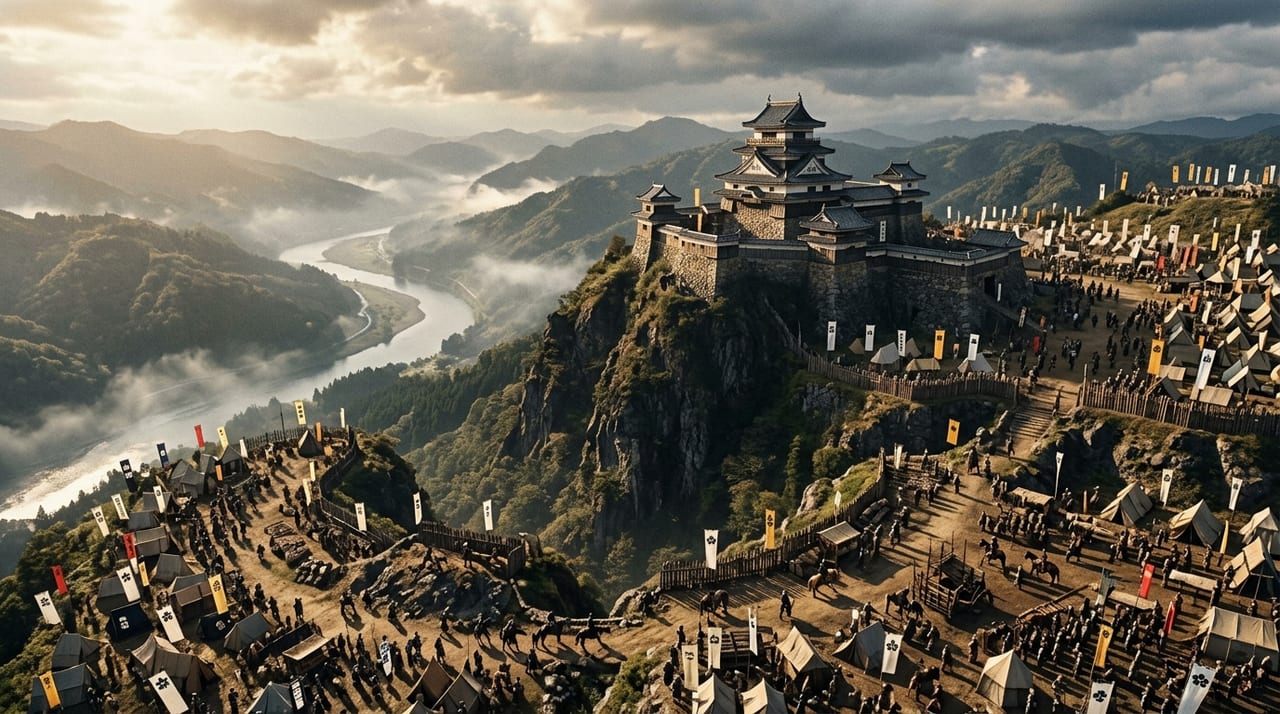
In Kenkyū 4 (1193), Yoritomo held a large-scale maki-gari at Fujino. Kudō Suketsune was among those attending the hunt.
The entry for the 28th day of the 5th month in the Azuma Kagami is said to state in substance that Soga Jūrō Sukenari and his brother Gorō Tokimune forced their way into the shogun's lodging at Kanno in Fujino and killed Kudō Saemon-no-jō Suketsune. The same entry reportedly names the Shinto priest Ō-tōnai, who was seated with Suketsune, along with nine wounded and one dead. The Soga Monogatari adds that Ō-tōnai woke and tried to dissuade the brothers before being cut down, and that after killing Suketsune the brothers fought ten men in turn (the "jūban-giri"), but these are the tale's accounts.
Sukenari faced Nitta Shirō Tadatsune and was killed by him.
Tokimune made for Yoritomo but was seized by Goshono Gorōmaru. On the following day, the 29th day of the 5th month, he was questioned by Yoritomo and, at the plea of Suketsune's son Inubōmaru (Itō Suketoki), beheaded the same day. The brothers' death dates thus differ by one day, the 28th for Sukenari and the 29th for Tokimune.
The incident is said to have had unexpected consequences for the Kamakura regime. The Hōryaku Kanki records that Yoritomo's half-brother Noriyori, hearing a false report that Yoritomo had been killed, told Hōjō Masako, "I am still here to stand behind you," and that this aroused suspicion of rebellion. However, only the Hōryaku Kanki records this.
According to the Azuma Kagami and related sources, on the 2nd day of the 8th month Noriyori sent Yoritomo a written oath, but Yoritomo refused to forgive him, regarding his use of the Minamoto surname as presumptuous. On the night of the 10th, Noriyori's retainer Tōma Tarō was caught hiding under the floor of Yoritomo's bedchamber, and on the 17th Noriyori was exiled to Izu. On the 20th, Hara Kojirō, the brothers' half-brother by their mother, was put to death for complicity with Noriyori. The Azuma Kagami does not record Noriyori's later fate; the Hōryaku Kanki and others say he was killed, but they were compiled in the 14th century or later, so there is no contemporary confirmation.
The Soga Monogatari is a war tale whose author and date are unknown; its prototype is thought to have taken shape in the mid-to-late Kamakura period and developed in the Nanboku-chō and Muromachi periods. One theory holds that monks of Mt. Hakone created the prototype, another that blind female reciters (goze) of Hakone and Izusan spread it.
The Soga Monogatari became source material for Noh, kōwakamai and Kabuki, and works about the brothers are collectively called "Soga-mono." In Edo Kabuki, from around the Kyōhō era it became customary to stage a Soga play in the New Year program. The Noh play Genpuku Soga depicts Jūrō taking his younger brother Hakoō, who had been placed in the care of the chief priest of Hakone, to have his coming-of-age ceremony; this is the plot of a performing-arts work, not history. Well-known Kabuki pieces include Ya no Ne, Taimen and Kusazuribiki.
In Edo theaters, in years when Soga plays ran from the first month through the fifth, a Soga festival was held around the 28th of the 5th month. The Nakamura-za did so first in 1753, it became customary for the three Edo theaters, and it is said to have continued until around the Bunsei era.
In the Kabuki play Sukeroku, the hero Sukeroku is in truth Soga Gorō, who frequents the Yoshiwara in search of the treasured Genji sword Tomokirimaru and recovers it from Hige no Ikyū. That is a premise within a stage work, not a historical record.