New Arrivals — Browse our catalog for the latest authentic Japanese sword arrivals. Browse →
September 5–8, 1864 (Genji 1/8/5–8)
Kanmon Strait and Shimonoseki (Nagato Province) coastal artillery batteries, and Bakan (present-day Shimonoseki, Yamaguchi Prefecture)
Forces
Chōshū Domain
Four-Nation Allied Squadron (Britain, France, USA, Netherlands)
About 15 min read
From the 5th month of Bunkyū 3 (1863) to the 8th month of Genji 1 (1864), the series of military clashes over control of the Kanmon Strait in the Chōshū Domain (present-day Yamaguchi Prefecture) is collectively called the Shimonoseki War (Bakan War). In particular, the incident on September 5, 1864 (Genji 1/8/5), in which a 17-ship fleet of the four-nation allied forces of Britain, the United States, France, and the Netherlands simultaneously bombarded the Chōshū batteries, is recorded in history as a symbolic event in which the late-Tokugawa jōi movement was utterly crushed by the modern military power of the Western powers.
On the 10th day of the 5th month of Bunkyū 3 (1863), by the old calendar, the Chōshū batteries fired on the American merchant ship Pembroke, which was passing through the Kanmon Strait. Then, on the 23rd day of the 5th month, they fired on the French dispatch ship Kien Chang, and on the 26th day of the 5th month, on the Dutch warship Medusa. By carrying out the "execution of jōi" that Emperor Kōmei had ordered the shogunate to undertake, doing so in the shogunate's place, the Chōshū Domain, which harbored many radical sonnō jōi factions, sought to seize political leadership. These attacks caused enormous shock among the foreign powers. The USS Wyoming entered Shimonoseki on July 16, 1863 (Bunkyū 3/6/1) and carried out a retaliatory bombardment, and the French fleet also dispatched a landing force and temporarily occupied the Chōshū batteries. However, Chōshū rebuilt its batteries and held firm to its policy of blockading the Kanmon Strait.
Among the Chōshū activists of the time of the Shimonoseki War, the most important were Kusaka Genzui and Kijima Matabei. Kusaka Genzui (1840–1864) was one of Yoshida Shōin's most outstanding disciples, and together with Takasugi Shinsaku he was known as the "twin pillars" of the Shōka Sonjuku. In the Kinmon Incident (Hamaguri Gate Rebellion) of the 7th month of Genji 1 (1864), he led Chōshū forces to press toward the Imperial Palace, and when the fighting turned against them, he committed seppuku. He was 25 years old at his death. Kijima Matabei (1817–1864) was a central figure among Chōshū's radical sonnō jōi faction, and he was killed in action leading Chōshū forces in the Kinmon Incident. Shōka Sonjuku activists such as Yoshida Toshimaro and Irie Kuichi also lost their lives one after another in the torrent of the sonnō jōi movement.
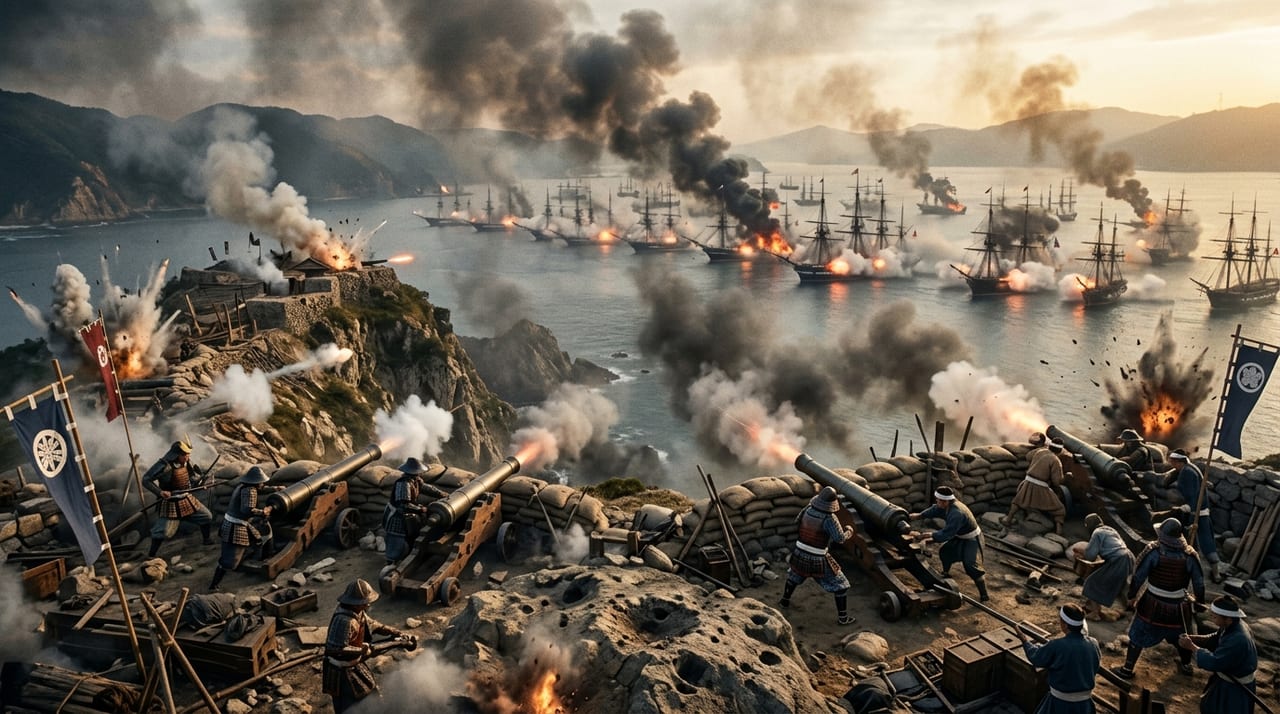
On September 5, 1864 (Genji 1/8/5), an allied fleet of 17 warships from Britain, France, the Netherlands, and the United States deployed in the Kanmon Strait and began a simultaneous bombardment of the Chōshū coastal batteries. The Chōshū batteries (a little over 100 guns) also returned fire, but the overwhelming difference in firepower was clear, and the Chōshū batteries fell silent one after another. From that same day until September 7, 1864 (Genji 1/8/7), the allied forces landed naval landing parties, occupied the batteries, and destroyed and seized the cannons. By September 8, 1864 (Genji 1/8/8), all of Shimonoseki's batteries had been destroyed, and before the overwhelming military strength of the allied forces, the Chōshū forces suffered a complete defeat. The allied fleet also suffered 60 to 70 casualties.
After the allied fleet subdued Shimonoseki, the domain authorities chose Takasugi Shinsaku (1839–1867) as their negotiator. Takasugi could not speak English and had no diplomatic experience, but he entered the negotiations with a resolute attitude. He argued that the Chōshū Domain had no authority to pay indemnities on its own, shifted the issue to the shogunate, and bought time so that the allied fleet would not attack Chōshū any further. The demand for an indemnity of 3 million dollars was ultimately settled when the shogunate took it over (in fact, the shogunate never paid the full amount). Through these negotiations, Takasugi saw up close the enormous size and firepower of the allied warships, became convinced of the impossibility of jōi, and instead recognized the need for a modern army armed with Western technology. This experience led to the Kōzan-ji uprising of January 1865 (Genji 1/12), a coup by the Justice Faction that overthrew the conservative faction within the Chōshū Domain. It became the driving force behind the modern military reforms centered on the Kiheitai.
The Chōshū samurai's fighting in the Shimonoseki War once again proved that the Japanese sword was utterly powerless before modern artillery. At the batteries of the Kanmon Strait, cannons were the main actors, and the samurai's carrying of swords had no tactical significance. Yet many of the activists involved in the Shimonoseki War were figures closely tied to sword culture. Kusaka Genzui studied under Yoshida Shōin and, as if embodying his teacher's spirit ("If there is a prospect of enduring fame after death, one should be ready to die at any time"), he committed seppuku in the Kinmon Incident. Takasugi Shinsaku was also a swordsman who had received full transmission in the Yagyū Shinkage-ryū.
It is thought that many of the swords carried by the disciples of the Shōka Sonjuku, which was based in Chōshū, were either works by smiths of Suō and Nagato or famous blades procured in Kyoto and Osaka.
Like the Anglo-Satsuma War, the Shimonoseki War was an event that signaled the end of the sonnō jōi movement. First, the Chōshū Domain completely abandoned the jōi line and shifted to a course of overthrowing the shogunate and honoring the emperor. Second, Takasugi Shinsaku staged a domain coup with the Kōzan-ji uprising (January 1865, Genji 1/12) and pushed forward the building of a modern army centered on the Kiheitai. Third, the groundwork was laid for the formation of the Satchō Alliance with the Satsuma Domain (Keiō 2, 1866).
Facing the defeat in the Shimonoseki War squarely, Chōshū adopted a modernization strategy of "countering the West with Western strength," and in time turned its military power toward the overthrow of the shogunate and the Meiji Restoration. From the autumn of 1864, when Shimonoseki's batteries fell silent, to the Meiji Restoration (1868) was only four years. In present-day Shimonoseki City, monuments to the Shimonoseki War remain alongside Akama Shrine, the old battlefield of Dan-no-ura, Shunpanrō, and others. They are preserved as historic sites where the late-Tokugawa jōi movement ended in a fierce defeat.
It is thought that many of the swords carried by Yoshida Shōin's disciples were made by smiths of Chōshū or Bōshū (present-day Yamaguchi Prefecture), or were obtained in Kyoto or Osaka.
Even after their teacher's death (Ansei 6, 1859), the Shōka Sonjuku disciples kept in their hearts the words "No one who is utterly sincere has ever failed to move others," and, wearing swords, walked the path of sonnō jōi. The Shimonoseki War was the final military expression of that spirit, and at the same time a turning point at which that spirit was transformed into a new form: the building of modern military power.
Chōshū (Suō and Nagato Provinces) has long been known as a center of smithing, and smiths of Bōshū (Suō) produced swords actively throughout the Muromachi and Sengoku periods. As the sonnō jōi movement grew toward the late Tokugawa period, demand for swords within the Chōshū Domain surged. After the Kiheitai was formed, armed militia organizations, regardless of social standing, required large numbers of swords, spears, and guns.
It is thought that many of the swords carried by the soldiers of the batteries that the allied fleet destroyed in the Shimonoseki War were practical blades produced by these Suō and Nagato smiths.