New Arrivals — Browse our catalog for the latest authentic Japanese sword arrivals. Browse →
27th day of the 3rd month, Genji 1 (May 2, 1864) — rising at Mount Tsukuba; surrender in Echizen, 17th day of the 12th month, Genji 1 (January 14, 1865)
Mount Tsukuba, Hitachi Province (present-day Tsukuba City, Ibaraki Prefecture); route through Hitachi, Shimōtsuke, Tōsandō, to Tsuruga, Echizen Province (present-day Tsuruga City, Fukui Prefecture)
Forces
Tengu-tō (Mito Loyalist-Expulsionist Faction)
Shogunate Coalition and Pro-Shogunate Domains
About 14 min read
On May 2, 1864 (Genji 1/3/27), the radical sonnō jōi faction of the Mito domain, known as the Tengu-tō, rose in revolt at Mount Tsukuba in Hitachi Province (present-day Ibaraki Prefecture). Fujita Koshirō, a son of Fujita Tōko, gathered like-minded men and installed Tamaru Inanoemon, a Mito town magistrate, as commander. This uprising marked the beginning of the Tengu-tō Rebellion, one of the largest civil wars of the Bakumatsu period. The rebellion was the escalation into armed clashes of a power struggle between the Tengu-tō (radical sonnō jōi faction) and the Shosei-tō (conservative pro-shogunate faction), which intensified within the Mito domain, the headquarters of Mito school (the sonnō jōi ideology). The self-destructive civil war of the Mito domain, which had spread the ideology of expelling foreigners throughout Japan, sums up in concentrated form the contradictions and tragedy of the sonnō jōi movement.
The Mito domain (Hitachi Province, present-day Mito City, Ibaraki Prefecture) was throughout the Edo period the center for developing the Mito school of imperial loyalist thought. There, Fujita Tōko, Aizawa Seishisai, and Tokugawa Nariaki (Reikō) systematized the political theory of sonnō jōi. Tokugawa Nariaki, who was domain lord from 1829 to 1844, actively promoted Mito learning, and his son Tokugawa Yoshinobu later became the last shogun. Toward the end of the Bakumatsu period, the Mito domain split politically into two factions: a reformist, radical sonnō jōi faction (the Tengu-tō line) and a conservative faction that valued cooperation with the shogunate (the Shosei-tō line). The conflict between these factions intensified across domain governance, personnel, military affairs, and foreign policy alike, and became a fierce power struggle that drew in each side's families and retainers.
Fujita Koshirō (1842–1865) was born the fourth son of Fujita Tōko, a great Confucian scholar of the Mito school, and under his father's tutelage he deeply internalized the spirit of sonnō jōi. Angered that the closing of the port of Yokohama, which the shogunate had promised the imperial court, was never carried out, Fujita Koshirō plotted with like-minded men and drew up a plan to raise an uprising based at Mount Tsukuba. On the 27th day of the 3rd month of Genji 1 (1864), Fujita Koshirō rose in revolt together with 62 like-minded men who had gathered at Mount Tsukuba. Participants joined from various regions afterward, and at its peak the force is said to have swelled to about 1,400 people. The stated aim of the uprising was to press the shogunate to carry out the closing of the port of Yokohama immediately. Later, it would aim to travel to Kyoto (ascend to the capital) and appeal its cause to the imperial court through Hitotsubashi Yoshinobu.
At the outset of the uprising, Fujita Koshirō and his companions were few in number. When Takeda Kōunsai (1803–1865), a senior retainer of the Mito domain, joined, the Tengu-tō became a major force. Takeda Kōunsai had served as chief minister of the Mito domain and was a powerful figure, so his participation gave the uprising political legitimacy. Originally a moderate advocate of sonnō jōi, he joined Fujita Koshirō's uprising out of anger at the Shosei-tō's purge of Tengu-tō-aligned figures. His decision transformed the Tengu-tō Rebellion from the reckless uprising of a few young men of the domain into a full-scale armed revolt joined by the domain's leading figures. In the end, the strength of the Tengu-tō reached roughly 1,000 men.
Regrouping at Mount Tsukuba, the Tengu-tō fought across northern Kantō while replenishing its weapons, supplies, and manpower. Pursued by the shogunate's punitive army, commanded by Tanuma Okitaka, the Tengu-tō kept advancing west while fighting Takasaki domain (the Battle of Shimonita), Takashima and Matsumoto domains (the Battle of Wada Pass), and others. The Tengu-tō continued its westward march from Hitachi through Shimotsuke (present-day Tochigi Prefecture), Kōzuke (present-day Gunma Prefecture), Shinano (present-day Nagano Prefecture), and Mino (present-day Gifu Prefecture). The march lasted several months, and people joined and deserted the column one after another along the way.
The Tengu-tō aimed to make a direct appeal to Tokugawa Yoshinobu (Hitotsubashi Yoshinobu) and to press him to force the shogunate to carry out the expulsion of foreigners. Yoshinobu came from the Mito Tokugawa house, and the Tengu-tō expected that he was their ideological comrade. This expectation, however, would be utterly betrayed.
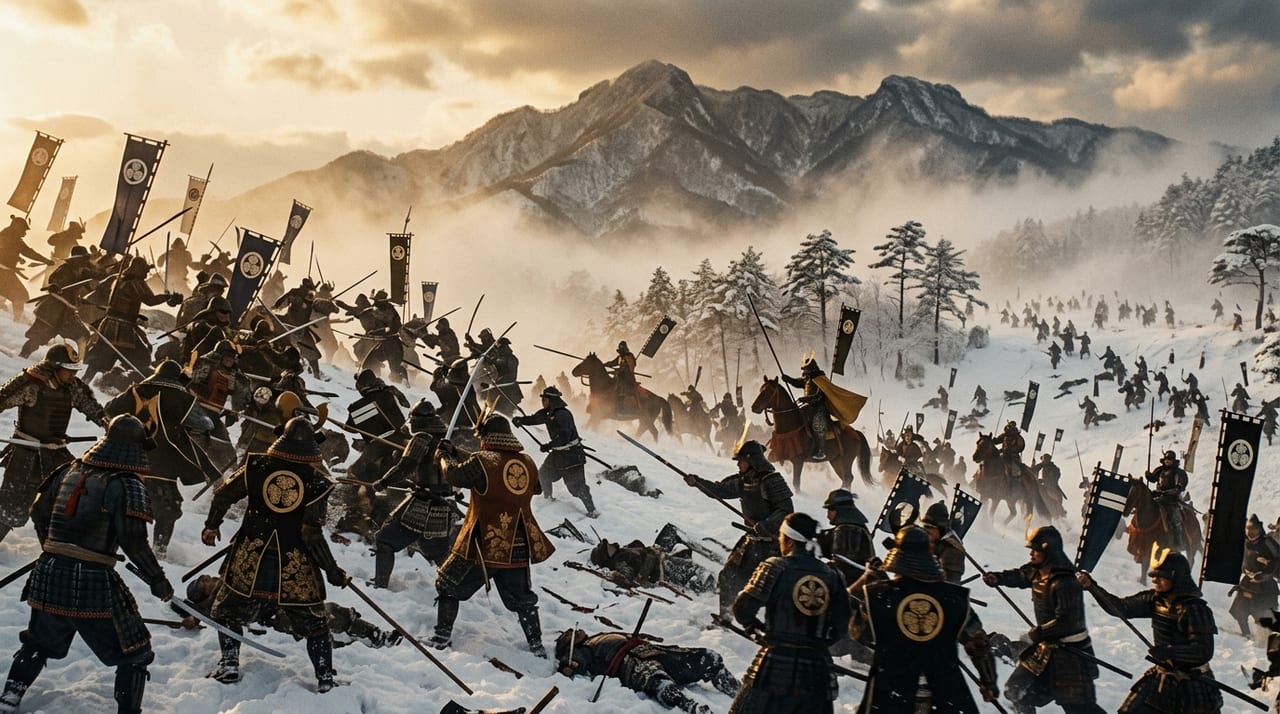
In the 12th month of Genji 1 (1864), the Tengu-tō was cut off near Shinbo village in Echizen (present-day Fukui Prefecture) by a large army of Kaga domain (the Maeda house, present-day Ishikawa Prefecture). Surrounded in the snow, with fighting, surrender, and desertion occurring one after another, Takeda Kōunsai decided to surrender in order to save the lives of all his men. On January 14, 1865 (Genji 1/12/17), the Tengu-tō laid down its arms and surrendered to Kaga domain. Its men were later handed over to the shogunate at Tsuruga. But Tokugawa Yoshinobu, whom the Tengu-tō had hoped for, was then head of the Hitotsubashi house and sided with the shogunate, and he rejected the petitions for clemency for the Tengu-tō. On the 4th day of the 2nd month of Genji 2 (1865), 24 leaders, including Takeda Kōunsai, were beheaded at Raikō-ji temple in Tsuruga. By the 23rd day of the 2nd month, when Fujita Koshirō was executed, more than 350 men had been beheaded. In addition, many associated persons, including women and children, were executed or exiled. The Tengu-tō Rebellion reached a tragic end: having raised the banner of expelling foreigners, its men were beheaded in the snow of Echizen without support from their home domain of Mito.
The Tengu-tō Rebellion occupies a distinctive place in the political history of the late Tokugawa period as an incident in which the Mito domain, the headquarters of sonnō jōi thought, was exhausted by a self-destructive civil war. First, as a result of the losses from the Tengu-tō Rebellion, the Mito domain came to trail behind Satsuma and Chōshū in the movement to overthrow the shogunate. The conflict between the Tengu-tō and Shosei-tō factions continued even after the Meiji Restoration, and the internal strife of the Mito domain did not end until the early Meiji period. Second, the Tengu-tō Rebellion showed the whole nation the political danger inherent in the sonnō jōi ideology of the Mito school. The Mito school produced an extreme political philosophy that made the expulsion of foreigners an absolute imperative. That this ideology ended in civil war within its own domain and mass executions laid bare the contradictions of the sonnō jōi movement. Third, the executions of Takeda Kōunsai and Fujita Koshirō left behind a legend of martyrdom among the Mito sonnō jōi activists. In the later reign of the Meiji Emperor, many of the Tengu-tō's surviving families and associates received the grace of rehabilitation.
In Tsuruga City, Fukui Prefecture, there is a mound where the executed Tengu-tō members are buried (designated a national historic site as the "Graves of Takeda Kōunsai and Others"), and the Matsubara Shrine, built in Meiji 7 (1874) to enshrine the Tengu-tō members. In Tsukuba City, Ibaraki Prefecture, the Tsukubasan Shrine also has a monument commemorating the Tengu-tō and a statue of Fujita Koshirō. The memory of the Mito patriots who fell under the banner of expelling foreigners in the turmoil of the late Bakumatsu period still lives on in these places today.