New Arrivals — Browse our catalog for the latest authentic Japanese sword arrivals. Browse →
The 23rd–24th days of the 8th month of Eishō 8 (September 25–26, 1511)
Mount Funaoka, Yamashiro Province (present-day Kita Ward, Kyoto)
Forces
The forces of Hosokawa Takakuni and Ōuchi Yoshioki, backing shogun Ashikaga Yoshitane
The forces of Hosokawa Sumimoto, backing former shogun Ashikaga Yoshizumi
About 10 min read
The roots of the Battle of Funaokayama lie in the "Ryō-Hosokawa War" — the struggle over the headship of the Hosokawa Keichō house. In Meiō 2 (1493), the kanrei Hosokawa Masamoto staged a coup known as the Meiō Incident, expelling shogun Ashikaga Yoshiki (later Yoshitane) and installing Ashikaga Yoshizumi as the new shogun, thereby seizing real control of the shogunate. Masamoto, however, had no biological son, and had taken in three adopted heirs — Hosokawa Sumiyuki, Hosokawa Sumimoto, and Hosokawa Takakuni — planting the seeds of a succession dispute among them.
On the 23rd day of the 6th month of Eishō 4 (1507), Masamoto was assassinated by Sumiyuki's faction in what became known as the Eishō Disturbance. Hosokawa Sumimoto, who had fled to Ōmi, subsequently rebuilt his strength, retook Kyoto, and eliminated Sumiyuki to secure headship of the house.
Meanwhile, former shogun Ashikaga Yoshiki (Yoshitane), who had been expelled in the Meiō Incident, had taken refuge in the Chūgoku region under the protection of the powerful Suō daimyō Ōuchi Yoshioki. In Eishō 5 (1508), Yoshitane, accompanied by Yoshioki, marched on Kyoto, and when Hosokawa Takakuni rose in support, the forces of Yoshizumi and Sumimoto could not hold the capital and were routed. Yoshitane was restored as shogun, and a regime in which Takakuni, as kanrei, directed shogunate affairs was established.
Sumimoto's side did not abandon the struggle, however, and in Eishō 8 (1511) launched a counteroffensive to reverse its fortunes. Sumimoto's forces won successive victories at the Battles of Fukai and Ashiyagawara, and briefly retook Kyoto. Yoshitane and Takakuni fled to Ōmi, and the situation in the capital once again grew unsettled.
Driven from Kyoto, Takakuni and Yoshioki regrouped and waited for an opportunity to strike back. During this period, Rokkaku Takayori of Ōmi, who had been aligned with Sumimoto's side, suddenly defected to Yoshitane's camp. Compounding this setback, former shogun Ashikaga Yoshizumi, whom Sumimoto's faction had championed, died in despair from illness. With these developments, Sumimoto's side lost the initiative in the conflict. In response, Takakuni and Yoshioki resolved on a major offensive to retake Kyoto, and the two armies moved to settle the matter at Mount Funaoka in Yamashiro Province (present-day Kita Ward, Kyoto).
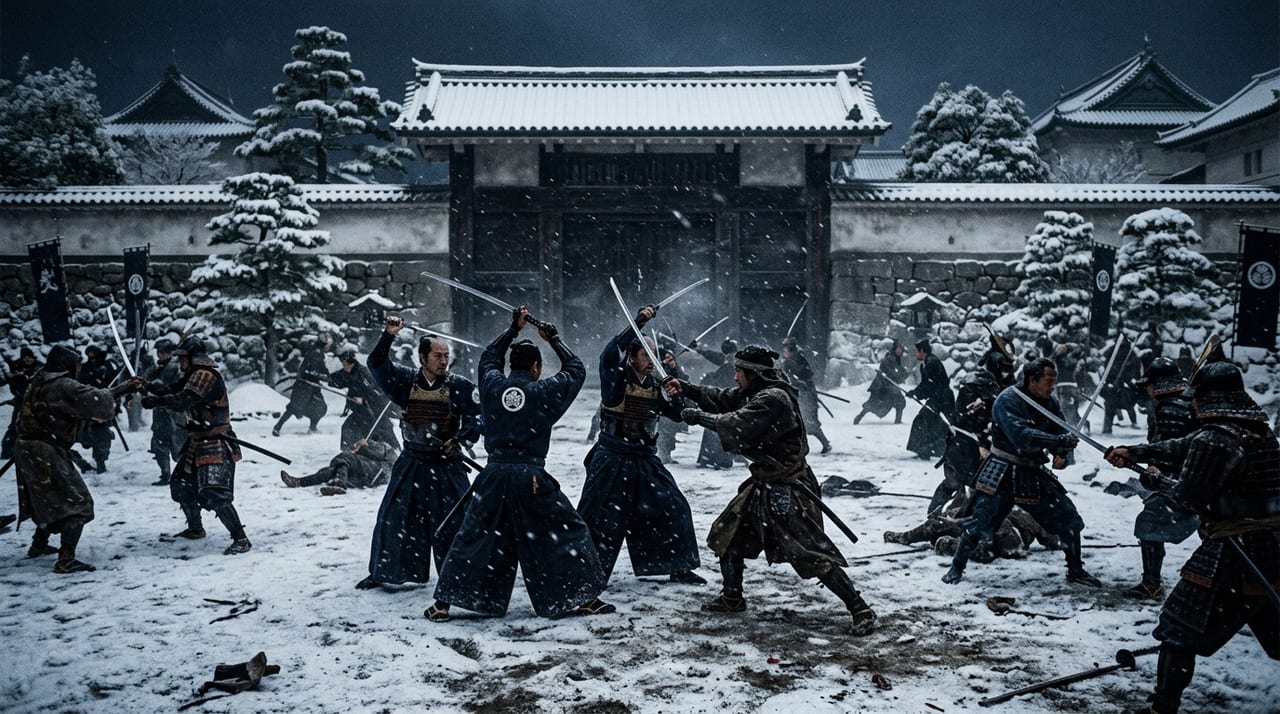
From the 23rd to the 24th day of the 8th month of Eishō 8 (September 25–26, 1511), the two armies clashed at Funaokayama. Sumimoto's forces, under the overall command of Hosokawa Masakata and joined by Hosokawa Mototsune and Yamanaka Tametoshi, took up defensive positions on the mountain. Their combined strength — roughly 2,000 under Masakata, 1,000 under Mototsune, and 3,000 under Yamanaka Tametoshi, totaling around 6,000 — was vastly outmatched by the more than 20,000 troops fielded by Takakuni and Yoshioki.
When Ōuchi Yoshioki's forces launched a night assault on Funaokayama, Sumimoto's outnumbered army could not hold and collapsed entirely. Commanding general Hosokawa Masakata was killed in the chaos of battle, and nearly all of the principal commanders on Sumimoto's side lost their lives in the fighting.
The crushing defeat at Funaokayama forced Hosokawa Sumimoto to flee to his base in Awa Province (present-day Tokushima Prefecture). Kyoto once again came under the control of Ashikaga Yoshitane and Hosokawa Takakuni, and Yoshitane's position as shogun and Takakuni's as kanrei were, for the time being, secured. The disparity in strength between the two armies — more than 20,000 for Takakuni and Yoshioki against roughly 6,000 for Sumimoto — made Funaokayama one of the largest pitched battles of the entire Ryō-Hosokawa War.
Even after the defeat at Funaokayama, Hosokawa Sumimoto continued to resist. He briefly recovered Kyoto in Eishō 17 (1520), but his chief retainer Miyoshi Yukinaga was killed at the Battle of Tōji-in, and Sumimoto himself died amid the ensuing turmoil later that same year. Ōuchi Yoshioki, who had aided Takakuni's victory, remained in the capital for a time to support the shogunate, but returned to his home province of Suō in Eishō 15 (1518) in response to unrest stirred up by the Amago of Izumo and the Aki Takeda. He never again marched on Kyoto, and died of illness in Kyōroku 2 (1529).
Although his victory at Funaokayama consolidated Takakuni's hold on the Hosokawa Keichō house, the political situation that followed was far from stable. Takakuni later came into conflict with shogun Ashikaga Yoshitane, expelling him in Daiei 1 (1521) and installing Ashikaga Yoshiharu as the new shogun. He then found himself at odds with Sumimoto's son, Hosokawa Harumoto, and was defeated at the Battle of Katsuragawara in Daiei 7 (1527); he was ultimately driven to suicide following the Ōmono Kuzure defeat in Kyōroku 4 (1531).
The Battle of Funaokayama stands as the most decisive victory won by the Takakuni–Yoshioki side in the nearly half-century of intermittent conflict that made up the Ryō-Hosokawa War over control of the Hosokawa Keichō house and the shogunate itself. Yet the victory did not bring the Ryō-Hosokawa War itself to an end — Takakuni, the victor at Funaokayama, would himself later meet a violent death in the continuing struggle against Sumimoto's line, a fact that underscores just how complex and unrelenting the power struggles surrounding the Hosokawa clan remained in the early Sengoku period.