New Arrivals — Browse our catalog for the latest authentic Japanese sword arrivals. Browse →
8th month, Eiroku 10 (1567)
Inabayama (present-day Kinkazan hill, Gifu City, Gifu Prefecture)
Forces
Oda Forces
Saitō Forces
About 14 min read
The Siege of Inabayama Castle — Nobunaga's Conquest of Mino and the Foundation of Tenka Fubu
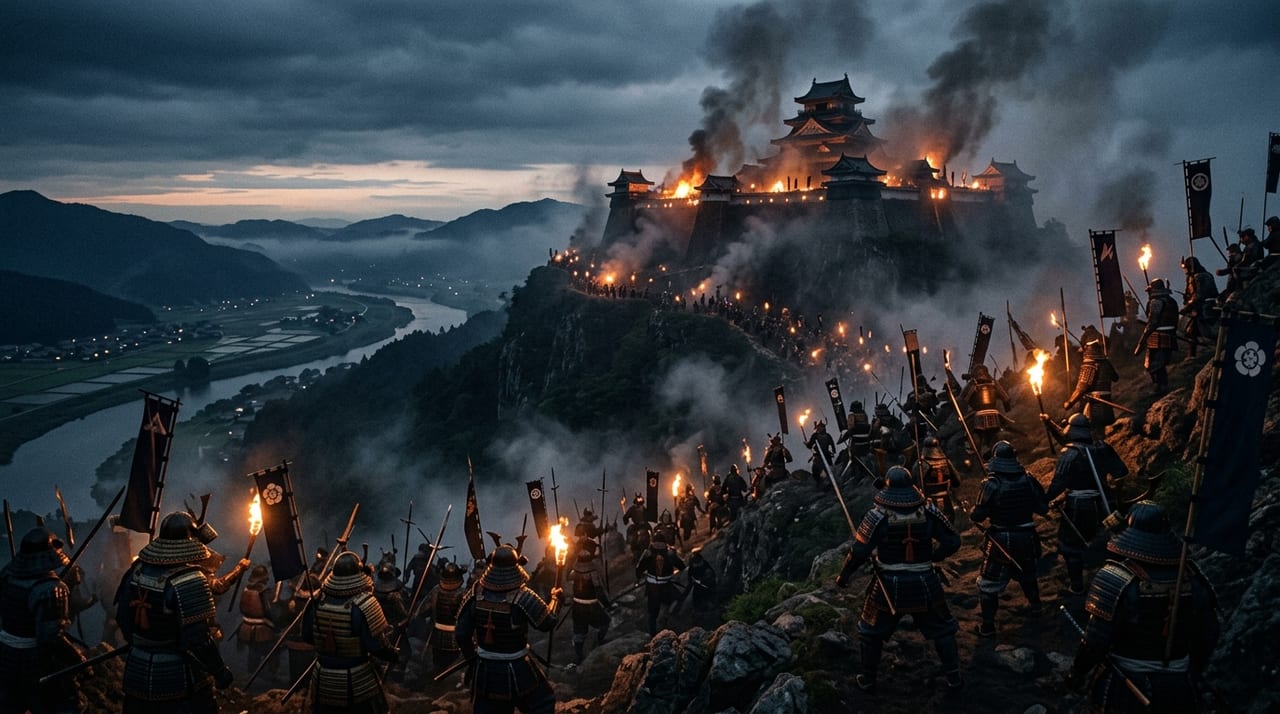
In the 8th month of Eiroku 10 (1567), Oda Nobunaga, based in Owari Province (present-day Aichi Prefecture), finally seized Inabayama Castle, the strategic stronghold in Mino Province (present-day southern Gifu Prefecture), which he had long sought to conquer. This "Siege of Inabayama Castle" stands as one of the decisive battles that altered the course of the Sengoku period, and is positioned as the first major turning point in Nobunaga's campaign to unify Japan under his rule.
Inabayama Castle was a mountain fortress built atop Mount Kinkazan (329 meters above sea level), and was known as an "impregnable castle" owing to its natural defensive advantages and its commanding position overlooking the Nagara and Kiso rivers. The castle had once served as the base from which Saitō Dōsan, the "Viper of Mino," ruled the province, and was passed down to his son Yoshitatsu and grandson Tatsuoki.
The Long Prelude to Mino's Conquest — Saitō Dōsan's Will and Nobunaga's Determination
The tie between Nobunaga and Mino Province ran deep. Nobunaga's principal wife, Kicho (also called Nōhime), was the daughter of Saitō Dōsan, making Nobunaga the latter's son-in-law. Dōsan was killed by his eldest son Yoshitatsu (in Kōji 2, 1556), and it is said that just before his death he left a will bequeathing Mino Province to Nobunaga. Whether this will was genuine or not, the conquest of Mino became an essential objective for Nobunaga on both familial and strategic grounds.
From around Eiroku 2 (1559) onward, Nobunaga intensified his offensive against Mino, engaging Saitō Yoshitatsu (Tatsuoki's father) in several battles. But Yoshitatsu was a figure of both military prowess and strategic cunning, and Nobunaga found himself struggling in his efforts to conquer Mino during this period. When Yoshitatsu died suddenly in Eiroku 4 (1561) at the age of thirty-five, he was succeeded by his heir Saitō Tatsuoki, then only fourteen or fifteen years old. Tatsuoki lacked the capacity of his grandfather Dōsan or his father Yoshitatsu, and factional strife plagued the Saitō clan, creating an opportunity for Nobunaga.
Eiroku 7: Takenaka Hanbei's Occupation of Inabayama Castle — A Sign of Internal Turmoil
An important incident served as a prelude to the final assault on Inabayama Castle. In Eiroku 7 (1564), Takenaka Hanbei (Shigeharu), a young commander of Mino, occupied Inabayama Castle together with the forces of his father-in-law, Andō Morinari. Against Tatsuoki, who indulged in wine and women, neglected government and favored only a few close attendants, Hanbei entered the castle on the pretext of nursing his brother Kyūsaku (Shigenori), who was within it, and is said to have killed Tatsuoki's favorite Saitō Hida-no-kami and others and seized the castle. Hanbei and his companions held the castle for about half a year before giving it up and retiring into seclusion, but the incident made the decline of the Saitō clan evident, and defections among its retainers became conspicuous. Later, Hanbei was earnestly recruited by Kinoshita Tōkichirō (Hideyoshi) and joined the Oda forces, eventually serving as Hideyoshi's strategist.
The Final Assault of Eiroku 10 — The Defection of the Three Western Mino Commanders and Tatsuoki's Flight
In Eiroku 10 (1567), Nobunaga undertook the final phase of Mino's conquest. The crucial role was played by the defection of the Three Western Mino Commanders (Inaba Yoshimichi, Andō Morinari, and Ujiie Naomoto), senior retainers of the Saitō clan. According to the Shinchō Kōki, once the three commanders promised to defect, Nobunaga quickly raised his forces and marched into Mino, burned Inokuchi at the foot of the castle, leaving Inabayama Castle a bare fortress, and surrounded it with shikagaki (palisade fences). Later military chronicles also tell that Kinoshita Tōkichirō (the future Toyotomi Hideyoshi) led a small force to attack through the castle's rear gate (karamete). On the 15th day of the 8th month, when the Mino officers and troops surrendered, Saitō Tatsuoki fled by boat down the Nagara River to Nagashima in Ise. The Oda forces captured Inabayama Castle, bringing all of Mino Province under Nobunaga's control. After his flight, Tatsuoki continued his resistance to Nobunaga while wandering through Ise and Ōmi provinces. He is said to have died in battle at Tonezaka during Tenshō 1 (1573), fighting on the Asakura side.
The Renaming to Gifu Castle and "Tenka Fubu" — The Dawn of a New Era
Upon seizing Inabayama Castle, Nobunaga immediately began the development of the castle and its surrounding town. Most notably, he renamed the castle to Gifu Castle, and the town below it likewise became Gifu. The character 'gi' (岐) was drawn from Mount Qi (岐山) in China, the legendary origin of the Zhou dynasty. The name is said to echo the precedent of King Wen of Zhou, who pacified the realm from Mount Qi. Nobunaga's grand ambition to unify Japan was embedded in this name.
Moreover, from this period onward, Nobunaga began using the seal Tenka Fubu ("to spread military rule throughout the realm" — in other words, to unify Japan through military force). This motto was an explicit declaration of Nobunaga's determination to unify Japan and represented a new value system of the Sengoku period — the assertion that practical power rather than ritual propriety would determine mastery of the realm. Gifu Castle became the base from which Nobunaga would pursue this agenda, and he deployed it as a political stage for negotiations with regional commanders, daimyo, and the imperial court and nobility.
The Connection to Blades — Mino's Swordsmiths and the Fame of Seki Forges
In considering the relationship between the Siege of Inabayama Castle and the culture of the sword, the most important fact is that Seki (in Mino Province, present-day Seki City, Gifu Prefecture) has long been known as one of Japan's leading sword-producing centers. The history of the Seki forges extends back to the period of the Northern and Southern Courts (the fourteenth century), with tradition attributing its lineage to Kanemoto, a distinguished student of Masamune. By the Muromachi period, Seki smiths had achieved national renown, and their blades were known for their cutting quality. During the Sengoku period, Mino continued to supply swords to both the Oda and Saitō forces as a major center of production.
The struggle over Inabayama Castle was not only a contest for control of Mino's economic and political power but also a struggle to secure access to the fine weapons produced by Seki smiths. When Nobunaga established control of Mino, the techniques and productive capacity of Seki smiths became part of the foundation supporting the Oda regime's military power.
The Historical Significance of the Siege of Inabayama Castle — The Full Mobilization of the Campaign for Unification
The fall of Inabayama Castle was more than the conquest of a single castle and province; viewed in the broader context of the Sengoku period, it represented a distinctive historical turning point. With Nobunaga's acquisition of Mino — a vast and prosperous domain — following his rise from a regional lord of Owari, his campaign for national unification entered its decisive phase. In the following year, Eiroku 11 (1568), Nobunaga escorted Ashikaga Yoshiaki to Kyoto and established control over the capital and the Kinai region. Nobunaga's campaigns continued: the Battle of Anegawa in Eiroku 13 (Genki 1, 1570), the Siege of Ichijōdani in Tenshō 1 (1573, which resulted in the destruction of the Asakura clan) and the fall of the Asai clan. All of these campaigns traced their origin to the conquest of Inabayama Castle in the 8th month of Eiroku 10.
Inabayama Castle — Gifu Castle — stands today as a symbol of Gifu City, with a replica keep rising from the summit of Mount Kinkazan, bearing witness to Nobunaga's dream of Tenka Fubu. Each autumn, the "Gifu Nobunaga Festival" is held in central Gifu City, drawing many visitors. The remains of Nobunaga's castle town that spread beneath Gifu Castle form the foundation of present-day Gifu's urban layout, still bearing witness to the significance of this place as a turning point in the Sengoku period.