 * Image is for illustrative purposes only.
Polishers and Appraisers: A Lineage
研磨師・鑑定師の系譜
The value of a Japanese sword is not determined solely by the swordsmith's forging skill; rather, it is completed only through the integration of specialized craftspeople—polishers, appraisers, habaki makers, and scabbard makers. The Hon'ami family and other specialized polishing and appraisal workshops became established from the Muromachi period onward and provided the intellectual infrastructure that elevated swords from mere weapons to artworks and cultural treasures.
Description
The Role and Technique of Polishing Specialists
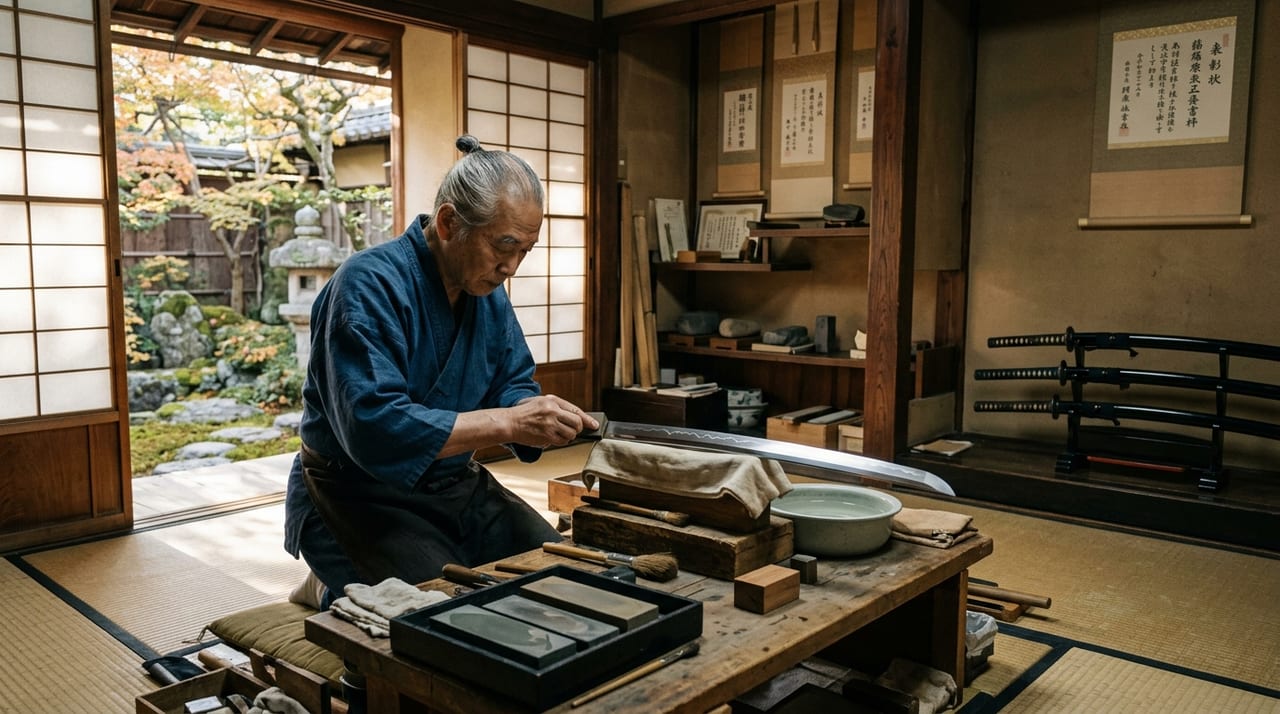
The polishing (togi) of a Japanese sword is not merely blade maintenance; it is a highly developed artistic technique that brings out to the fullest the jihada grain patterns inherent in the steel, the character of the hamon edge pattern, and the form of the boushi. A polisher works through approximately ten stages of polishing, from rough polishing (shitaji-togi) to final polishing (shiage-togi), skillfully adjusting the type of whetstone, polishing technique, and pressure to bring the steel and edge pattern into optimal condition. In the process called edge definition (hatori), the blade is rubbed along the shape of the hamon with hazuya (small flakes of finishing stone) to bring out the hamon contour. In the steel finish (jitsuya) stage, the jihada grain patterns are brought into a state where they can be appreciated; in the edge finish (hatsutsuya) stage, the polishing is completed so that the activity (nie) and scent (nioi) of the hamon can be observed in both transmitted and reflected light. Only through the work of an excellent polisher is the true value of a blade revealed, and the quality of polishing directly affects the appraisal value of a sword. Even today, the condition of the polish is a crucial factor in the evaluation process of the Japanese Art Sword Preservation Society.
Establishment of the Hon'ami Family
The Hon'ami family was the leading authority on sword polishing and appraisal in Kyoto, established from the mid-Muromachi period onward, serving the Ashikaga shogunal household of the Muromachi shogunate. The Hon'ami family, responsible for managing, polishing, and appraising the vast collection of celebrated swords gathered by the Ashikaga shoguns, was uniquely positioned to continuously handle these masterpieces. From the accumulation of this experience, they developed their own distinctive system of appraisal knowledge. Honami Kōetsu (1558–1637) was an outstanding versatile artist in calligraphy, ceramics, and lacquerware, elevating the cultural standing of the Hon'ami family beyond swords alone. During the Edo period, the family became the officially recognized appraisal authority of the Tokugawa shogunate as the Appraisal Office (mekikidokoro), and the appraisal documents called oridame functioned as official certificates of authenticity for celebrated swords.
Methodology of Appraisal
The methodology of sword appraisal established by the Hon'ami family consisted of a three-tiered structure: identifying the Five Traditions (gokauden), determining the period (jidai), and recognizing individual swordsmith characteristics. First, the tradition (denpo)—whether it belongs to Yamashiro, Yamato, Bizen, Soshu, or Mino—is determined by examining the jihada grain patterns, hamon style, and construction characteristics. Next, the period—whether the sword is from the old sword (koto), new sword (shinto), or new new sword (shinshinto) era—is determined from the distinctive characteristics of forging technique for each period, such as the compactness of the steel, the quality of the nie, and the shape of the curvature. Finally, the individual maker attribution—whether it can be specifically attributed as 'made by [smith name]'—is determined from the individual swordsmith's distinctive habits and techniques. This methodology is fundamentally inherited in the modern appraisal system of the Japanese Art Sword Preservation Society, and the intellectual legacy of the Hon'ami family continues to live on today.
Lineage of Polishing Specialists
Besides the Hon'ami family, multiple lineages of polishing specialists developed. During the Edo period, 'polishers (togishi)' became established as professional guilds in various regions, with polishers employed by daimyo families contributing to the preservation of regional sword culture. From the Meiji period onward, polishers who inherited the Hon'ami tradition coexisted with independently developed polishing lineages. In modern Japan, the transmission of traditional technique occurs through presentations of polishing and mounting techniques such as the gendai tōshoku-ten (Contemporary Sword Craftsmanship Exhibition), organized by the Japanese Art Sword Preservation Society. Training to become an accomplished polisher requires a minimum of ten years or more of apprenticeship, and the transmission of knowledge through oral instruction and hands-on guidance from master to apprentice continues today.
The Role of Habaki Makers, Scabbard Makers, and Grip Wrappers
Beyond the blade and polishing, the completion of a sword requires indispensable specialist craftspeople: habaki makers, scabbard makers, grip wrappers, metalworkers, and lacquer specialists. The habaki, the fitting that joins the blade to the scabbard, is an important component meticulously crafted by habaki makers from copper, silver, gold, and other metals. The scabbard is constructed with a wooden core crafted by woodworkers, then finished by lacquer specialists with techniques such as exposed-picture lacquer (togidashi-makie), subdued finish (tame-nuri), and black high-gloss lacquer (kuro-roiro-urushi). Grip wrappers meticulously bind and assemble the grip wrapped in ray skin (samegawa) using silk thread and leather cord. The complete mounting of a sword (koshirae), assembled from the collective craftsmanship of these specialists, is an artistic achievement equal to the blade itself, and like the polishers and appraisers, it became highly specialized within the Edo period craft culture.
Transmission to the Modern Age
With the establishment of the Japanese Art Sword Preservation Society (NBTHK) in 1948, the training of polishers and appraisers became systematized. NBTHK appraisals are conducted in four grades: Preservation (hozon), Special Preservation (tokubetsu-hozon), Important (juyo), and Special Important (tokubetsu-juyo), each evaluated according to strict criteria. This modern systematized appraisal framework represents a democratization and universalization of the knowledge system built up by the Hon'ami family since the Muromachi period, and stands as evidence that the tradition of polishing and appraisal continues as a living culture in contemporary Japan.
Characteristics of This Era
- Multi-stage polishing technique (togi): Approximately ten stages from rough polishing to final polishing constitute a highly developed artistic technique. Specialized stages such as steel finish (jitsuya), edge finish (hatsutsuya), and edge definition bring out the full beauty of the jihada and hamon.
- Hon'ami family appraisal methodology: Established a three-tiered appraisal system of tradition (denpo), period, and attribution. Construction of a systematic knowledge infrastructure for identifying the Five Traditions, determining period, and recognizing individual swordsmith characteristics.
- Oridame certificate system: Appraisal documents issued by the Hon'ami family functioned as official certificates of authenticity for celebrated swords. The valuations recorded (oridame values) became the pricing standard in the celebrated sword market.
- Specialized division of labor among mounting craftspeople: Habaki makers, scabbard makers, grip wrappers, metalworkers, and lacquer specialists collaborate to complete the 'total aesthetic' of the sword. The artistic integration of blade and mounting is characteristic of Japanese sword culture.
- NBTHK appraisal system: The four-tier evaluation system (Preservation → Special Preservation → Important → Special Important) established in the postwar period modernizes the Hon'ami family tradition. Functions as the world standard for sword appraisal.