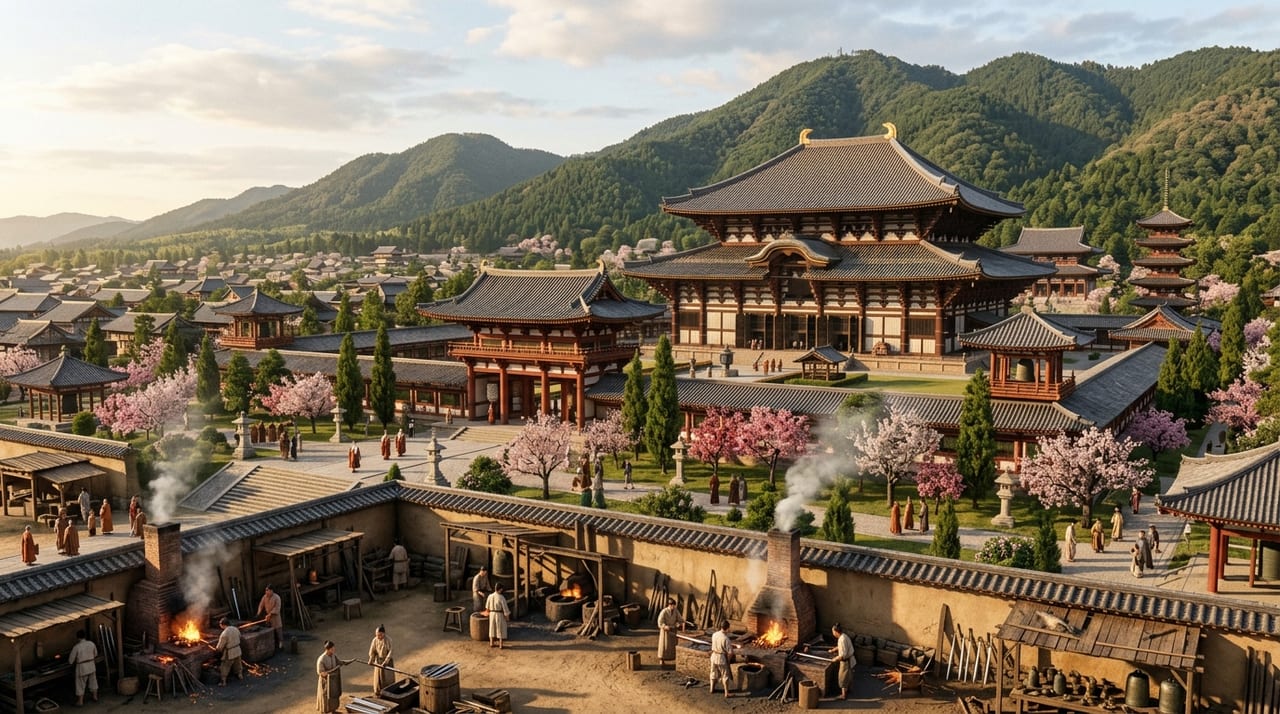
 * Image is for illustrative purposes only.
Early Tenpei Ancient Swords and Nara Imperial Workshops
天平初期の古刀と奈良官営工房
Organized sword production under the Nara imperial workshop system during the legal-code era, marking the transition from straight to curved blades as iron quality improved.
Description
The Tenpyō 13 to 20 period (741–748) was the peak of Nara-period culture and politics. Under Emperor Shōmu, the edict on the establishment of Kokubunji and Kokubunniji was issued in 741. In 742 construction of the Shigaraki-no-miya began, and in 743 the edict for the construction of the Great Buddha launched the casting of the Rushana Buddha at Tōdaiji. This was a period in which Japan's largest state-led Buddhist undertakings in ancient cultural history were pushed forward in rapid succession. The accumulation of metalworking technology on this national scale also indirectly influenced sword making. The state-run workshops of Nara (kanga kōbō) were bureaucratic production organizations that made a wide range of metal products, from Buddhist implements and temple bells to weapons. Within this system, the workshops under the Hyōbushō lineage played one of the major roles in sword production.
Tenpyō-period swords belong to the earliest stage of Japanese sword history, the age of the chokutō (straight sword). They are fundamentally different from the wantō (curved sword), the so-called Japanese sword with a curve, which was established from the Heian period onward. Tenpyō swords were single-edged with an almost straight blade, and took forms such as hira-zukuri, which lack a shinogi. As for materials, wa-tetsu (Japanese iron) and forging techniques of continental origin coexisted. The homogeneous Japanese-style tamahagane smelting method was not established until the Heian period or later. For this reason, Tenpyō swords were strongly influenced by the continent, namely Tang-dynasty China and the Korean Peninsula, in both material and technique.
The Shōsō-in is the most important repository for Tenpyō-period swords. This treasure house, which belongs to Tōdaiji in Nara, still preserves the swords included when Empress Kōmyō dedicated the personal effects of Emperor Shōmu in 756 (Tenpyō Shōhō 8). The Shōsō-in imperial treasures include several long swords of the Nara period, among them the Kingin Densō no Karatachi. These are of unparalleled value even worldwide as physical evidence of Tenpyō-period sword-making techniques and decorative styles. The decoration of the Kingin Densō no Karatachi shows continental (Tang-style) influence. This shows that Japan's sword culture of the Nara period was at a stage of actively absorbing continental culture.
The warabitetō was a distinctive sword form used in northern Japan (Tōhoku and Hokkaido) around the Tenpyō period and earlier. Its pommel curls inward like a young fern shoot. As the design was refined, the curvature of the hilt increased, and the blade is said to have acquired a curve. Its influence on the later formation of curved swords has been discussed. The transition from the straight swords of the Tenpyō period to curved swords was gradual. Research on the curved shape of warabitetō therefore provides important material evidence in the scholarly debate over the origin of the curve in Japanese swords. In recent years, archaeological excavations in the Tōhoku region have confirmed iron-smelting sites from the 7th to 8th centuries one after another. This is clarifying the actual state of local iron-object production in the Tenpyō period.
Sword production in the state-run workshops of Nara was closely tied to the bureaucratic system of the ritsuryō state. Under the Hyōbushō, as stipulated by the Taihō Code (701) and the Yōrō Code (718), groups of craftsmen were organized to produce swords, armor, and bows and arrows. These kanga kōshō (state craftsmen) were technicians under state control, and differed in character from the later medieval swordsmiths (katana-kaji). The fundamental difference between Tenpyō sword production and later medieval sword culture lies in this: Tenpyō sword making functioned as organized production within the state bureaucracy, not as the autonomous creation of individual master smiths. Moreover, whether the technical know-how accumulated in the state's large-scale metalworking projects of the Shōmu era, such as the casting of the Daibutsu and the making of bells, indirectly raised the level of sword-making technology of the same period is an important question. From the perspective of material culture history, it deserves examination.
Characteristics of This Era
- Peak of the straight-sword era: the Tenpyō period is positioned as the technical zenith of the straight-sword culture that preceded the establishment of curved swords (Japanese swords with sori) after the Heian period
- Primary sources from the Shōsō-in: the Kingin Densō no Karatachi and other swords dedicated in 756 are unrivaled worldwide as physical evidence of sword-making in the Tenpyō period
- Warabitetō and the scholarly debate over the origin of the curve: the curvature of the hilt of northern Japan's warabitetō and the curvature of their blades are studied as influences on the later formation of the Japanese sword's curve
- Organized production in state workshops under the ritsuryō system: production by state-run craftsmen under the jurisdiction of the Hyōbushō, a mode of production distinct from the medieval sword culture centered on individual master smiths
- Materials and techniques strongly influenced by the continent (Tang and Korea): the mixture of wa-tetsu and continental forging techniques shows an international technical environment that predates the establishment of tamahagane production
- Linkage of metalworking with state Buddhist projects: large-scale metal works such as the casting of the Daibutsu and the construction of kokubunji were indirectly linked to the accumulation of sword-making technology