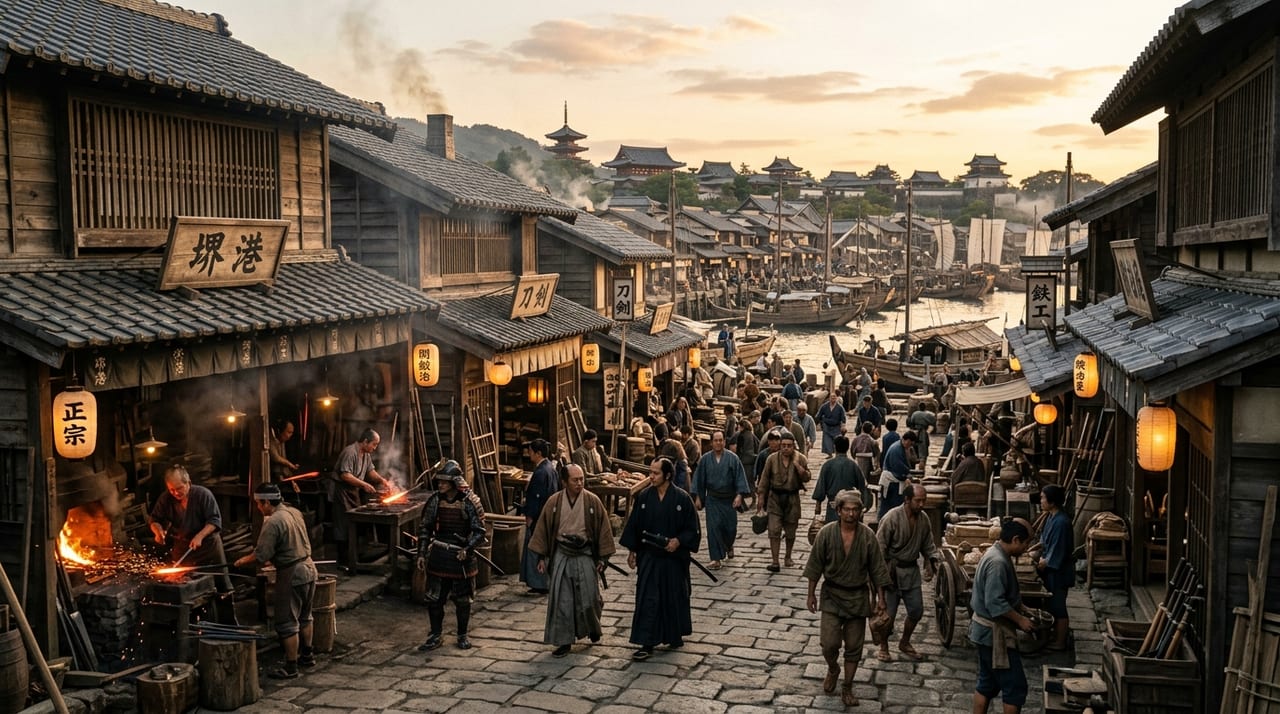
 * Image is for illustrative purposes only.
Sakai Merchants and the Sword Trade
堺の商人と刀剣流通
Sakai, medieval Japan's greatest autonomous city, served as a hub of the sword trade, building distribution networks from production centers like Bizen and Mino to markets nationwide. After the arrival of firearms, sword merchants doubled as arms dealers, becoming central to the Sengoku economy.
Description
The Unique Character of Sakai
Located on the border of Settsu and Izumi provinces, Sakai grew into one of Japan's leading autonomous cities during the fifteenth and sixteenth centuries. Governed by wealthy merchant councils (egōshū) even under the overlordship of the Miyoshi, Oda, and Toyotomi clans, Sakai served as the gateway for trade with China, the Ryukyus, and Southeast Asia. It became the primary depot for military materiel—swords, firearms, gunpowder, saltpeter—cementing its role as the strategic logistics center for Sengoku warlords.
Sakai as the Hub of Sword Distribution
Blades produced in Bizen (Okayama), Mino (Gifu), and Yamato (Nara) entered Sakai's network of wholesalers and brokers and were distributed to daimyo, samurai, and merchants across Japan. The city also concentrated specialist craftsmen for appraisal, repair, and koshirae production, functioning as a comprehensive sword-industry center rather than merely a marketplace. Swords for export were also shipped from Sakai to China through the Japan–Ming trade (tribute-mission ships) and other routes.
Firearms and the Transformation of the Arms Merchant
After the introduction of firearms at Tanegashima in 1543, Sakai smiths and merchants rapidly mastered and mass-produced the matchlock arquebus. Many sword merchants became dual-trade arms dealers, supplying daimyo with the full range of weapons—swords, spears, firearms, bows, armor. This shift further amplified Sakai's economic and political leverage, one factor behind Nobunaga's imposition of a war levy (yasen) of 20,000 kan on Sakai in 1568 (Eiroku 11).
Tea Culture and the Merchants of Sakai
Sakai was a center of the tea ceremony, where Takeno Jōō, Sen no Rikyū, and Imai Sōkyū were active. Jōō is said to have been a dealer in arms or leather, and Sōkyū made his fortune selling deerskin and other leather goods used in making armor.
The Sengoku Sword Market
Post-Ōnin warfare caused explosive demand for blades, splitting the market between mass-produced battlefield swords (kazuuchi-mono) and expensive named masterpieces (meibutsu and custom commissions). Sakai brokered both, forming a layered market that handled cheap combat swords and precious named blades simultaneously.
Legacy
Absorbed into the Osaka economic sphere, Sakai's metalworking and sword-craft expertise persisted into modern times, ultimately underpinning today's Sakai kitchen-knife industry (Sakai Uchihamono).
Characteristics of This Era
- Layered market structure: Sakai simultaneously handled mass-produced battlefield swords and bespoke masterpiece commissions, accommodating the full price and quality spectrum within a single distribution network.
- Professionalization of appraisal and brokerage: Specialized functions of authentication, pricing, and intermediation developed in Sakai.
- Integration with overseas trade: Export demand for blades influenced domestic production; suppliers in Bizen and Mino developed specialized capacity for swords made to foreign specifications and tastes.
- Combined firearms-and-swords business: After arquebus adoption, sword merchants evolved into comprehensive arms dealers handling guns, powder, and shot alongside blades, with smithing technology flowing between sword and gun craftsmen.
- Commercialization of koshirae production: Craftsmen specializing in saya, tsuka, tsuba, and menuki clustered in Sakai alongside blade traders, enabling commercial production of custom fittings to individual daimyo taste.