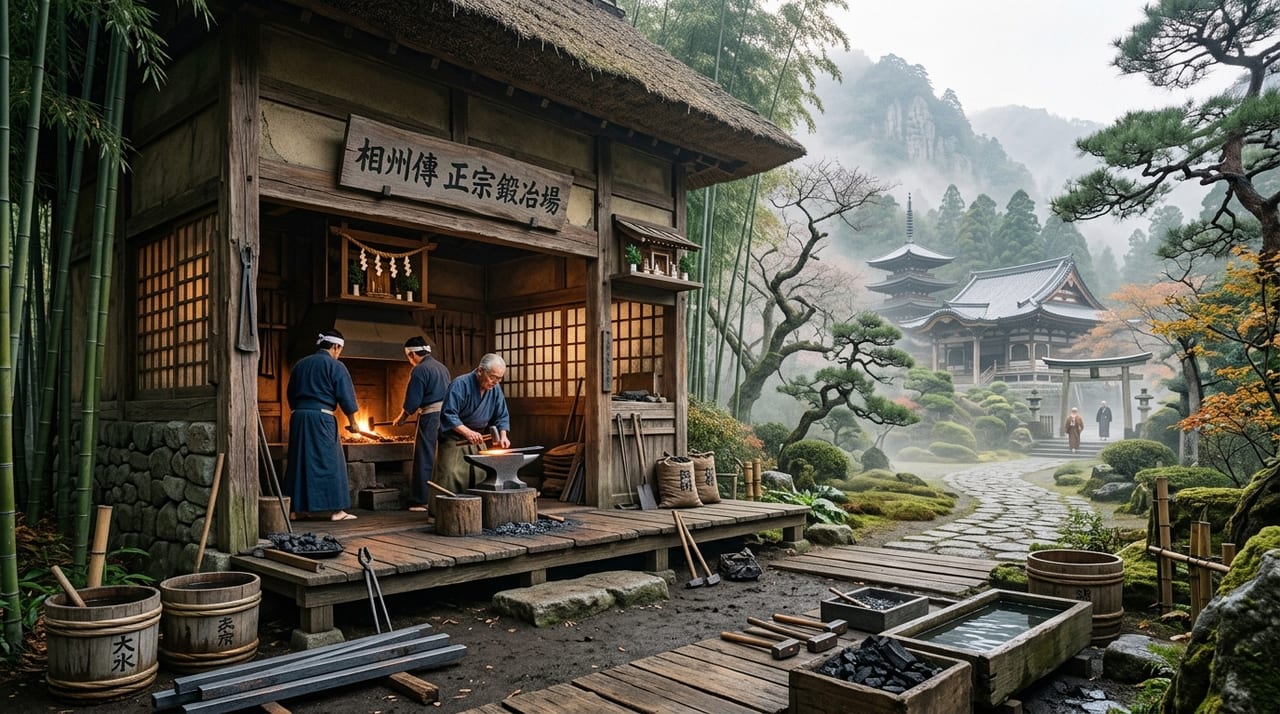
 * Image is for illustrative purposes only.
The Sōshū-den Inheritance and Development—Technical Transmission Beyond the Five Schools
相州伝の継承と展開——五伝を超えた技術の伝播
Exploring how the Sōshū-den (sword-making technique centered in Kamakura and Sagami) spread to sword-making communities throughout Japan from the Nanboku-chō period onward, achieving unique regional transformation in each locality. The dynamics of technical transmission transcending the Five Schools framework, and the diverse sword culture generated by regional Sōshū-style swordsmiths.
Description
Sōshūden is a system of Japanese sword-making techniques that took shape from the height of the Kamakura shogunate through the Nanboku-chō period, centered on Sagami Province in what is now Kamakura, Kanagawa Prefecture. It is one of the “Five Traditions” (goden) established by brilliant swordsmiths such as Masamune, Yukimitsu, and Sadamune. Although it is one of the Five Great Traditions alongside Yamato, Yamashiro, Bizen, and Mino, Sōshūden has an influence pattern different from the other four traditions. Whereas Yamashiro, Bizen, Yamato, and Mino formed their own groups as regional production centers, Sōshūden is characterized as a “tradition whose techniques spread nationwide through people.”
Masamune’s disciples, the so-called “Ten Great Disciples of Masamune” (Masamune Juttetsu), scattered from Sagami to various regions and carried Sōshūden techniques back across Japan. As a result, during the Nanboku-chō to Muromachi periods, swordsmiths nationwide were exposed to the innovative techniques of Sōshūden, namely vigorous midare-hamon, rich nie and nioi, and a varied range of hachū no hataraki (kinsuji, sunagashi, inazuma, and others). Each of them interpreted these techniques independently according to local material conditions, aesthetic sensibilities, and the demands of the samurai. This process of “transmission and transformation” is one of the fundamental driving forces that produced the diversity of Japan’s regional sword culture.
The legendary lineage of the Ten Great Disciples of Masamune is as follows (various theories exist): Gō Yoshihiro (Etchū), Hasebe Kunishige (Yamashiro), Kaneshige (Echizen → Mino), Kaneuji (Mino), and Samonji (Chikuzen), among others. Starting from the techniques these smiths brought back from Sagami, each one flowered in a completely different style in their own region. Gō Yoshihiro (Etchū) expressed bold, grand midare-hamon and complex jigane activity using Etchū materials, while Samonji (Chikuzen) forged bright, clear swords with mainly notare and well-developed nie.
Technically, the “dissemination” of Sōshūden has the following characteristics. First, the hamon-making technique based on the nie and nioi of Sōshūden (precise control through quenching temperature and the thickness of the habuto clay coating) enabled a diversity of expression that other traditions did not possess. Second, the “hachū no hataraki” (kinsuji, sunagashi, inazuma, ashi, yō, and others) are features prominently seen in Sōshūden works. Third, Sōshūden’s “integrated expression of jigane and hamon,” a resonance of iron particles in which the ground and the edge echo each other, was accepted in each production region as a new aesthetic ideal.
The dissemination of Sōshūden continued into the Edo period and beyond. In the shintō period (early Edo), Horikawa Kunihiro, Echizen Yasutsugu, and others reinterpreted Sōshūden techniques in line with Edo aesthetic sensibilities. In the shinshintō period (late Edo), Suishinshi Masahide advocated the fukko shintō theory that Japanese swords should return to the old works of the Kamakura and Nanboku-chō periods, and together with his pupil Taikei Naotane and others worked to reproduce the styles of the old swords (kotō). Even today, “Sōshūden utsushi” (works that imitate and study the Sōshūden style) remains one of the important creative themes for contemporary swordsmiths.
Characteristics of This Era
- Nationwide technical dissemination by the Ten Great Disciples of Masamune — disciples who scattered from Sagami to various regions transformed regional sword culture
- Spread of “hachū no hataraki” across the country — activity within the blade such as kinsuji, sunagashi, and inazuma, prominently seen in Sōshūden works
- Diversity of regional transformation — completely different styles produced by disciples in various regions, such as Gō Yoshihiro (Etchū) and Samonji (Chikuzen)
- Revival of Sōshūden in the shintō and shinshintō periods — continuous admiration for and practice of “Sōshū-teki na bi” (Sōshū-style beauty) throughout the Edo period
- Contemporary Sōshūden utsushi — the most demanding creative theme that Living National Treasures and contemporary swordsmiths continue to pursue today