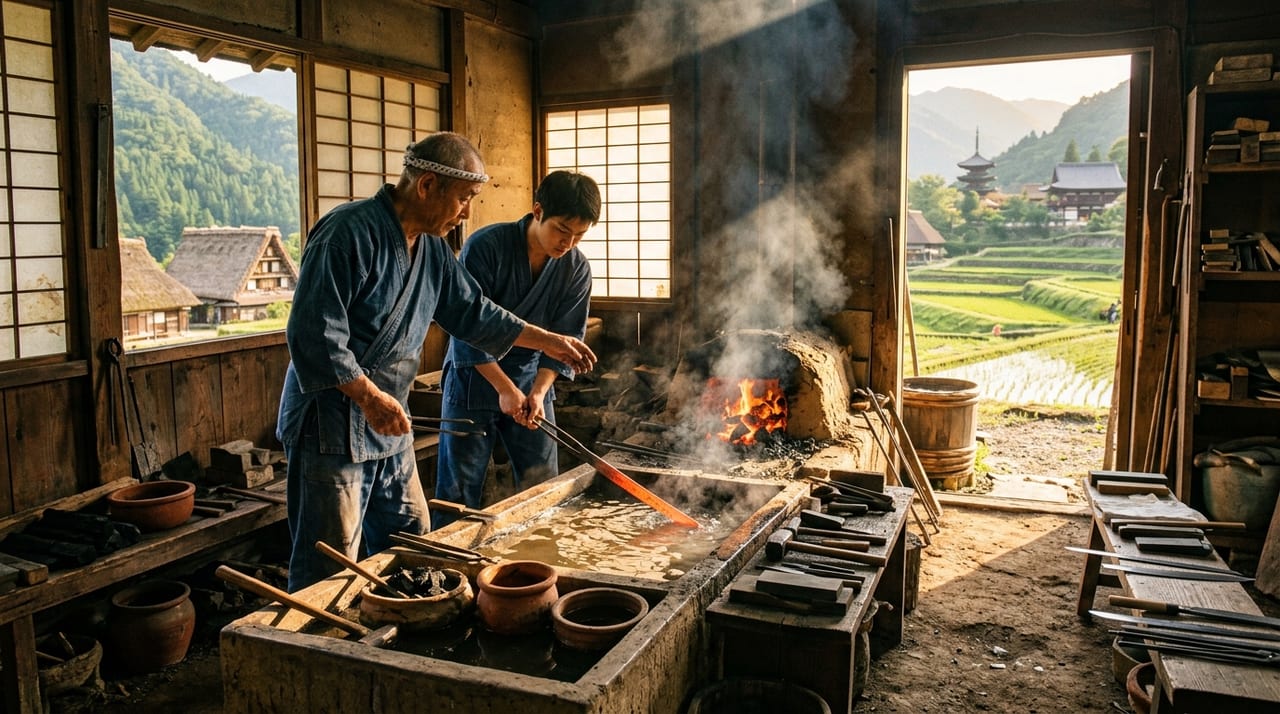
 * Image is for illustrative purposes only.
Schools, Transmission, and Lineages in Japanese Swordsmithing
刀工流派の伝授と系譜
Japanese swordsmithing technique has been transmitted across a thousand years primarily through the ryūha (school lineage) system—an interlocking network of master-disciple relationships organized around regional traditions, family successions, and closely guarded oral and hands-on secret transmissions (hiden). This system simultaneously created the rich regional and stylistic diversity of Japanese sword traditions and maintained their historical continuity.
Description
Structure of Schools
The ryūha (school) structure of Japanese swords consists of three broad layers. The first is den (tradition): the Goka-den (Five Traditions of Yamashiro, Yamato, Bizen, Sōshū, and Mino), a regional and technical broad classification. It is the most fundamental framework, defining the characteristics of each tradition's methods (the styles of jigane, hamon, and tsukurikomi). The second is ha (lineage): the concrete schools within each tradition, such as the Osafune-ha, Katayama Ichimonji-ha, and Unshō-ha within the Bizen-den. These refer to the technical features shared by a specific founding smith and his line. The third is the individual mei (signature), the maker's name used by each smith. It includes the concept of dai (generation), in which the same signature is carried by multiple generations (for example, Masamune's ichidai, the single generation).
Transmission of Secret Techniques
The core techniques of each school were transmitted from master to disciple directly, orally, and through hands-on practice, as hiden (secret traditions). The content of hiden centers on tacit knowledge that is difficult to fully record in writing, such as quenching temperature, the composition of the quenching clay (tsuchioki), the number and method of forging (tanren), the selection of raw materials, and the criteria for judging fire control. In particular, yakiire (quenching) is the most important and dangerous process in sword-making. Subtle conditions such as heating temperature, water temperature, withdrawal speed, and angle determine how the hamon forms, so it can only be mastered by watching the master's demonstration and experiencing it oneself. The transmission of such tacit knowledge explains why, even when using the same satetsu (iron sand) and charcoal and following the same steps, the works of master and disciple show clear differences. For a disciple to internalize the kankakuchi (sensory knowledge) held by a superior master, several to more than ten years of training were considered necessary.
Family Transmission and Adoptive Succession
School succession may occur either through biological children (blood-related heirs) or through yōshi keishō (adoptive succession), in which a talented disciple inherits the master's name (myōgō) and techniques. In the world of Japanese swords, adoptive succession based on merit was widely accepted. For example, famous signatures such as Kotetsu and Kanemoto have been carried on by successors. As a result, distinguishing the "genuine first generation" from "successors of later generations" has become an important challenge in authentication.
Genealogical Characteristics of Each Tradition
Each of the Goka-den has its own genealogical patterns of transmission. Yamashiro-den is characterized by refined transmission tied to the culture of the court nobility (kuge) in Kyoto. Its major schools, Sanjō, Gojō, Awataguchi, and Rai, remain connected by fine threads across the ages. Yamato-den was sustained by the special institutional environment of Nara's temples and shrines (jisha). The five schools of Taima, Senjuin, Shikkake, Tegai, and Hōshō continued relatively independently. Bizen-den had a genealogy in which numerous swordsmith families intermingled in a complex manner under a mass-production system, and many schools coexisted, including Osafune, Fukuoka Ichimonji, Hatakeda, and Katayama Ichimonji. Sōshū-den's Masamune style influenced the whole country. Through smiths from various regions, later called the Masamune Juttetsu (the 'Ten Sages' of Masamune), who were not necessarily Masamune's direct disciples, it transformed sword techniques throughout Japan. Mino-den schools that emphasized practicality, such as Kaneshige, Kaneuji, and Kanemoto, spread nationwide through migration to the eastern provinces (Tōgoku) and supported the mass demand of the Sengoku period.
Transmission Challenges in the Present Day
In modern Japan, learning sword-forging requires first apprenticing to a master and completing at least five years of training before becoming independent. Beyond that, one must complete the Bijutsu Tōken Tōshō Gijutsu Hozon Kenshūkai (training course for the preservation of art-sword smithing techniques) organized by the Agency for Cultural Affairs (Bunkachō). The number of swordsmiths fell from about 300 in 1989 to 188 in 2017. Six individuals have been designated as Ningen Kokuhō (Living National Treasures) in the past, and there have been no living holders since 2013. Their master-disciple relationships form the "genealogical authority" of modern swords. The traditional oral form of hiden transmission is still basically maintained today. The form of direct training in a master's workshop has continued unchanged for more than a thousand years. This chain of "direct transmission" is the very essence of the technical continuity of Japanese swords and the significance of the ryūha system in the present day.
Characteristics of This Era
- Three-tier school structure (den, ha, mei): The system of three levels, from the Gokaden traditions to individual schools to individual signatures, made both regional consistency and individual distinctiveness possible. It is the organizational basis for both the diversity and the unity of Japanese swords.
- Secret oral transmission and hands-on instruction: Core techniques such as hardening and forging were passed directly from master to disciple as tacit knowledge. Transmitting sensory knowledge that cannot be written down is the essence of school succession.
- Coexistence of blood-line and adoptive succession: Hereditary succession by biological children and meritocratic adoptive succession coexist. The "○○-generation" system is a flexible arrangement that separates technique and authority and then reintegrates them.
- Nationwide spread of the Sōshū tradition through the Masamune Juttetsu: Masamune's style influenced smiths in various regions who were later called the Masamune Juttetsu (the 'Ten Sages' of Masamune), though they were not necessarily direct disciples. This is an example of a school spreading and transforming sword-making techniques across the country, and it demonstrates the function of the master-disciple system in spreading technical innovation.
- Living succession into the present: The number of smiths fell to 188 in 2017, but the form of direct transmission, in which trainees study under a master for five years or more, continues. This is evidence that the school system still functions effectively today.