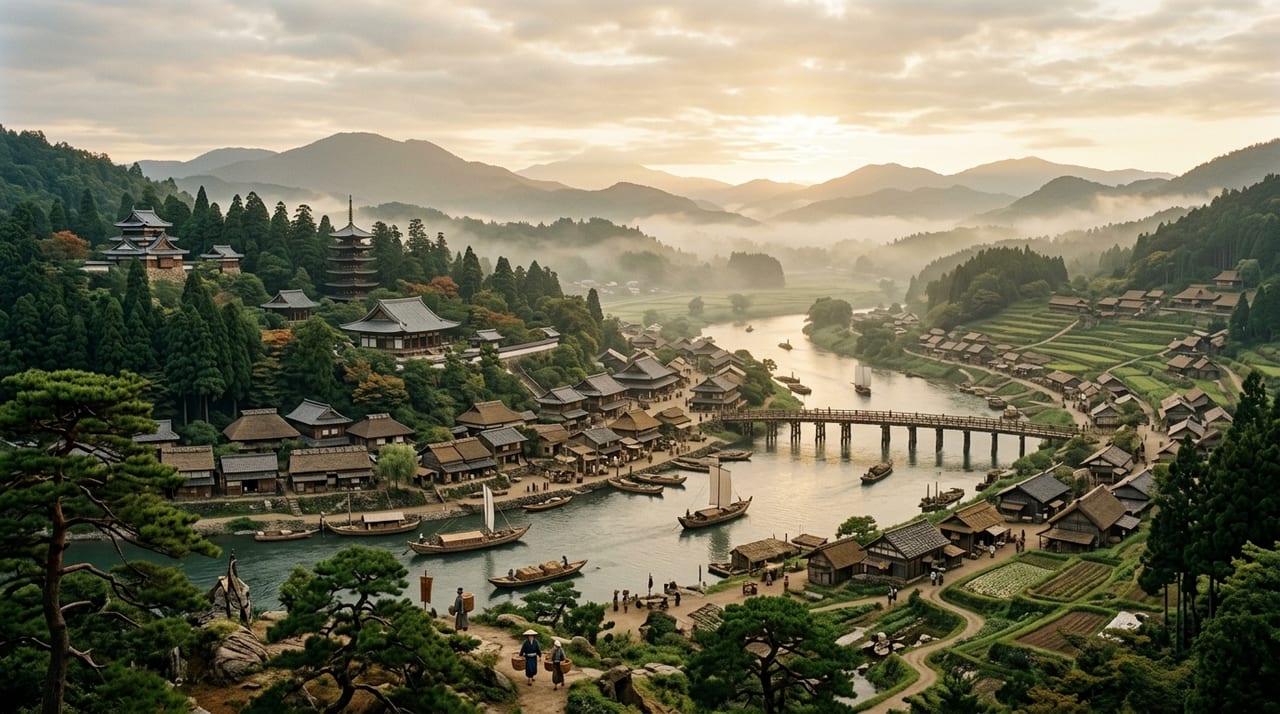
 * Image is for illustrative purposes only.
Settsu Tradition
摂津伝
The swordsmithing tradition of Settsu Province (present-day northern Osaka and southeastern Hyogo) during the koto period. Absorbing techniques from Yamato and Yamashiro while drawing on Naniwa's role as the Kinai's foremost commercial hub, Settsu smiths forged a distinctive regional identity that predates and exists apart from the celebrated Osaka Shinto tradition of the early Edo period.
Description
Settsu Province (present-day northern Osaka Prefecture and southeastern Hyogo Prefecture) had since antiquity been the Kinai region's greatest hub of traffic and commerce, with Naniwa Port at its heart. The intersection of the western terminus of the Seto Inland Sea with the transportation network of the Yodo River system connecting Ōmi and Yamashiro created ideal conditions for the wide circulation of iron materials, smithing craftsmen, and finished blades. Settsu's sword culture took root in the late Heian period against this geopolitical advantage and established its own distinctive style through the Kamakura and Muromachi periods.
The origins of Settsu-den lie in close technical exchange with Yamato-den and Yamashiro-den. Settsu and Yamato were neighboring provinces separated by the Nara Mountains from antiquity, and the practice of smiths from the Yamato Five Schools (Senjuin, Taima, Tegai, Shikikake, Hōshō) relocating to or seasonally working in Settsu is evident from early records. Records also document that groups of Yamashiro smiths advanced into Settsu via the Yodo River. The Settsu smiths were thus positioned to absorb both Yamato's austere, solemn straight-temper aesthetic and Yamashiro's graceful, elegant billowing-temper technique. This technical eclecticism itself is the defining characteristic of Settsu-den, bringing about a plurality that contrasts with production centers of the same period, such as Bizen and Sagami, which converged on unified styles.
Among the ancient smiths representing Settsu, Nakajima Ki (also known as Ki Kundinaga, read Rai Kundinaga) is well known—a smith from the Yamashiro-Ki lineage who relocated to Nakajima in Settsu Province. Nakajima Ki transmitted the refined fine-grain itame jihada of the Yamashiro-Ki school, combined with a nie-enriched straight temper and small irregular temper, to the land of Settsu, bringing Yamashiro-den refinement to Settsu blades. The Settsu smiths generally did not coalesce into a single dominant lineage but maintained a pluralistic production-center structure in which multiple lineages existed in parallel.
The turmoil of the Nanbokuchō period (1336–1392) brought dramatic stimulus to Settsu's sword industry. When Kusunoki Masashige raised the Southern Court's banner with Kawachi and Settsu as his base, Settsu became a direct theater of war, and blade demand surged. During this period, Settsu smiths received commissions from both Southern and Northern Court warriors, and both production scale and technical level advanced markedly. The extant Nanbokuchō-period Settsu works demonstrate magnificent, expansive construction of the ōkissaki matching the highest domestic standards of the time, bearing the influence of the bold irregular-temper of Sagami-den while retaining Settsu's own dignity.
In the late Muromachi period, the Ōnin War (1467–1477) and the turmoil that followed inflicted great damage upon Settsu. Many smiths departed Settsu and relocated to neighboring Izumi, Kawachi, and Yamashiro, and the organized production-center structure of Settsu-den gradually dissolved. In the late Sengoku period, Settsu came under the rule of Oda Nobunaga and Toyotomi Hideyoshi, and the center of sword production shifted to the commercial city of Osaka. This transition provided the foundation for the emergence of a distinct tradition known as "Osaka Shintō" in the early Edo period, though that was not a direct successor to Settsu-den but rather a new production center formed by the concentration of smiths from across Japan in Osaka. Settsu-den is properly evaluated as a regional tradition unique to the Kotō period.
Characteristics of This Era
- Eclectic multi-tradition style fusing Yamato and Yamashiro techniques — stylistic diversity rather than convergence on a single school
- Naniwa commercial base — the Kinai's foremost port enabling wide-ranging iron sourcing and product distribution
- Itame jihada with notare and gunome hamon — the defining style of the Hiromitsu lineage
- Bold ōkissaki construction in the Nanbokuchō period — ambitious large-format blades under Sagami-tradition influence
- Distinct from Osaka Shinto (early Edo) — Settsu-den evaluated as an independent koto-period regional tradition