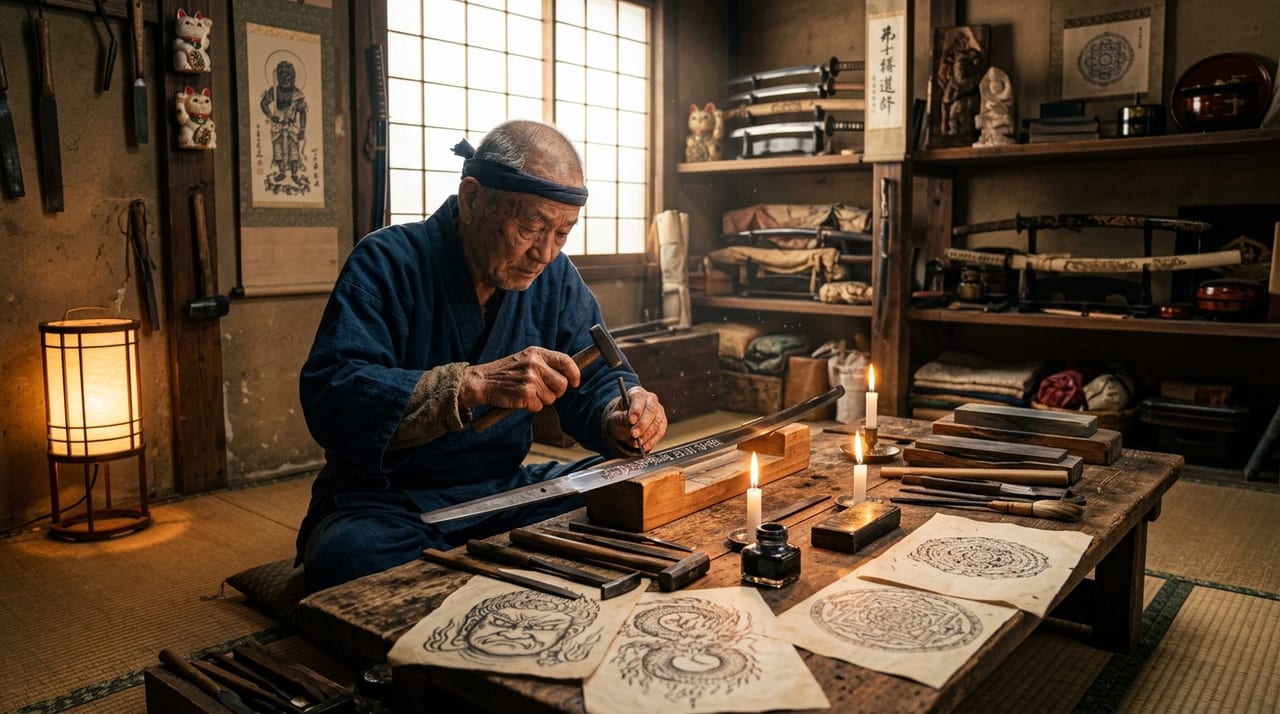
 * Image is for illustrative purposes only.
Horimono — The Tradition and Design of Blade Engraving
彫物(ほりもの)の伝統と意匠
Horimono refers to the decorative and religious engravings applied to a sword blade. Originating from religious demand in the late Heian period, this tradition evolved alongside samurai culture into a rich vocabulary of designs — from standardized motifs such as Sanskrit letters, grooves, plain swords, Fudō Myōō, and Kurikara dragons, to individualized compositions. Horimono enhances both the spiritual and artistic value of a blade and continues to be practiced today.
Description
Origins and Religious Background of Horimono
The history of horimono (blade engravings) is deeply intertwined with the establishment of the Japanese sword itself. The earliest horimono emerged from purely religious purposes. From the late Heian period (12th century) through the Kamakura period, as veneration of swords intensified, the practice of engraving Sanskrit letters (bonji) and symbols representing Buddhist deities onto blades became widespread. In particular, Fudō Myōō was venerated as a guardian deity of warriors, and images of the Kurikara dragon, which served as its symbol, came to be engraved on blades.
The engraving of Sanskrit letters is rooted in the belief that such inscriptions amplify the spiritual power residing within the blade and protect its bearer. Sanskrit characters representing specific Buddhas—such as "A" (Taizōkai Dainichi Nyorai), "Bān" (Kongōkai Dainichi Nyorai), and "Kan" (Fudō Myōō)—were selected and engraved at specific positions on the blade, most often on the mune (spine) side near the tang. Among swordsmiths, some commissioned specialist engravers (horishi), while others performed the engraving themselves.
System of Major Horimono Motifs
Horimono on Japanese swords can be broadly classified into the following categories.
Hi (groove): Longitudinal grooves cut vertically on both sides of the blade. They serve both decorative purposes and functional roles in lightening the blade and adjusting structural integrity. Variants include maru-hi (round groove), kaku-hi (square groove), futatsu-hi (double groove), and bō-hi (rod groove). Standardized from the late Heian through the Kamakura period, these remain among the most common horimono on modern swords.
Suken (plain sword): Engravings of sword forms on the blade. These designs may consist of a single sword or multiple swords arranged together, combining martial symbolism with Buddhist significance (warding off evil). They became widespread from the late Kamakura period onward and appear frequently on votive swords and great swords presented to shrines.
Kurikara (dragon on sword): An image of a dragon (Kurikara Ryūō) coiled around a sword. It is the symbol of Fudō Myōō and is regarded as one of the most prestigious horimono motifs on Japanese swords. The visual vocabulary was perfected from the Kamakura through Nanbokuchō periods, and the engraver's skill is vividly revealed in the detailed depiction of the dragon's scales, flames, and clouds.
Fudō Myōō: A standing figure of the guardian deity in fierce aspect with a flaming halo. Often engraved alone or paired with the Kurikara dragon, it was favored by warriors who sought victory and protection.
Bonji (Sanskrit letters): As noted above, Sanskrit characters representing specific Buddhas or bodhisattvas. They may appear alone or in combination with suken or Kurikara imagery.
Floral and animal motifs: Japanese traditional auspicious designs such as pine, bamboo, plum, crane, dragon, tiger, and peony became widely employed from the Edo period onward. Custom designs tailored to clan crests or personal preferences became common, marking an era in which the decorative dimension of horimono came to the fore.
Lineages and Schools of Horishi
The horishi (engraving specialist) emerged as an independent profession from the late Kamakura period onward. Among the most notable schools was the Umetada family of Kyoto. Umetada Myōju was an acclaimed craftsman who flourished from the late Momoyama through early Edo period (late 16th–early 17th century), and excelled not only in the production of sword fittings (tsuba, menuki, kōgai) but also in horimono. His work exerted considerable influence on subsequent Edo-period horishi.
During the Edo period, artistic and craft values came to take precedence over the sword's practical utility, and horimono evolved toward greater refinement and complexity. Schools of horishi formed, centered in Osaka and Edo, producing diverse works tailored to the preferences of patrons—warriors, daimyo, and wealthy merchants.
Horimono in Modern Sword Appreciation
In contemporary sword connoisseurship, horimono is regarded as one of the principal points of appreciation alongside jihada (steel grain) and hamon (temper line). In evaluations by the NBTHK (Japanese Art Sword Preservation Society), the quality, preservation, and aesthetic distinction of horimono are included in the assessment criteria.
The fundamentals of horimono appreciation involve observing three aspects: the choice of subject (what is depicted), the precision of technique (the depth and clarity of the carving), and the effects of aging (the character imparted by rust and wear). Older horimono shows greater wear, yet this is sometimes regarded as lending historical gravitas.
Horimono is typically executed by a specialist engraver distinct from the swordsmith. However, certain smiths are known for performing their own horimono, and such work is particularly prized. Even in modern swords, horimono remains a significant expression of the maker's individual artistry.
Characteristics of This Era
- The earliest layer of horimono arose from religious demand in the late Heian–Kamakura period (Sanskrit letters, Kurikara dragons, Fudō Myōō imagery), inextricably linked to samurai beliefs in divine protection
- Hi (grooves) are the most widely employed horimono, balancing practicality with decoration; various theories cite blade lightening, structural reinforcement, or blood channeling as functions, and they remain a standard feature of modern swords
- The Kurikara dragon is regarded as the pinnacle motif of Japanese sword engraving; the complete formal vocabulary was established in the late Kamakura–Nanbokuchō periods, with the engraver's mastery concentrated in the depiction of flames, scales, and clouds
- Umetada Myōju (Momoyama–early Edo) was a master who worked across both horimono and sword fittings, laying the foundation of Edo-period horishi culture; many surviving works are designated Important Cultural Properties
- From the Edo period onward, custom compositions reflecting patrons' identities, clan crests, and personal tastes proliferated, and horimono designs diversified and grew more intricate as a form of spiritual and personal ornamentation for warriors
- NBTHK evaluations include the quality and preservation of horimono; age-related wear and rust are not necessarily negative, and may be appreciated as the patina of antiquity lending historical gravitas to an old work