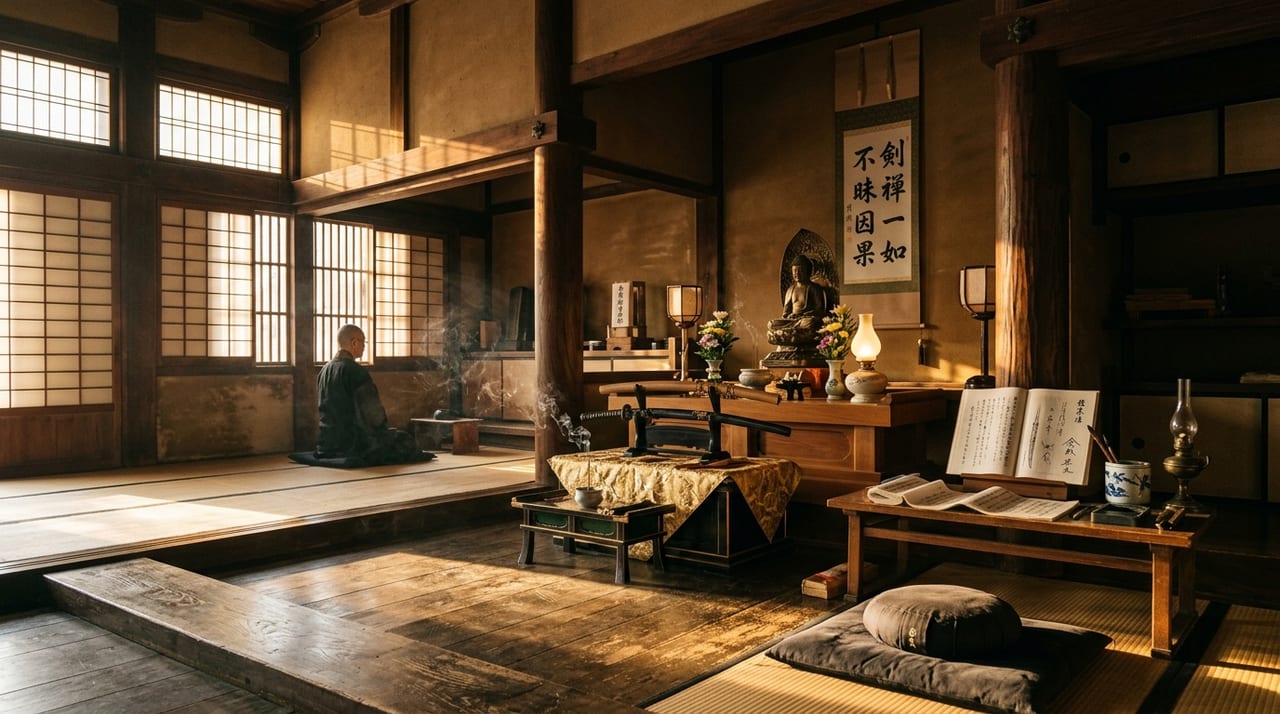
 * Image is for illustrative purposes only.
Swords and Zen Buddhism—The Spiritual Foundations of the Samurai and the Philosophical Basis of the Way of the Blade
刀剣と禅宗——武士の精神と刀道の哲学的基盤
Tracing how Zen thought, transmitted from the 12th-13th centuries onward, permeated samurai conceptions of swords, martial philosophy, and the creative spirit of sword smiths. The doctrine of 'sword and Zen as one' and the dialogue between Takuan Soho and Yagyu Munenori.
Description
Zen Buddhism was formally transmitted from China to Japan in the 12th–13th centuries, and through its deep integration with the samurai warrior-class government of the Kamakura shogunate, exerted incalculable influence on Japanese culture. The practice of Zen—the emphasis on direct experience through zazen (seated meditation), the pursuit of enlightenment through personal dialogue with the master (koan), and complete concentration on "this moment"—brought fundamental transformation to the samurai understanding of swords and martial philosophy.
During the Kamakura period, samurai began practicing zazen at Zen temples, linking their meditation experience directly to the handling of the blade. Mushin (no-mind)—a state of mind unencumbered by calculation, responding freely to all phenomena—became a Zen concept embraced by samurai as the ultimate principle of swordsmanship. To think at the moment when blades meet is to invite death. The swordsman sought to wield the blade from a realm transcending thought—what Zen calls munen-musō (no-thought, no-image)—which would form the foundation of later martial theory.
In the early Edo period, this philosophy crystallized into the concept of ken-zen-ichinyō (sword and Zen as one). This was the doctrine that Zen and the sword are fundamentally the same path, and that the perfection of swordsmanship is identical to the realization of Zen enlightenment. The most refined expression of this doctrine appeared in the exchange between Takuan Soho (1573–1646), a high-ranking Rinzai Zen master, and Yagyu Munenori (1571–1646). The Rinzai Zen master Takuan sent Munenori two works—the Fudō-chi Shinmyōroku (Record of the Immovable Wisdom) and the Taiaki (Record of the Great Sword)—expounding that the Zen principle of fudō-chi (immovable wisdom)—unwavering wisdom—was the ultimate secret of swordsmanship. These works became the philosophical foundation for Munenori's own treatise, the Heihō Kadensho (The Secret Book of Martial Transmission), and rank among the most important texts in the history of Japanese martial philosophy.
The influence of Zen on the spirituality of sword smiths cannot be overlooked. From the early modern period onward, master smiths increasingly positioned their craft as shugyo (ascetic practice), treating the forging of a single blade as equivalent to a spiritual discipline—zazen, sutra recitation, or koan study. The state of spiritual concentration achieved by the smith facing the forge was described as identical to the samadhi (deep meditative absorption) of Zen practice. This philosophy of "making is practice" continues to breathe in the words used by many contemporary sword smiths, including Living National Treasures, to explain their work.
Characteristics of This Era
- Mushin (no-mind) and swordsmanship—how Zen's emphasis on direct experience transformed the very foundation of martial philosophy
- Ken-zen-ichinyō as philosophical crystallization—the dialogue between Takuan Soho and Yagyu Munenori that forged a unique Japanese sword philosophy
- Making as practice—the early modern craftsman's vision of sword forging as equivalent to Zen samadhi
- Fudō-chi Shinmyōroku and Heihō Kadensho—uniquely world-historical texts that developed the ken-zen-ichinyō doctrine