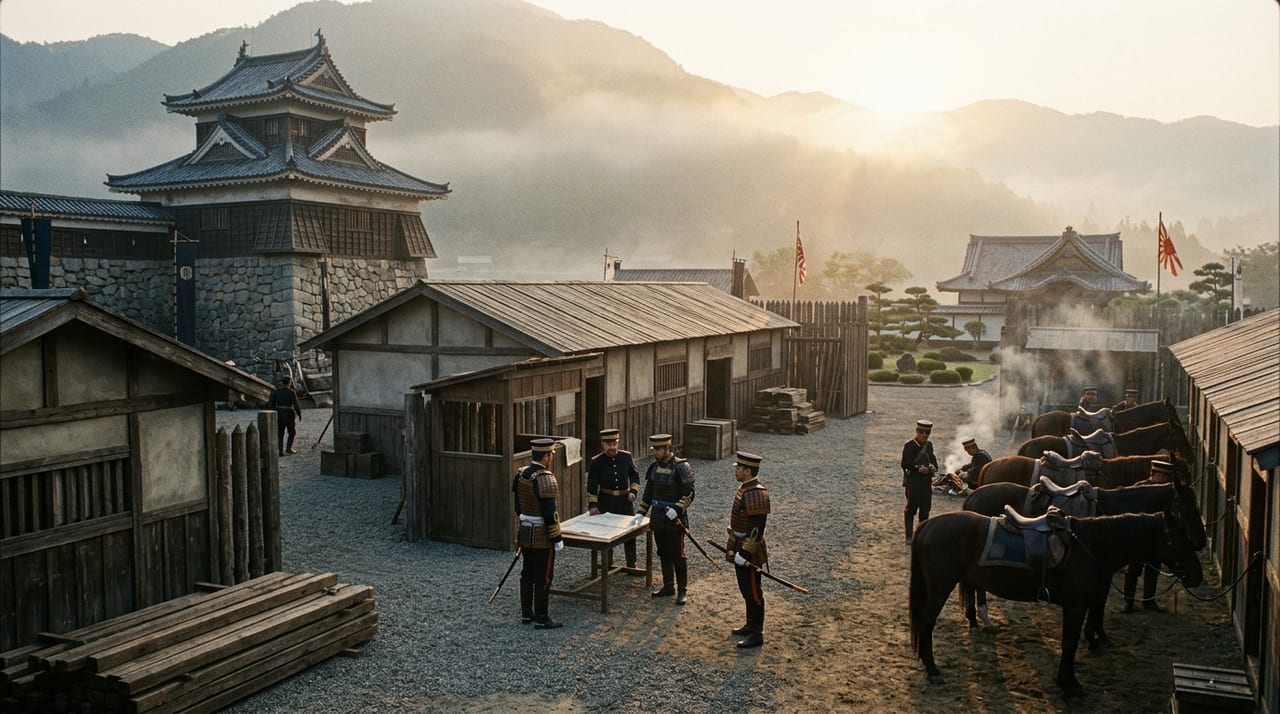
 * Image is for illustrative purposes only.
Sino-Japanese and Russo-Japanese War Era
日清日露戦争期
The Sino-Japanese War (1894–1895) and the Russo-Japanese War (1904–1905) were epoch-making wars in which Japan emerged on the international stage as a modern great power. After the Haitōrei (sword-abolition edict), military swords came to be widely made by fitting a nihontō blade into saber-style mountings. A movement for the 'revival of nihontō' rose, but the period also contained the contradiction of mass-producing military swords with modern industry.
Description
Military Swords After the Haitōrei
Following the Haitōrei (sword-abolition edict) of Meiji 9 (1876), which banned the general wearing of swords, the swords worn by military personnel had become mainly Western-style sabers. The adoption of the saber (Western-style guntō) as the official military equipment was met with strong opposition from sword enthusiasts and those of samurai origin, who saw it as a rejection of the nihontō tradition. However, the experience in the Satsuma Rebellion (Seinan War) (1877), where government bayonet troops were forced into an inferior position against nihontō in close combat with Satsuma shizoku, reaffirmed the practical superiority of the nihontō. Based on this experience, calls within the army for a return to 'nihontō-style guntō' grew stronger.
Establishment of the Meiji 19 Standard Military Sword
The 'Meiji 19 Standard Military Sword', established in Meiji 19 (1886), was an eclectic style that housed a nihontō blade in Western-style mountings (metal scabbard and metal handle). It was an attempt to reconcile the practical function of nihontō cutting performance with the consistency of Western-style military dress, and it became the prototype for later standard military swords. At the time of the Sino-Japanese War (1894–1895), army officers carried standard military swords and confirmed their effectiveness in actual combat. The navy adopted its own naval sword format, so different types of military swords coexisted in the army and navy.
The Sino-Japanese War and the Reappraisal of Nihontō
The overwhelming Japanese victory in the Sino-Japanese War brought national enthusiasm and a boost to national prestige. Together with a militaristic atmosphere, it heightened interest in nihontō. Among officers, demand grew for the traditional nihontō style over the earlier saber-type guntō, and an increasing number of officers privately ordered guntō using nihontō blades. Swordsmiths of this era faced the challenge of combining modern steel-making technology with traditional tamahagane forging, and they continued to search between tradition and modernity. Master smiths, led by Gassan Sadakazu, met the demand for military swords while preserving traditional techniques.
The Russo-Japanese War and Cavalry Swords
The Russo-Japanese War (1904–1905) included large-scale battles on the vast plains of Manchuria, and in cavalry charges the practical value of military swords was put to the test. Nihontō-style guntō are said to have been effective in Japanese cavalry close combat against Cossack cavalry and in close fighting during the siege of Port Arthur (Ryojun). Japan's victory in this war, a historic event in which an Asian nation defeated a European great power for the first time in the world, brought about a reappraisal of Japanese culture as a whole. Nihontō attracted international attention as a symbol of that culture. In Meiji 32 (1899), the purely Western-style Type 32 military sword was established as a government-issued sword for non-commissioned officers and enlisted men. Later, in the Shōwa period, a tachi-type guntō (Type 94) for officers and warrant officers and the Type 95 guntō for non-commissioned officers and enlisted men were established.
Industrial Production and the Divergence from Traditional Forging
The Sino-Japanese and Russo-Japanese War era was also a time when the major issue of industrializing military sword production came to the fore. Faced with the large demand for military swords that came with the expansion of the scale of war, hand-forging with traditional tamahagane was fundamentally insufficient in production capacity. The Type 32 military sword for non-commissioned officers and enlisted men was produced industrially at army arsenals and elsewhere. Industrial swords such as Murata-tō were also used in the Sino-Japanese and Russo-Japanese Wars, so traditionally forged swords and industrially produced swords came to stand side by side. This problem became even more serious in the wartime military swords of the Shōwa period (Shōwa-tō), but its beginnings were already visible in this era.
Overseas Appraisal of Nihontō
The Russo-Japanese War also gave Western powers an opportunity to widely recognize the existence of nihontō. Foreign observers and military attachés who accompanied the forces observed and recorded the military swords of Japanese army officers, and praise for their refinement and cutting ability was conveyed to their home countries. This international appraisal laid the groundwork for sword exports and for the interest of foreign collectors in the Taishō and Shōwa periods.
Characteristics of This Era
- Organization of the officers' and warrant officers' sword established in Meiji 19, and of the Type 32 military sword: the officers' sword was a blend of Japanese and Western styles, with a nihontō blade set into Western-style mountings, while the Type 32 for non-commissioned officers and enlisted men was a purely Western-style saber-type sword
- Coexistence of traditional tamahagane forging and Western-style special steel: wartime mass demand promoted industrial production, and the practice moved away from exclusive reliance on traditional techniques. This was the earliest stage in which differences in quality became evident
- Rise in individually commissioned swords by officers: orders placed with traditional swordsmiths increased amid the victory atmosphere of the Sino-Japanese and Russo-Japanese Wars, activating the work of Meiji-period swordsmiths
- Activity of Meiji master smiths such as Gassan Sadakazu: they responded to military sword demand while preserving traditional techniques, and high-quality works in the fukkotō style were favored by officers and patrons
- Rising international recognition: after the Russo-Japanese War, Western military attachés and observers reported the excellence of nihontō to their home countries, and this became an occasion for foreigners to collect and study nihontō