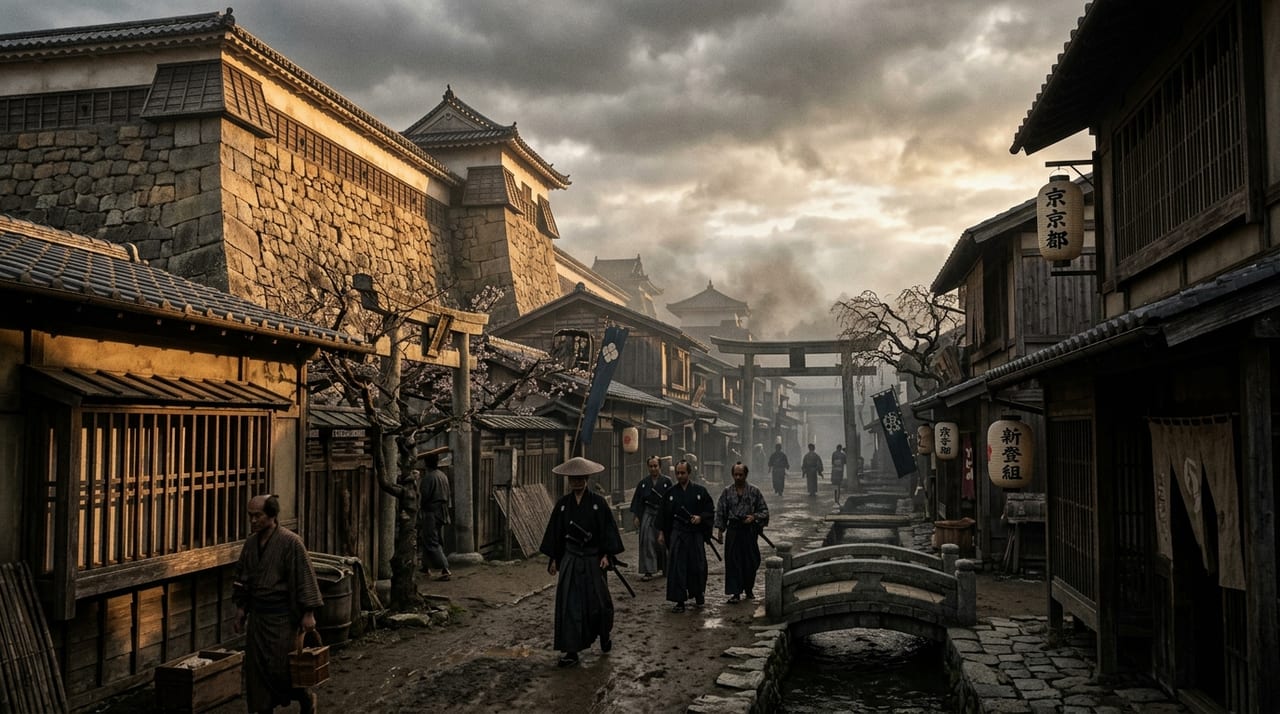
 * Image is for illustrative purposes only.
Bunkyū Era — Swords Between the Sakuradamon Incident and the Shinsengumi
文久(ぶんきゅう)
Sword culture of the Bunkyū era (1861–1864), from immediately after the Sakuradamon Incident (1860) through the founding of the Shinsengumi (1863). A sword history of the most turbulent stretch of the late Edo period, in which the Ansei Purge and the Sakuradamon Incident produced the armed radicalization of exclusionist activists and a surge in demand for swords, and in which the conflict between the Kōbu Gattai faction and the anti-shogunate faction complicated the social role of swords.
Description
The Bunkyū era (1861–1864) was one of the periods in which the political turmoil of the late Edo period escalated most rapidly. The Sakuradamon Incident of the 3rd month of Ansei 7 (1860), the assassination of Ii Naosuke by rōshi from Mito and others, struck activists across the country with a powerful impression: it showed that the Japanese sword had once again become a direct instrument of political violence. A grand councillor being cut down in broad daylight before the Sakuradamon gate of Edo Castle was an unprecedented event. It made the fragility of shogunal authority visible and spread among activists the radical conviction that history could be changed with a single sword.
The greatest characteristic of sword culture in the Bunkyū era was a sharp rise in demand for swords for political purposes. As the exclusion movement gained momentum, activists from domains such as Mito, Satsuma, Chōshū, and Tosa actively sought to procure swords for practical use. A series of incidents followed in which exclusionists who advocated maintaining the seclusion policy resorted to force: the Namamugi Incident of Bunkyū 2 (1862), in which Satsuma domain samurai killed and wounded British nationals, and the Jōi jikkō ('carrying out the expulsion of foreigners') of Bunkyū 3 (1863), in which the Chōshū domain fired on foreign ships. Under these circumstances, obtaining and selecting swords became an important aspect of activist activity.
The sword industry of the Bunkyū era was pressed to change dramatically in order to meet this special demand. In Edo's sword market, high-quality blades by famous shinshintō masters became objects of admiration among activists. In particular, the works of Minamoto Kiyomaro (who died in Kaei 7 (1855), though his works continued to circulate), along with those of Koyama Munetsugu and Kurihara Nobuhide, were prized. At the same time, demand for inexpensive practical swords also surged, creating a complex situation in which smiths in various regions accepted orders regardless of their political position.
In Bunkyū 2 (1862), Tokugawa Yoshinobu was appointed shōgun's guardian (shōgun kōken-shoku) and Matsudaira Katamori was appointed Kyoto shugoshoku (military governor of Kyoto). In Bunkyū 3 (1863), Emperor Kōmei issued an imperial edict on exclusion. These events moved the focus of Bakumatsu politics to Kyoto. In the 8th month of Bunkyū 3 (1863), the Coup of the 18th Day of the 8th Month took place, and the Chōshū domain was excluded from Kyoto. Amid this political turmoil, Kyoto remained in an abnormal state in which rōshi, activists, and shogunal forces all walked the city with drawn blades. The organization and start of activities of the Shinsengumi (Mibu rōshigumi) from Bunkyū 3 (1863) to Genji 1 (1864) was the shogunate's organized response to the escalation of this political close-quarters fighting.
The Bunkyū era was a transitional period in which the position of swords changed from 'a samurai's accomplishment' back to 'instruments of political assassination and the use of force'. The Bunkyū sword culture, in which the ideals of the shinshintō period (restoring the beauty and technique of the old swords) intersected with the Bakumatsu reality that swords were the front-line tools of political change, embodied the taut tension that preceded the final eruption of the Keiō period.
Characteristics of This Era
- Impact of the Sakuradamon Incident — the resurgence of the sword as a means of political assassination accelerated the armed radicalization of exclusionist activists
- Exclusion movement and surge in demand for practical swords — organized sword procurement by domain activists intersected with admiration for famous shinshintō blades
- Bunkyū turmoil and close-quarters fighting in Kyoto — an abnormal urban situation in which rōshi, activists, and shogunal forces all walked the city armed with swords
- Founding of the Shinsengumi (Mibu rōshigumi) — the late Bunkyū-era organization formed as the shogunate's organized response to close-quarters fighting
- Clash between the shinshintō ideal and Bakumatsu reality — an era in which the aesthetics of restoring the old swords and the reality of swords as tools of political assassination were imposed on the same blades