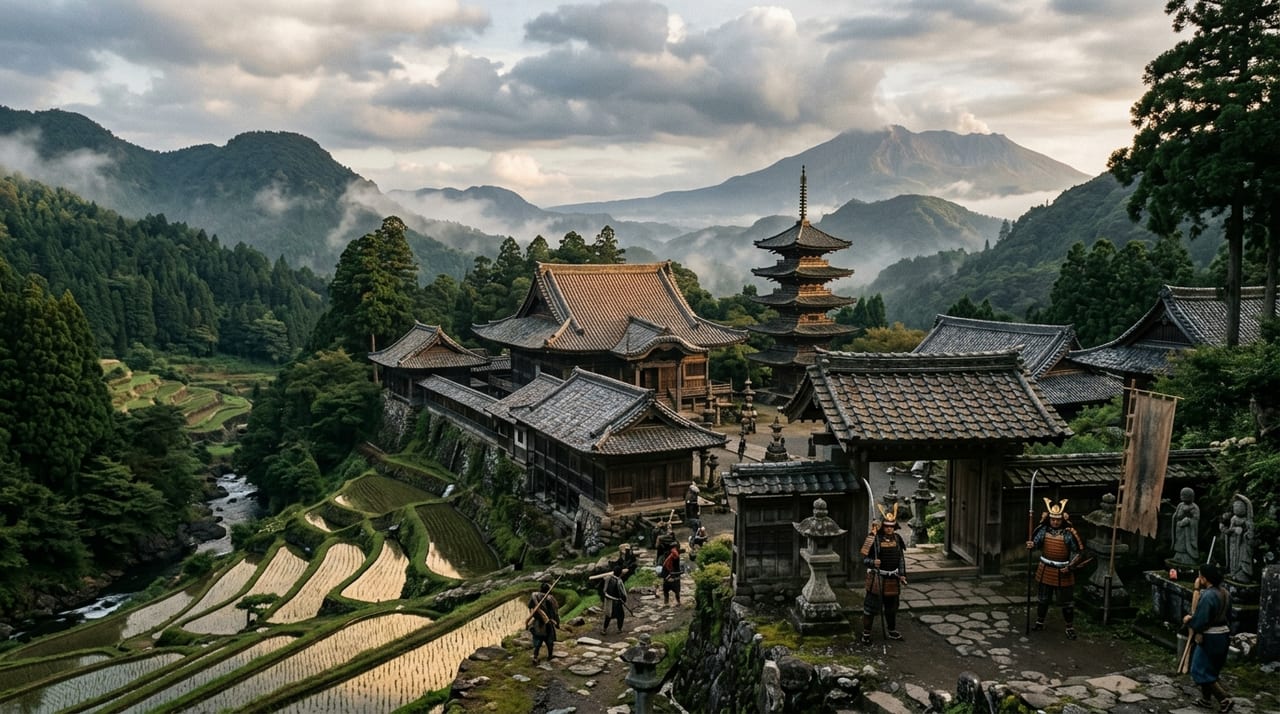
 * Image is for illustrative purposes only.
Ko-Naminohira—Kyushu's Oldest Sword School
古波平——九州最古の刀剣流派
Ko-Naminohira refers to the group of sword smiths that flourished from the late Heian period through the Nanbokuchō period, based in the Naminohira area of present-day Kagoshima Prefecture's Satsuma region (former Satsuma Province). It is regarded as the earliest sword-smithing group in Kyūshū and as the predecessor of the Naminohira school, whose founder was Naminohira Yukiyasu. It is also positioned as a direct source of the Satsuma tradition. The Ko-Naminohira smiths inherited the lineage of Masakuni, who is said to have migrated from Yamato Province, and developed an old-fashioned style that shared qualities with the Yamato-den of the same era. Its characteristic works are tachi with a small kissaki and a deep koshi-zori, along with a plain style built on jigane with a whitish (shirake) tinge and hoso-suguha (narrow straight hamon). Because the Naminohira school continued until the early Meiji period, the technical legacy of Ko-Naminohira continued to shape the sword culture of southern Kyūshū for several centuries.
Description
Geographical and Historical Background of Ko-Naminohira
Naminohira is a place name near Higashi-Taniyama in present-day Kagoshima City (former Satsuma Province), where a sword-smithing group formed within the distinctive geographical and cultural environment of southern Kyūshū. Southern Kyūshū was a remote region far from Kinai, yet the works of Naminohira closely resemble the Yamato-den of the same era, which agrees with the tradition that smiths who migrated from Yamato transmitted the technique.
There are various theories about the founder of Ko-Naminohira, but the most prominent theory names Naminohira Yukiyasu as the founder. Yukiyasu is said to have been active in the late Heian period (around the 11th century). According to some accounts, his father Masakuni migrated from Yamato Province (Nara) to Satsuma and transmitted the technique there, while other accounts say that the technique was established independently; there are several theories. The oldest surviving works of the Naminohira school mostly date back to the Kamakura period, and works from the earlier Ko-Naminohira period, including those attributed as 'den~', are extremely rare.
The Ko-Naminohira period (11th to 14th centuries) coincided with the formation and development of warrior bands in southern Kyūshū. As the warrior bands that would become the Shimazu clan held territory across the three provinces of Satsuma, Ōsumi and Hyūga, demand for swords grew along with the development of regional warrior society. The Shimazu later took control of Satsuma Province (late 12th to 13th century), and the Naminohira school came to receive special patronage as the Shimazu clan's official smiths (goyō-kaji). The role of Ko-Naminohira as the prehistory of this development is nonetheless important.
Technical Characteristics and Style
Characteristics of the jigane (base steel): The jigane of Ko-Naminohira has a whitish (shirake) tinge and a plain character that shares qualities with the Yamato-den of the same era.
Characteristics of the hamon (temper line): The hamon of Ko-Naminohira is based on hoso-suguha (narrow straight hamon), an old-fashioned style. Small midare and ko-chōji may occasionally be mixed in, but compared with the bold hamon of the Kamakura and Nanbokuchō periods, it is refined and tightly controlled. The hardening zone contains abundant nie, and some examples show fine kinsuji and sunagashi. This is thought to be the origin of the later evaluation of Satsuma-den as 'rough and imposing, yet precise in its details'.
Sugata (overall shape): Tachi of the Ko-Naminohira period before the Kamakura period are slender with a deep koshi-zori close to the Heian style. From the Kamakura period onward, the width of the blade increased somewhat and the curvature changed, but the overall impression is one of plain, robust strength typical of provincial swords. The 'unpolished' form, with a wide moto-haba that keeps a relatively maintained saki-haba, distinguishes these swords from the swords of Kyoto and Kinai with their court-aristocratic taste and emphasizes their character as a warrior's practical weapon.
Style of the mei (inscription): Ko-Naminohira inscriptions often take the form of prefixing 'Naminohira', as in 'Naminohira Yukiyasu'. The inscription script is plain and forceful, typical of provincial swords, and the inscriptions are relatively deep and firm. In later periods, examples that add the province name (Satsuma) or a place name are also seen.
Principal Smiths and Surviving Works
Naminohira Yukiyasu: The effective founder of Ko-Naminohira and the Naminohira school. His activity in the late Heian period (around the 11th century) is transmitted, but few certain surviving works remain, and most works traditionally attributed to Yukiyasu are later pieces (from the Kamakura to Muromachi periods). The name Yukiyasu was succeeded by the main line of the Naminohira school until the Meiji period. Among the tachi inscribed with the name Yukiyasu, the Important Cultural Property 'Sasanuki' is well known.
Position in the History of Kyūshū Swords
The importance of Ko-Naminohira lies not merely in the fact that it was the oldest sword-smithing group in Kyūshū. In contrast to the Enju school (Enju-ha), which developed centered on Kikuchi in Higo Province (present-day Kumamoto Prefecture) under the influence of the Kyoto Rai school, Ko-Naminohira maintained an old-fashioned style related to Yamato-den for a long time in southern Kyūshū and formed a 'second sword culture' in southern Kyūshū.
The Naminohira group continued to forge swords worn by Satsuma samurai even in the Edo period, and it made swords for about 900 years, from the Heian period to the early Meiji period.
In addition, Ko-Naminohira swords were widely supplied not only to the Shimazu clan in southern Kyūshū but also to other warrior bands in Satsuma, Ōsumi and Hyūga. This suggests that Ko-Naminohira did not depend on any particular daimyo power but functioned as the core of a regional sword distribution network. Even after the establishment of the Satsuma domain, this regional supply network was inherited by the Naminohira school and became the foundation for the brand of 'swords of Satsuma'.
Later Influence
The technical legacy of Ko-Naminohira was transmitted to later generations mainly through the Naminohira school. The Naminohira school continued from the Muromachi period through the Edo period and lasted until the early Meiji period. It is said to have been the longest-running sword-smithing school, and its works are still valued today as part of the sword tradition of Satsuma.
In terms of technical comparison with the Enju school, the Enju school transplanted the stylistic beauty of the Rai school to Kyūshū, whereas Ko-Naminohira took the opposite direction, emphasizing the plain simplicity and robust strength native to Kyūshū. This difference shows the diversity of Kyūshū swords, and it has become an important point of reference when later researchers discuss the layered nature of sword culture in the Kyūshū region.
Characteristics of This Era
- Kyūshū's oldest distinct sword-smithing lineage: a sword-smithing lineage, the oldest in Kyūshū, that developed independently in southern Kyūshū, drawing on the lineage of smiths said to have migrated from Yamato. In contrast to the Enju school, which transplanted the Kyoto style of the Rai school, Ko-Naminohira established the identity of 'swords of southern Kyūshū', emphasizing local materials and robust strength
- Whitish jigane and hoso-suguha: the old-fashioned style, with a small kissaki, a deep koshi-zori in the tachi form, and jigane with a whitish (shirake) tinge and hoso-suguha (narrow straight hamon), relates to the Yamato-den of the same era and created the simple beauty of Ko-Naminohira
- Practical and sturdy construction: swords of Ko-Naminohira developed as the practical weapons of warriors and prioritize sturdiness and utility over ornamentation. The tightly controlled hamon, based on straight and small midare, and the plain sugata are highly compatible with the values of the eastern warrior class that emerged after the Kamakura period
- Starting point of the direct lineage to Satsuma-den: the starting point of the technical lineage that led, through the Naminohira school, to the goyō-kaji of the Satsuma domain in the Edo period. The technical distinctiveness that became the basis for the Shimazu clan's patronage policy was established in the Ko-Naminohira period, forming the core of the historical identity of Satsuma sword culture
- Organic ties with local warrior society: the supply system of Ko-Naminohira swords, which developed together with the formation and growth of the southern Kyūshū warrior bands including the Shimazu clan, functioned as a regional sword distribution network that went beyond dependence on any particular daimyo. The stance of 'sword production for the region' was inherited by the later Naminohira school and formed the undercurrent of the sword culture of Satsuma