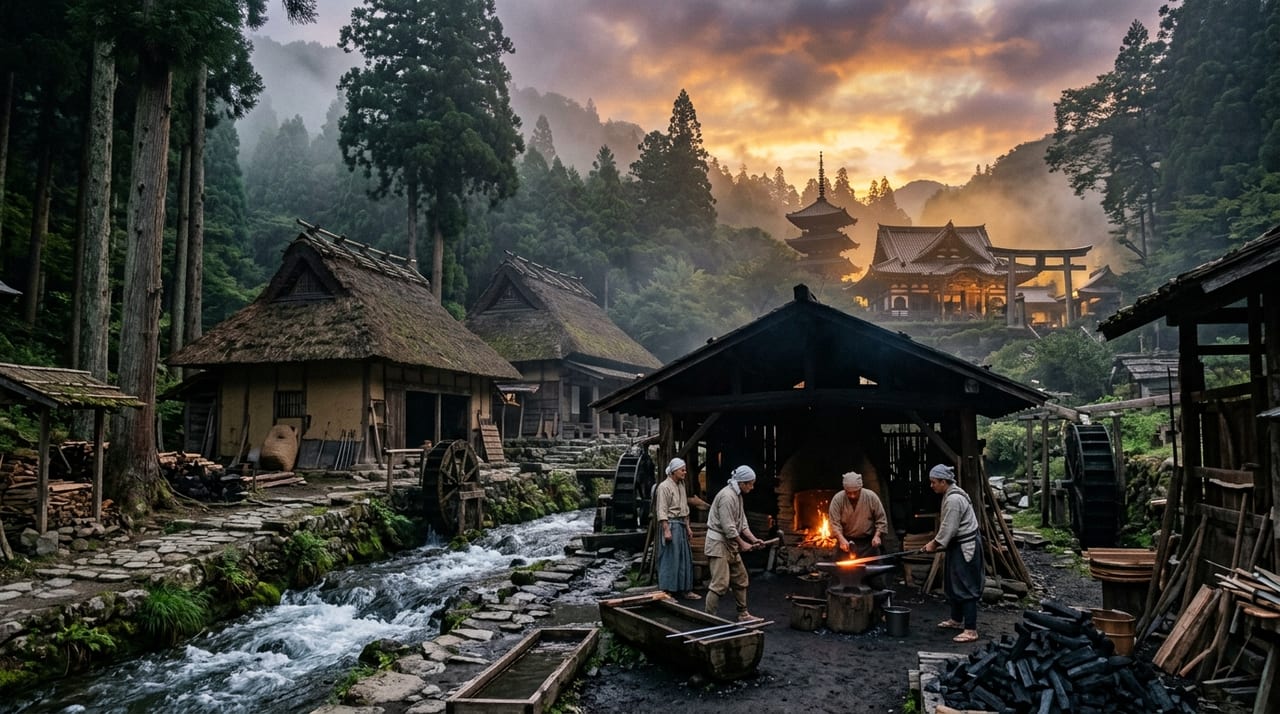
 * Image is for illustrative purposes only.
Jokyo Era
貞享(じょうきょう)
The Jokyo era (1684–1688) was a brief transitional period spanning the transition from Enpō to Genroku. Sword-smiths of this age, while preserving the slender and refined blade aesthetics pioneered in the Kanbun period (1661–1672), forged the philosophical bridge to the approaching golden age of Genroku. This was an era marked by the pursuit of balance between narrow masame-gumi (straight-grained forging) and appropriately curved blades, exemplifying the maturation stage of Edo Shintō aesthetics.
Description
Continuity of Kanbun Aesthetics
Sword-smiths of the Jokyo era inherited the sword aesthetic established in the preceding Kanbun period (1661–1672). During Kanbun, a trend emerged away from the robust blade forms of earlier periods toward slenderer, more refined shapes. Masame forging—straight-grained work—became especially valued, and a strong emphasis on technical refinement within narrower blade profiles took hold.
Jokyo-era smiths maintained this Kanbun refinement while adding slightly more curvature, thus embodying the transitional characteristics pointing toward the Genroku golden age.
Technical Maturation of Edo Shintō
This period represents the stage at which Edo-period Shintō blades achieved technical maturity. The balance between hardness and flexibility in the blade, the geometry of curvature, and the sharpness of the kissaki (point) were all increasingly subject to precise calibration.
Notably, the proportions of thickness and width, along with the pursuit of smooth curvature, advanced significantly. It was during this era that the dual achievement of practical function and aesthetic value was being perfected.
From a Blade Research Perspective
The Jokyo-era blade occupies a position between the Kanbun period's "innovative slenderization" and the Genroku period's "golden-age opulence." From this vantage point, Jokyo blades become invaluable case studies for understanding the evolution of Edo Shintō within the broader trajectory of Japanese sword history.
Characteristics of This Era
- Jokyo (1684–1688), though brief, stands as a crucial transitional era in sword aesthetics
- Inherited the slender, refined blade aesthetics of Kanbun (1661–1672) while adding moderate curvature to transition into Genroku
- Emphasized masame forging and slender proportions, exemplifying the technical maturation of Edo Shintō
- Represented a stage of precise calibration of multiple forging elements: blade hardness-flexibility balance, kissaki sharpness, and curvature geometry
- A period when the dual achievement of practical function and aesthetic value was being perfected en route to Edo Shintō completion
- Serves as a valuable case study in blade research for understanding the evolutionary stages of Shintō