 * Image is for illustrative purposes only.
Post-Great Kantō Earthquake Period
関東大震災後
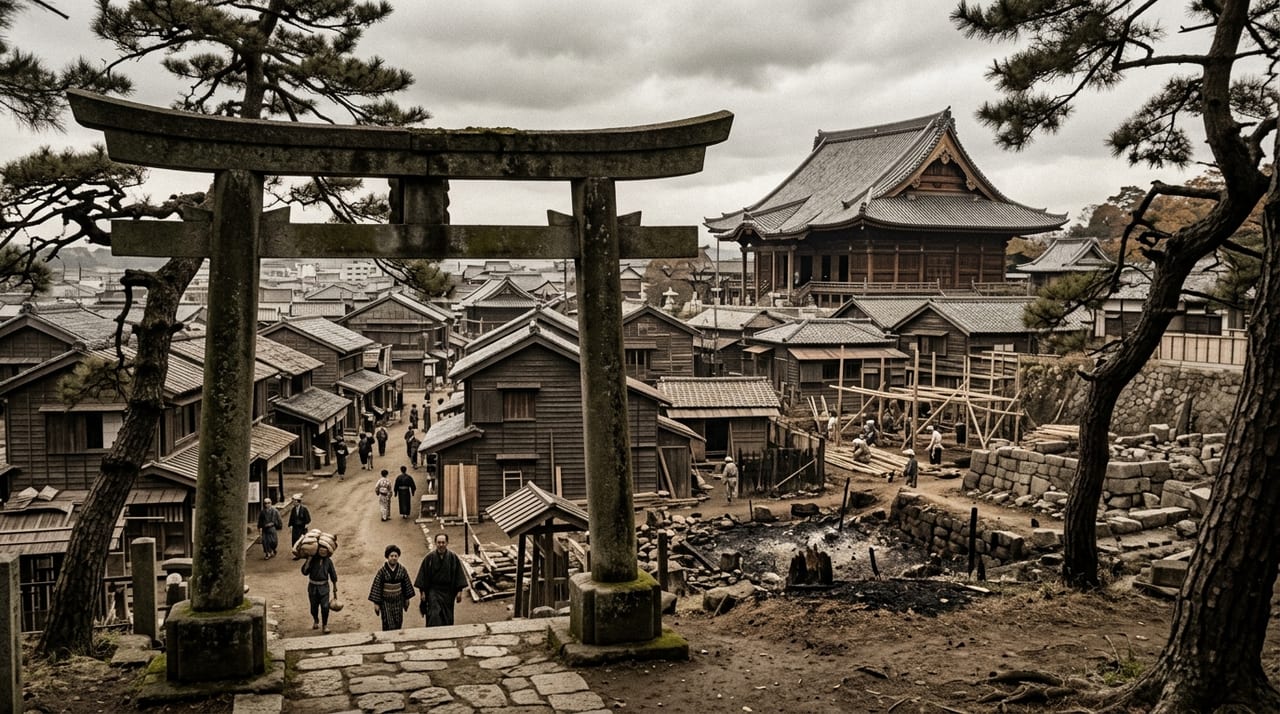
The Great Kantō Earthquake of September 1, Taishō 12 (1923), dealt a devastating blow to the sword collections of Tokyo and Yokohama. The loss of many famous swords in the fires, and the damage suffered by smiths, togishi, and appraisers, left serious lasting effects on sword culture. Meanwhile, in the recovery period, a new movement, “the rebuilding of sword culture,” began.
Description
The Great Kantō Earthquake and Its Devastating Blow to Swords
At 11:58 a.m. on September 1, Taishō 12 (1923), an earthquake of magnitude 7.9 struck the Kantō region. The quake itself caused severe damage, but the greatest destruction came from the major fires that broke out immediately afterward. Fires broke out simultaneously in the shitamachi (low city) and Yamanote (hill districts) areas of Tokyo and in Yokohama. Fanned by strong winds, they burned for several days, and about 45 percent of Tokyo City was reduced to burned ground. These fires indiscriminately destroyed the private collections, sword dealers’ shops, togishi workshops, and sword-fittings craftsmen’s workshops in Tokyo and Yokohama, where collectors from across Japan were concentrated. Countless famous swords and important swords that were never recorded were lost forever.
Scale of Swords Lost and the Cultural Loss
The number and quality of swords lost in the Great Kantō Earthquake can be grasped only in fragments, through later surveys and testimony. Since the Meiji period, famous swords from across the country had gathered in Tokyo and Yokohama, and many of the finest collections were owned by businessmen, politicians, former daimyo families, senior military officers, and others. Swords held in stock by sword dealers, swords being polished by togishi, and swords being repaired by saya-shi and tsuka-shi (hilt makers) were also lost in great numbers, since they were in the distribution process. The loss of written records, including appraisal certificates (origami), was also a serious loss, because it permanently destroyed the evidence of the provenance and value of famous swords.
Damage to Smiths, Polishers, and Appraisers, and the Crisis of Broken Technical Continuity
The earthquake also dealt a devastating blow to the craftsmen and specialists connected with swords. Many smiths, togishi, and appraisers who lived in Tokyo lost their homes, workshops, and tools in their entirety. The forging reference materials, reference swords, and documents they had collected over many years were all reduced to ash. Polishing skill maintains a high standard only through an accumulation of whetstones gathered over long years. Togishi who lost their precious collections of natural whetstones were therefore forced into technical regression. For young smiths and togishi, losing their masters, workshops, and reference materials in the middle of their training was a double or triple blow, and the continuity of technical transmission was threatened.
Movements to Rebuild Sword Culture in the Recovery Period
The recovery period after the earthquake (late Taishō to early Shōwa) was also an era in which a new movement for the institutional rebuilding of sword culture emerged. In addition, research groups and appreciation societies organized by sword enthusiasts and researchers were formed in various places. Survey, recording, and preservation work on surviving famous swords came to be carried out in an organized manner. In Shōwa 8 (1933), the Law for the Preservation of Important Art Objects was enacted, establishing a system to prevent art objects, including swords, from flowing overseas.
Sword-Making at Yasukuni Shrine and Rising Demand for Military Swords
The early Shōwa period after the earthquake was an era in which militarism was rising politically. In sword culture, a new movement emerged: sword-making within the grounds of Yasukuni Shrine. The Nihontō Tanrenkai (Japanese Sword Forging Association), established in Shōwa 8 (1933), made swords on the grounds of Yasukuni Shrine and produced military swords for officers known as “Yasukuni-tō.” Furthermore, as military tensions grew after the Manchurian Incident (Shōwa 6, 1931), demand for officers’ military swords increased, and attention once again gathered on smiths who possessed traditional Japanese sword-forging techniques. Combining the memory of loss from the earthquake with militaristic fervor, this period, in which “the revival of the Japanese sword” took on political and cultural meaning, occupies an indispensable place in understanding the modern transformation of Japanese sword culture.
Characteristics of This Era
- Mass loss of famous swords in the fires. Countless important swords, never recorded, were lost forever
- Crisis of technical discontinuity. Smiths and togishi lost their workshops, tools, and collected materials all at once, and the loss of natural whetstones in particular led to a regression in polishing techniques
- Rebuilding in the recovery period. Research groups were organized, and survey and recording activities advanced
- Complex intersection with militaristic demand. The “revival of the Japanese sword” after the earthquake was inseparably entangled with two aspects: a cultural and spiritual revival, and an increase in demand for military swords
- Loss of records, including appraisal certificates. The disappearance of evidence of provenance made later research difficult