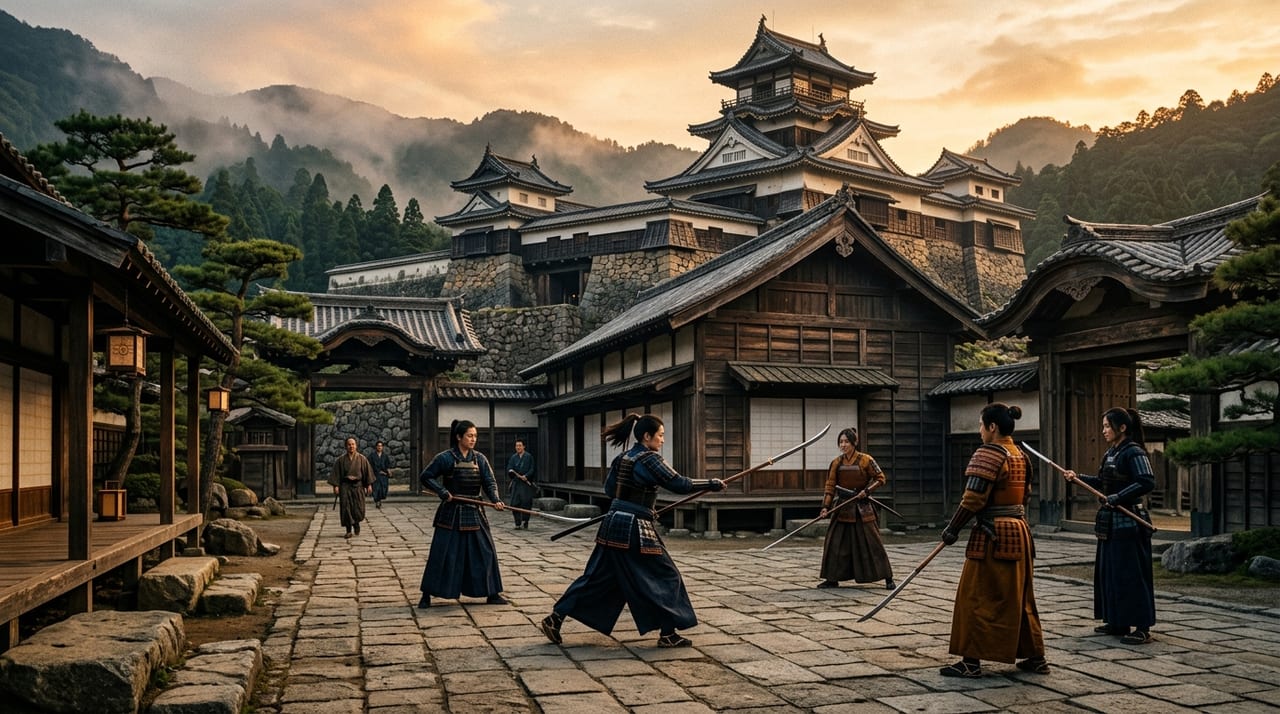
 * Image is for illustrative purposes only.
Einin Era
永仁(えいにん)
Einin (1293-1299) was a late-Kamakura era name between Shōō and Shōan, remembered for the 1297 Einin Tokusei Decree relieving debt-ridden warriors after the Mongol invasions, while swordsmiths such as Yamashiro's Rai Kunitoshi and Bizen's Osafune school remained active.
Description
Einin (1293-1299) was a late-Kamakura-period era name, proclaimed on the 5th day of the 8th month of Shōō 6 (September 6, 1293) in response to unusual celestial events and an earthquake in the Kantō region, and it lasted until the 25th day of the 4th month of Einin 7 (May 25, 1299), when the era was renamed Shōan. The reigning emperors were Fushimi and Go-Fushimi, and the Kamakura shogunate's regent (shikken) was Hōjō Sadatoki. The era's defining event was the Einin Tokusei Decree of Einin 5 (1297). Gokenin vassals, who had shouldered heavy defense burdens during the Mongol invasions (the Bun'ei and Kōan campaigns) without receiving adequate rewards, fell increasingly into debt as a money economy took hold; many were forced to pawn or sell their landholdings to moneylenders (karishiage). The decree banned the further pawning and sale of gokenin land and ordered the free return of already-lost holdings, marking a pivotal moment of strain in the relationship between the shogunate and the warrior class. In sword history, the celebrated Yamashiro Rai-school smith Rai Kunitoshi remained vigorously active through this period; a signed tachi dated "Rai Kunitoshi / Einin 5, 3rd month, 1st day" (named Hotarumaru, an Important Cultural Property) is recorded, though it has been missing since the end of the Second World War. Dated inscriptions on his surviving blades show Kunitoshi working continuously from Shōō through Genkō (1288-1324), placing the Einin years squarely within his prime. In Bizen province, Osafune Nagamitsu, the second head of the Osafune school, left a tachi dated Shōō 2 (1289), indicating that he too remained a central figure of his school into and around the Einin years. The era is thus marked by a striking contrast: gokenin vassals sinking into financial hardship despite insufficient reward for their wartime service, set against sword production in Yamashiro and Bizen that continued at a consistently high level.
Characteristics of This Era
- Late-Kamakura era name between Shōō and Shōan (8th month 1293 - 4th month 1299)
- The Einin Tokusei Decree (1297), relieving debt-burdened gokenin vassals
- Post-Mongol-invasion (Bun'ei and Kōan campaigns) financial hardship among gokenin as historical backdrop
- Spread of a money economy and the rise of moneylenders (karishiage)
- Yamashiro Rai-school smith Rai Kunitoshi's surviving dated tachi "Rai Kunitoshi / Einin 5, 3rd month, 1st day"
- Kunitoshi's long active career spanning Shōō to Genkō (1288-1324)
- Osafune Nagamitsu, second head of the Bizen Osafune school, remained active into this period