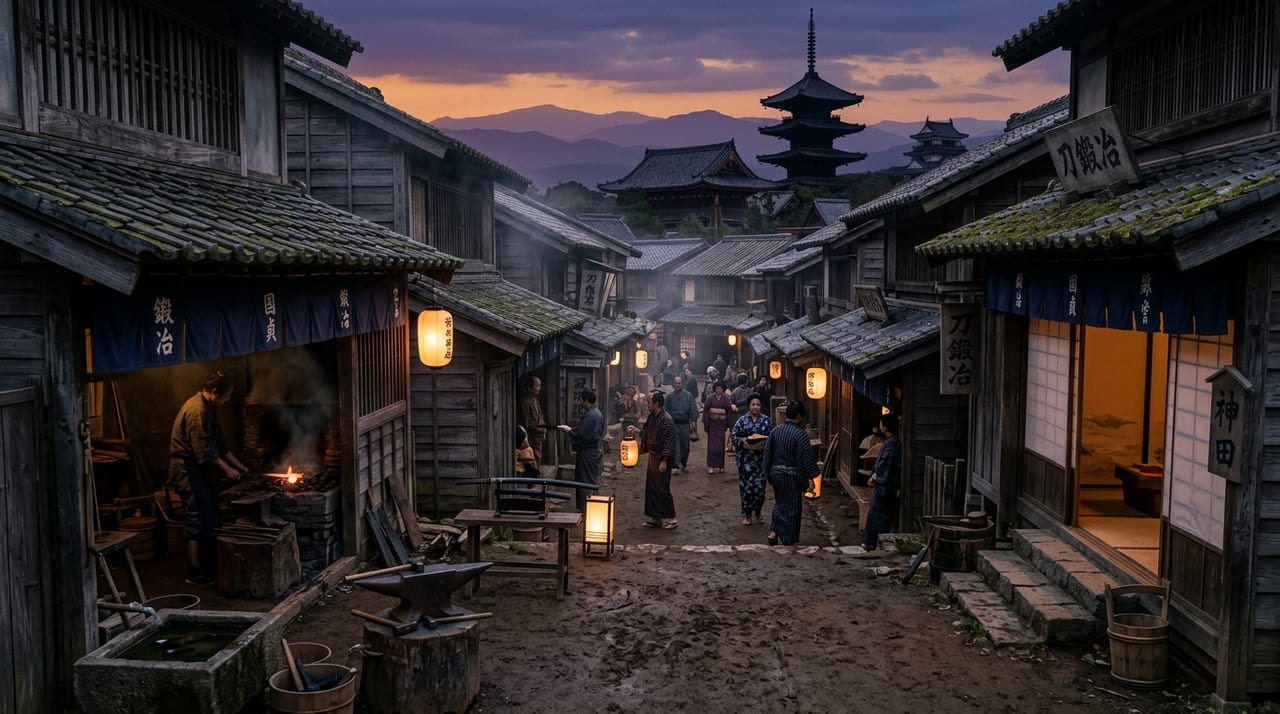
 * Image is for illustrative purposes only.
Kiyomaro School — The Bakumatsu Sōshū Revival and Its Disciples
清麿一派
The Kiyomaro school is a group of swordsmiths centered on Yamaura Kiyomaro, younger brother of Yamaura Masao, a leading shinshintō swordsmith of the late Edo period. Kiyomaro mastered the Sōshū tradition's ō-nie and intense midare hamon, and was a brilliant swordsmith of the late Edo period who was given the nickname “Yotsuya Masamune.” His elder brother Masao, his disciple Saitō Kiyohito, and others formed the school and carried the last brilliance of late Edo sword culture until just before the Haitōrei edict.
Description
The Kiyomaro school (Kiyomaro ippa) was a group of swordsmiths active in late Edo (Tenpō to Keiō eras, 1830s–1860s), formed around Yamaura Kiyomaro (real name: Yamaura Tamaki, 1813–1855). Kiyomaro was from Chiisagata District, Shinano Province (present-day Nagano Prefecture). Together with his elder brother Yamaura Masao, he studied under Kawamura Toshitaka, a smith of the Ueda domain. In Edo he trained under the patronage of the hatamoto Kubota Sugane, and he later settled in Yotsuya.
Kiyomaro's greatest achievement was the "recreation of the Sōshū tradition." At the same time that the shinshintō movement of Suishinshi Masahide and Taikei Naotane pursued the revival of kotō both theoretically and practically, Kiyomaro studied the bolder Sōshū tradition, the world of the great ōnie and intensely turbulent hamon left by Masamune and Sadamune. In Edo he succeeded in recreating the essence of the Sōshū tradition. The high quality of his work was praised by his contemporaries, and he earned the nickname "Yotsuya Masamune." This was the highest form of praise, combining Yotsuya, the Edo district where Kiyomaro lived, with Masamune, who stands at the summit of the Sōshū tradition. It shows that Kiyomaro's works were recognized in the bakumatsu period as an original artistic achievement that went beyond mere imitation.
Technically, Kiyomaro's blades stand out for "the beauty of the ōnie" and "the dramatic changes in the hamon." His hamon combines ō-gunome, ō-midare, togariba and other forms, and within the vigorously moving hamon, ji-nie, sunagashi and kinsuji appear in abundance. The jigane is based on itame with thick ji-nie, reproducing the rough yet precise texture unique to the Sōshū tradition. The kissaki are mostly chū- to ō-kissaki, and the slightly wide mihaba and kasane respond to the practical demand of the bakumatsu period.
One of Kiyomaro's works is a great sword of 2 shaku 6 sun (Important Art Object), made for his benefactor Kubota Sugane. Its inscription reads: "Tame Kubota Sugane-kun, Yamaura Tamaki Gen Kiyomaro sei, Kōka hinoe-uma-toshi hachi-gatsu hi."
After Kiyomaro took his own life at the age of 42 in January 1855 (Kaei 7/11), the transmission of his techniques was entrusted to his elder brother Yamaura Masao and his disciple Saitō Kiyohito (later Buzen no Kami Fujiwara no Kiyohito). Masao remained in Shinano and forged swords on commission for the Komoro and Matsushiro domains. In 1853 (Kaei 6), his blades demonstrated their toughness in the trial cutting at the Matsushiro domain. Kiyohito became Kiyomaro's disciple in Edo in Kaei 5. After his master's death, he is said to have forged the swords his master had received orders for and used them to settle the debts. His signatures include "Shōnai-jū Buzen no Kami Fujiwara no Kiyohito." After the sword-abolition edict of Meiji 9, he ran an inn in his home town of Atsumi Onsen.
The significance of the Kiyomaro school in the history of Japanese swords lies in its position as a symbol of "the artistic solitude of the individual in the turbulent bakumatsu period." If Kamakura-period Masamune formed the Sōshū tradition in response to the demands of the warrior regime, Kiyomaro re-created the Sōshū tradition as a pure artistic pursuit, independent of the demands of his era and society. The solitude of this individual achievement, a restoration by a single genius rather than an organized school movement, is what makes Kiyomaro one of the most fascinating swordsmiths in Japanese sword history.
Characteristics of This Era
- Recreation of the Sōshū tradition — Kiyomaro's own practice of reviving the Sōshū tradition, unlike the theoretical revival of old swords in the Suishinshi line
- The Yotsuya Masamune title — the highest praise, in which a late Edo swordsmith was judged comparable to Masamune, and which shows the artistic level of the school
- Dramatic expression of ō-nie and ō-midare — the technical core of Kiyomaro's works, in which large gunome and ō-midare are richly interwoven with kinsuji and sunagashi
- One of the Edo Sansaku — Kiyomaro is counted, along with Suishinshi Masahide and Taikei Naotane, among the “Three Masters of Edo”
- Elder brother Masao and disciple Kiyohito — even after Kiyomaro's suicide, his elder brother Yamaura Masao and his disciple Saitō Kiyohito (Buzen no Kami Kiyohito) continued to make swords until the early Meiji period