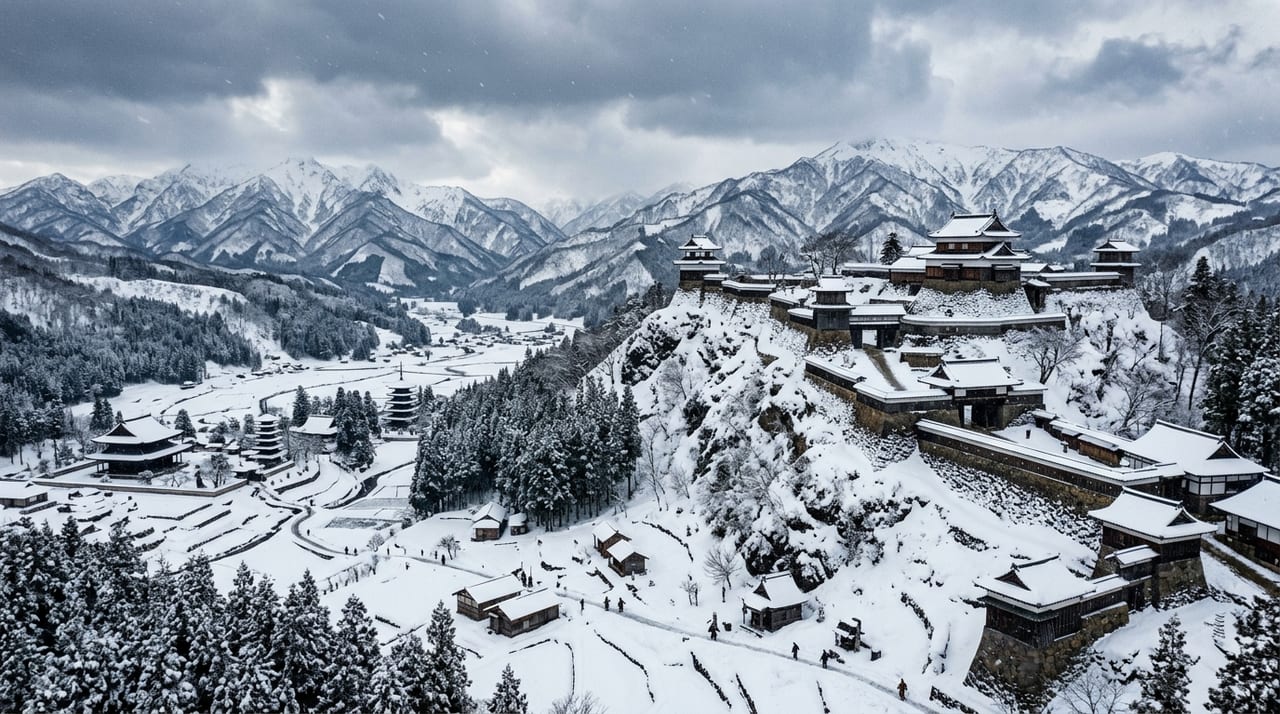
 * Image is for illustrative purposes only.
Echigo Tradition
越後伝
The swordsmithing tradition that developed in Echigo Province (present-day Niigata Prefecture), supplying the formidable armies of Uesugi Kenshin and his successors. Marked by practical, robustly constructed blades suited to mountain warfare in heavy snowfall terrain, Echigo smithing developed a distinctive regional identity under the patronage of the Uesugi clan.
Description
Echigo Province, facing the Japan Sea and buried under heavy snowfall for months each year, occupied a strategically vital position on the northern route connecting central Japan to the Tōhoku region. The province's sword culture evolved in response to the practical demands of mountain warfare and the logistical realities of a region where iron supply routes followed the sea coast and mountain passes. Echigo smiths are documented from the Kamakura period onward, initially absorbing techniques from Yamato and Bizen but gradually establishing a regional style uniquely their own.
The defining moment for Echigo's sword culture arrived with the warlord Uesugi Kenshin (1530–1578), known as the "Dragon of Echigo," who fought over seventy battles in his lifetime. Kenshin revered swords not merely as weapons but as sacred expressions of his devotion to Bishamonten, the Buddhist deity of war. He actively patronized Echigo smiths and established a sword-production environment at Kasugayama Castle, his base of operations. The "Himeturu Ichimonji," his legendary blade now preserved in the Yonezawa Uesugi Museum, exemplifies his legacy; though originally forged by Bizen smiths, it became deeply connected to Echigo's sword culture through its use by Kenshin during his campaigns in Echū and Echigo.
The most celebrated Echigo smithing lineages are the Kunishige and Kanenaga schools. Echigo Kunishige, active from the Muromachi through the early Edo period, was known for densely-grained mokume-hada jihada and suguha-based hamon with a clear, bright nioiguchi. The region's brutal winters—where smiths had to maintain forging temperatures in extreme cold—compelled Echigo smiths to develop unique tempering and forging techniques distinct from those of warmer central Japan.
During the Edo period, sword demand shifted from practical battlefield needs to ceremonial and aesthetic purposes under Echigo Domain governance. Despite this transformation, Echigo smiths remained faithful to their tradition of robust, functional construction, continuing to produce hardy blades into the mid-Edo period and beyond. Echigo's status as a major sand-iron producing region enabled independent tamahagane production, providing a distinctive material foundation for the tradition.
Characteristics of This Era
- Dense mokume-hada jihada — forging environment of the snow country producing distinctively tough grain
- Suguha and notare hamon with clear nioiguchi — functional temper patterns prioritizing cutting performance
- Powerful, wide-bodied sugata with deep curvature — form suited to mountain combat and anti-cavalry engagement
- Uesugi Kenshin's patronage and Bishamonten devotion — swords functioning as expressions of war-deity faith
- Indigenous sand-iron tamahagane production — self-sufficient material basis creating distinctive jihada qualities