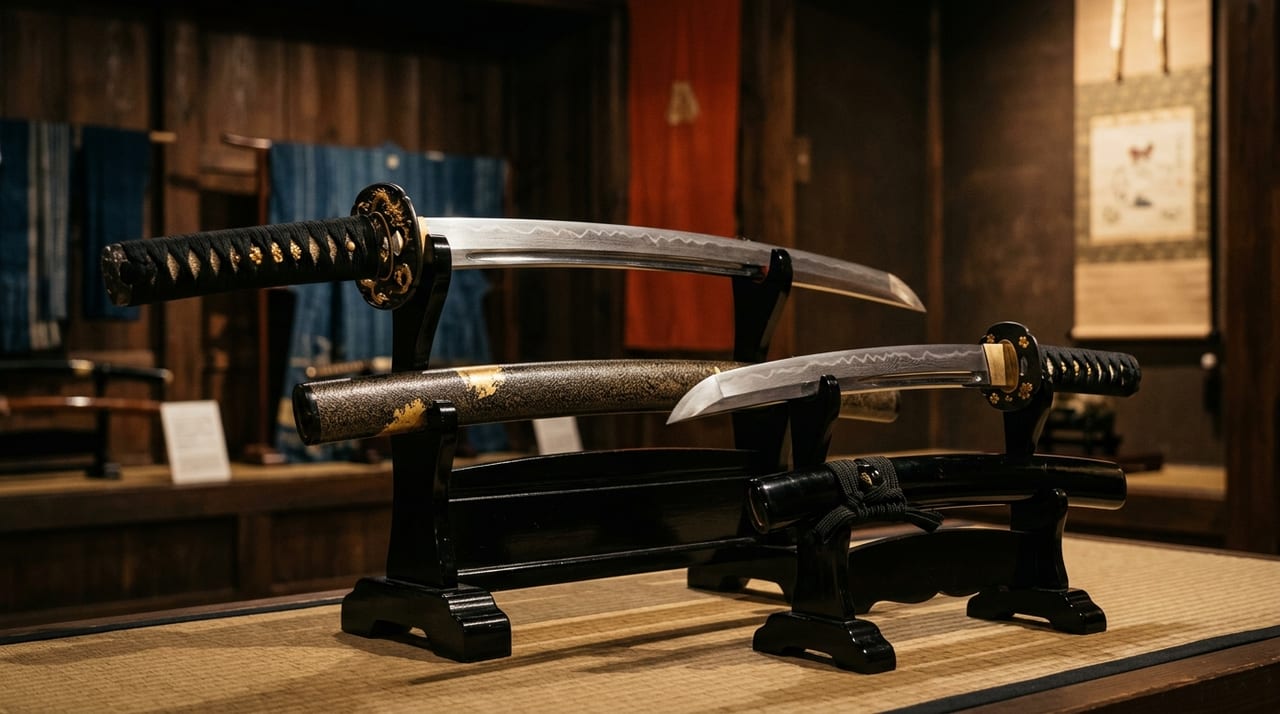
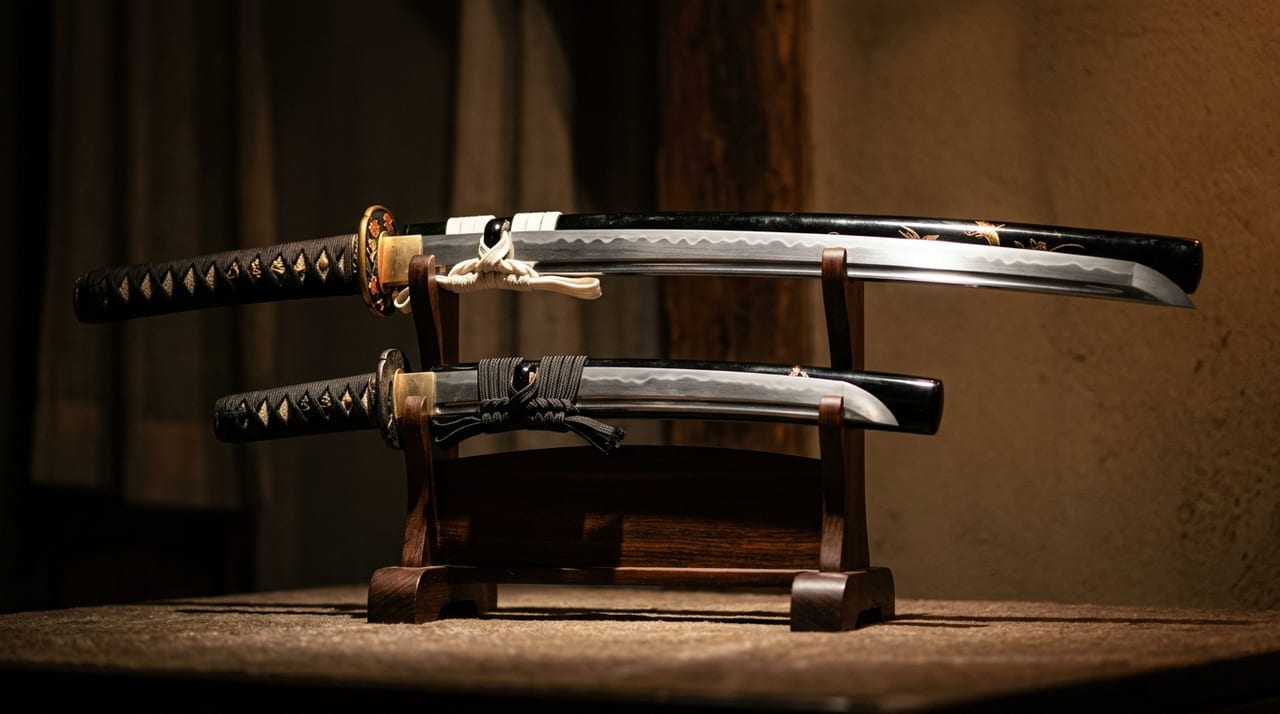
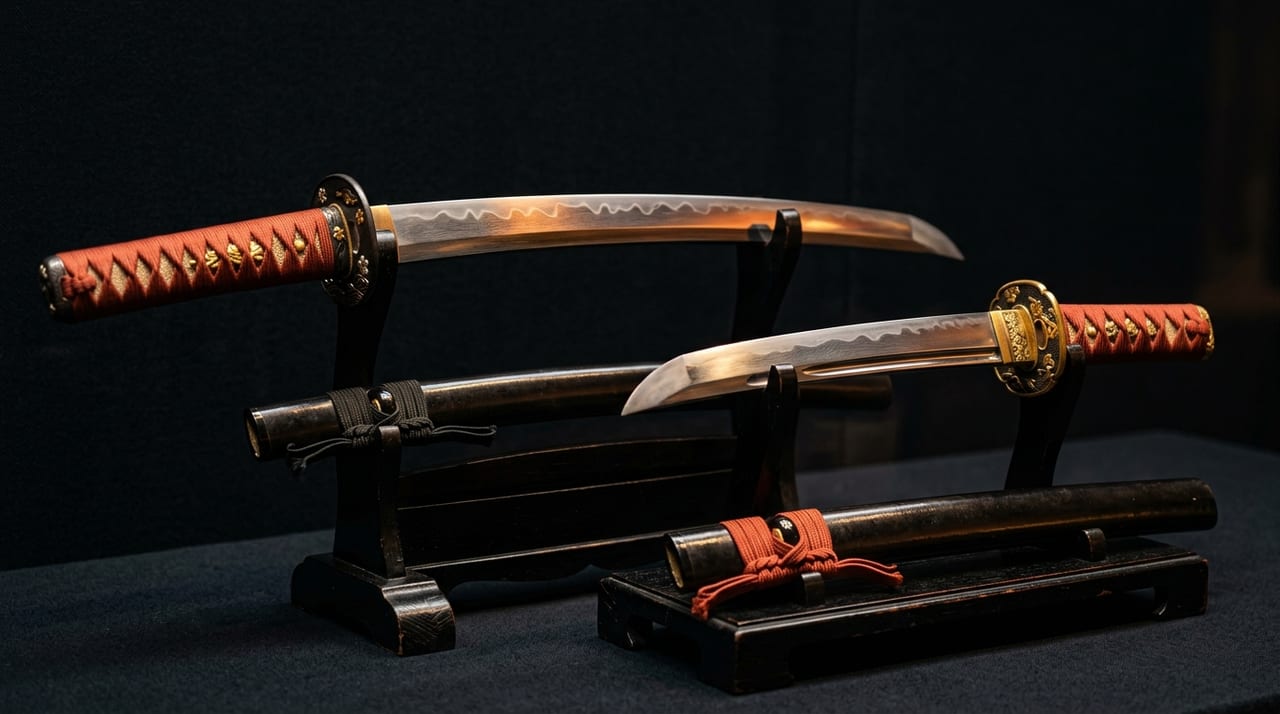
Complete Comparison of Japanese Sword Blade Curve Types: Waist Curve, Center Curve, Point Curve, and Straight Blade Historical Trends
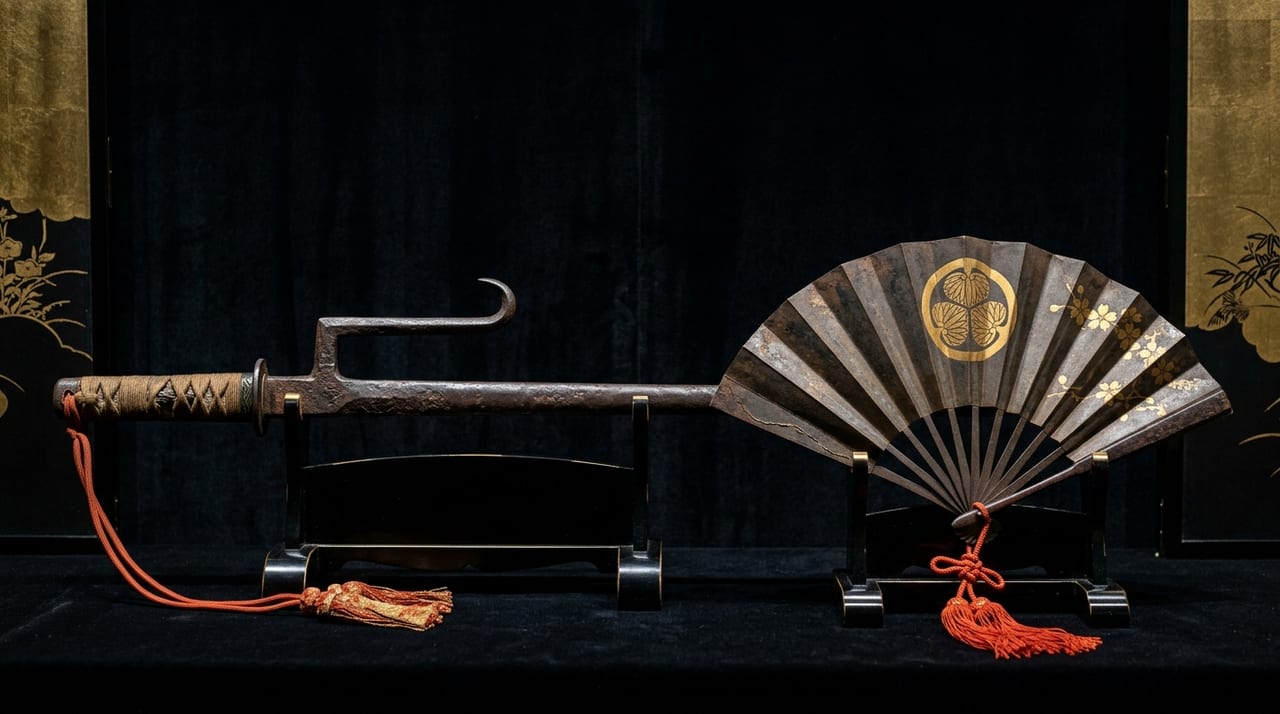 * Image is for illustrative purposes only.
Table of Contents
Types of Blade Curves—Why "Where It Curves" Matters
The "curve" (sori) of a Japanese sword refers to the blade's curvature, but information extends beyond simply "how much it curves" (the degree of curvature) to include "where it curves most" (the apex position of the curve).
Based on the apex position, curves are classified into "waist curve," "center curve," "point curve," and "straight blade" (or "deep curvature"), each associated with specific eras, production centers, and purposes. This article systematically explains each format from definitions through historical trends.
Measuring Blade Curves—Basic Concepts
Measuring Curve Depth
Curve depth refers to "the distance between a straight ruler placed along the blade and the point of maximum separation."
Measurement method:
- Place the sword on a flat surface
- Draw an imaginary line from the tang tip (nakago) to the point (kissaki)
- The maximum distance between this line and the blade surface is the "curve depth"
As a guideline, a standard modern sword (approximately 70 cm blade length) typically has a curve depth of 1.5–2.5 cm.
Apex Position of the Curve (Where It Curves Most)
The apex position is expressed by dividing the blade into three equal sections:
- Apex in the lower 1/3 (toward the tang) → "Waist curve" (koshi-zori)
- Apex in the middle 1/3 → "Center curve" (naka-zori)
- Apex in the upper 1/3 (toward the point) → "Point curve" (saki-zori)
- Curve distributed evenly across the blade → "Straight blade" or "even curve"
Waist Curve (Koshi-Zori)—Hallmark of Kamakura Tachi
Definition and Characteristics
Waist curve is a form where the apex of the curve occurs in the "waist" (lower 1/3 near the tang). Viewed from the side, the blade curves most sharply near the hilt and gradually straightens toward the point.
Visual characteristics:
- The section near the tang curves outward prominently
- The area near the point remains nearly straight
- The overall appearance resembles an "archer's bow with sharp curvature at the base"
Historical Trends
Waist curve is particularly characteristic of Heian to early Kamakura period tachi (large swords).
Tachi of this era were carried in the "haitou" style—suspended at the waist with the blade edge facing downward. When worn in this style, the waist curve naturally aligns with the angle required for the "pull-cutting" motion executed from horseback.
Representative waist-curve tachi:
- Tachi by the Bizen Ichimonji school from the early Kamakura period
- Tachi by the Yamashiro and Raiden traditions from the late Heian to early Kamakura periods
- Most ancient tachi preserved in the Shōsōin and various shrines feature waist curves
Functional Reasons
Why waist curves were favored by mounted warriors of the Heian and Kamakura periods:
- Stability when carried on horseback: The waist curve's shape minimizes interference with movement on horseback
- Natural blade orientation during unsheathing: Drawing the blade from the haitou position naturally directs the edge toward the opponent
Center Curve (Naka-Zori)—Standard from Late Kamakura to Present
Definition and Characteristics
Center curve is a form where the apex of the curve occurs in the "center section" of the blade.
Visual characteristics:
- The blade's center section curves outward most prominently
- Both the tang and point sections curve inward evenly
- The overall impression resembles a "well-balanced S-curve"
Historical Trends
Center curve represents the most versatile form from late Kamakura period to present day.
A transition from waist curve to center curve occurred in late Kamakura. This change resulted from:
- Transition from tachi to uchigatana (swords worn with blade up)
- Increased foot soldier and infantry combat, emphasizing handling during movement
- Aesthetic preference for "well-proportioned appearance"
Representative center-curve swords:
- Late Kamakura to Nanboku-chō tachi (including works by Okazaki Masamune and Sadamune)
- Numerous uchigatana from the Muromachi to Edo periods
- Standard form for contemporary handcrafted Japanese swords
Functional Reasons
Why center curve was adopted across diverse eras and purposes:
- Stability during movement: The sashitou wearing style shows minimal interference during walking and movement
- Efficient unsheathing: Center-curve swords can be drawn quickly from the insertion position
- Balance in combat: The curve accommodates cutting, thrusting, and defensive techniques equally well
Point Curve (Saki-Zori)—Characteristic of Muromachi to Edo Uchigatana
Definition and Characteristics
Point curve is a form where the apex of the curve occurs in the "point section" (upper 1/3 near the tip).
Visual characteristics:
- The area near the point curves outward most prominently
- The section near the tang remains nearly straight
- The point appears "raised upward"
Historical Trends
Point curve is frequently observed in Muromachi late period to early Edo uchigatana.
During the transition period from tachi to uchigatana (blade-up, insertion style), point-curve swords became increasingly common. In the sashitou style, the blade's tang remains fixed at the waist while the point rises upward. From this carrying position, the point-curve blade naturally directs its edge forward during unsheathing.
Functional Reasons
Why point curves suited the sashitou style:
- Enhanced unsheathing speed: When drawing from the sashitou position, the point quickly orients forward
- Adaptation for thrusting: The point-area curve facilitates power transfer during thrusting motions
- Compatibility with iaijutsu: In iaijutsu fundamentals (quick draw and cut), point-curve swords unsheath more rapidly
Straight Blade (Mu-Zori) and Deep Curves—Special Forms
Straight Blade
A form with little to no curvature, featuring a nearly linear blade. Found in ancient blades (straight swords from the Nara period and earlier) and certain short swords.
Modern use: In iaido training, shallow-curve or straight blades are occasionally used to reduce interference with the scabbard.
Deep Curve
A form with exceptionally pronounced curvature (3 cm or greater) common in "ōdachi" (large swords) of the Nanboku-chō period.
While the deep curve lends visual grandeur to these imposing blades, they present practical handling challenges.
Summary: Blade Curve Types and Corresponding Eras
| Curve Type | Primary Era | Representative Sword Type |
|---|---|---|
| Waist curve | Heian to early Kamakura | Haitou-style tachi |
| Center curve | Late Kamakura to present | Uchigatana and tachi (most versatile) |
| Point curve | Muromachi to early Edo | Sashitou-style uchigatana |
| Straight blade | Ancient period and special forms | Ancient blades and certain short swords |
| Deep curve | Nanboku-chō period | Ōdachi and ōdachi-style blades |
Appreciation Application—Reading Era from Curve Type
How to observe blade curves during direct viewing:
- View the blade from the side: Identify where the edge-side curve's "outermost point" is located
- Mentally draw a straight line from tang to point: The point of maximum separation from this line indicates the "curve apex"
- Use for dating: Strong waist curve suggests Heian to early Kamakura period; point-curve tendency suggests Muromachi to early Edo period
Conclusion—Blade Curves Reflect "How Each Era Fought"
The variation in apex positions—waist, center, and point curves—directly reflects changes in combat styles across eras (mounted warfare, foot soldier tactics, iaijutsu). Learning to read "where the curve lies" represents mastery of the fundamental skills essential to sword appraisal and appreciation.