Nouveautés — Découvrez les dernières arrivées dans notre catalogue. Voir →
797 (Enryaku 16) : nomination comme Sei'i Taishōgun ; 801–802 (Enryaku 20–21) : campagne décisive
Isawa (Oshu, préfecture d'Iwate) et Shiwa (près de Morioka, préfecture d'Iwate)
Forces
Forces impériales
Emishi (peuples non soumis du nord-est du Japon)
Environ 11 min de lecture
En 797 (Enryaku 16), l'empereur Kanmu nomma Sakanoue no Tamuramaro Sei'i Taishōgun. Premier à exercer réellement les fonctions effectives du Sei'i Taishōgun attestées dans les sources, Tamuramaro occupe une place normative dans l'histoire ultérieure du régime militaire. Sa campagne ne se limite pas à une victoire militaire : elle est profondément liée à la formation de la classe guerrière au Japon et au développement de la culture du sabre.
De la période Nara au début de la période Heian, la cour mena des affrontements militaires intermittents avec les forces non soumises du Tōhoku (Mutsu et Dewa), appelées Emishi. Les Emishi disposaient d'une organisation sociale propre et résistaient à la domination de la cour. La cour fit du château de Taga (Tagajō, préfecture de Miyagi) le siège du Chinjufu (quartier général de pacification), base de l'administration du Tōhoku, mais la résistance des Emishi se poursuivit.
L'empereur Kanmu (règne de 781 à 806) fit de la campagne contre les Emishi une politique majeure, parallèlement au transfert de la capitale à Nagaoka-kyō puis à Heian-kyō, et envoya plusieurs armées de conquête de grande ampleur. Lors de la première campagne, en 789 (Enryaku 8), une armée de vingt-quelques mille à trente mille hommes fut vaincue par celle du chef des Emishi Aterui (bataille de Subuse). Cette défaite lourde fit comprendre à l'empereur Kanmu la nécessité d'un commandant puissant, ce qui conduisit à la nomination de Tamuramaro.
Sakanoue no Tamuramaro (758 à 811) était issu d'un lignage de guerriers d'ascendance toraijin (immigrée). Son père était Sakanoue no Karitamaro. Il avait une stature d'une taille exceptionnelle pour l'époque, d'environ 175 cm, un teint rouge, un regard d'aigle et une barbe dorée à la mâchoire, qui lui donnaient une apparence impressionnante. La tradition rapporte pourtant que son cœur était bienveillant et compatissant.
Lors de la deuxième campagne, en 794 (Enryaku 13), il servit comme commandant adjoint et acquit une expérience du combat. Fort de ce mérite, il fut nommé Sei'i Taishōgun en 797 (Enryaku 16). Le titre de Sei'i Taishōgun désignait à l'origine un général temporaire chargé de la conquête des Emishi. Après la nomination de Tamuramaro, ce titre s'imposa dans l'histoire comme la fonction suprême du régime militaire.
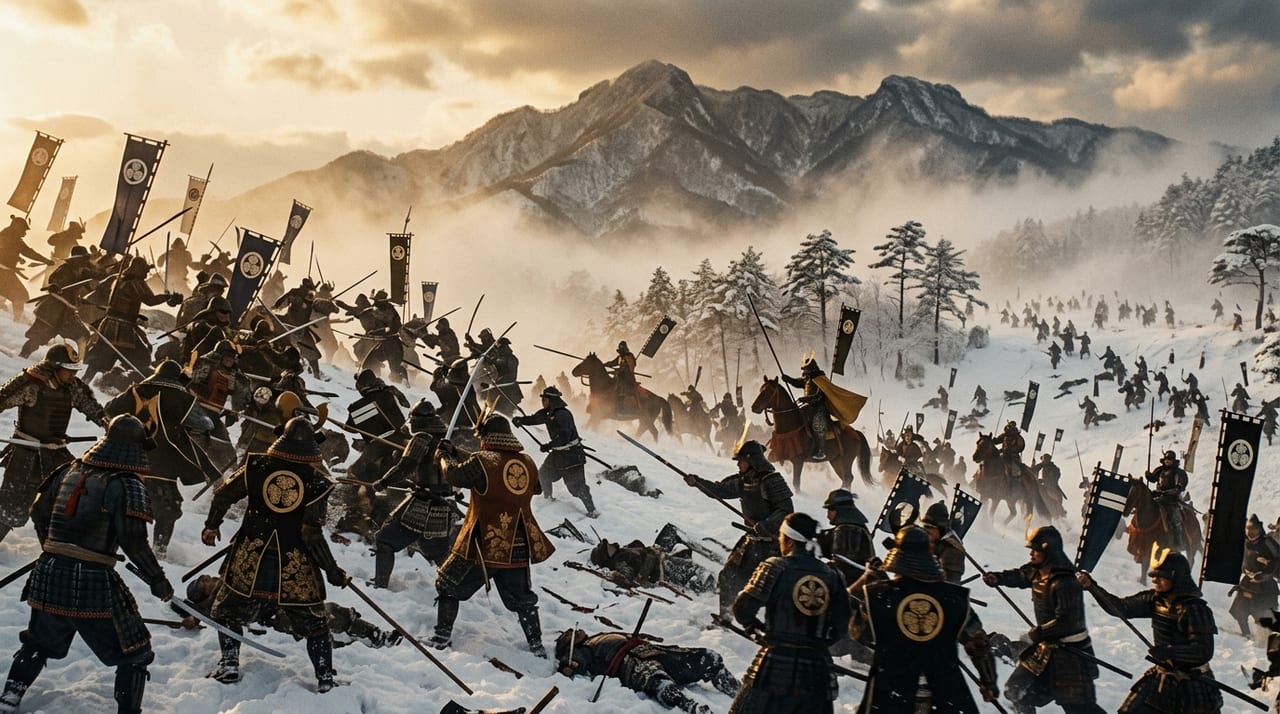
En 801 (Enryaku 20), Tamuramaro lança la troisième campagne à la tête d'une armée d'environ 40 000 hommes. En 802 (Enryaku 21), pendant la construction du château d'Isawa, Aterui et More, principaux chefs des Emishi, se rendirent à la tête de plus de cinq cents hommes. Certains historiens estiment que cette reddition fut le fruit de négociations de paix répétées, en plus de la soumission par la force.
La même année, Tamuramaro édifia le château d'Isawa à Isawa (Ōshū, préfecture d'Iwate), au cœur de la zone de domination des Emishi, et transféra le Chinjufu du château de Taga au château d'Isawa. En 803 (Enryaku 22), il bâtit en outre le château de Shiwa (près de Morioka, préfecture d'Iwate) afin d'étendre la domination vers le nord.
Aterui et More, soumis, furent conduits à Kyōto avec Tamuramaro. Tamuramaro proposa de les renvoyer dans leur pays natal pour amener les Emishi à se soumettre, mais les nobles de la cour s'y opposèrent, et les deux hommes furent exécutés dans la province de Kawachi. Cet épisode est au fondement de l'image légendaire ultérieure de Tamuramaro, celle d'un guerrier à la fois fort et miséricordieux.
Le titre de « Sei'i Taishōgun », dont la signification concrète fut gravée dans l'histoire par les campagnes de Tamuramaro, acquit par la suite une immense autorité symbolique dans les régimes militaires. Minamoto no Yoritomo, qui fonda le shogunat de Kamakura (nommé en 1192), Ashikaga Takauji, du shogunat de Muromachi (en 1338), et Tokugawa Ieyasu, du shogunat d'Edo (en 1603), revendiquèrent tous la légitimité de leur régime militaire en utilisant ce titre établi par Tamuramaro.
La période Heian initiale, à l'époque de Tamuramaro, marque une phase de transition dans la forme du sabre, du sabre droit (chokutō) au sabre courbe (wantō). Les sabres droits de l'époque Nara et du début de Heian évoluèrent, avec le changement de style de combat à cheval, vers le wantō, lame à un seul tranchant et courbée. Cette transformation s'accéléra de la seconde moitié du IXe siècle au Xe siècle, et le prototype du nihontō futur fut achevé. On estime que l'intégration de l'amélioration du warabitetō utilisé par les Emishi fut l'une des causes de cette évolution.
Le groupe de guerriers ayant acquis une expérience de combat dans le Tōhoku devint par la suite un noyau important dans la formation de la classe des bushi.
Après la mort de l'empereur Kanmu en 806 (Enryaku 25), Tamuramaro continua d'occuper de hautes fonctions. Il joua également un rôle actif dans la répression de l'incident de Kusuko (incident de l'empereur retiré Heizei) en 810 (Daidō 5). Il mourut en 811 (Kōnin 2) avec le titre de Dainagon et le troisième rang supérieur, et se vit conférer à titre posthume le second rang inférieur.
Après sa mort, Tamuramaro continua d'être vénéré comme divinité guerrière, et il est connu comme le héros de la légende de fondation du temple Kiyomizu-dera à Kyōto. Selon cette tradition, le temple fut fondé lorsque Tamuramaro, venu chasser le cerf sur le mont Otowa, rencontra le moine Kenshin (plus tard Enchin) et y édifia un sanctuaire-temple. Il fut aussi honoré comme gardien de la capitale impériale et comme divinité protectrice de Heian-kyō. En tant que divinité guerrière à laquelle on offrait sabres et armures, il continua d'attirer la foi des guerriers après le milieu de l'époque Heian, lorsque la classe des bushi se forma.