Nouveautés — Découvrez les dernières arrivées dans notre catalogue. Voir →
March 28, 1876 (Meiji 9)
Japan (nationwide, issued as Grand Council of State proclamation)
Forces
Meiji Government (proponents)
Former samurai class / shizoku (opposition)
Environ 8 min de lecture
On March 28, 1876 (Meiji 9), the Grand Council of State (Daijō-kan) issued Proclamation No. 38, formally titled "Prohibition of Sword-Wearing Except in Court Dress and by Military, Police, and Officials in Uniform"—known popularly as the Haitōrei. At a single stroke, this edict abolished the right to wear swords in public for all persons except military personnel, police officers, those wearing formal court dress, and others specifically authorized by the government.
The prohibition struck at the heart of samurai identity. For over a millennium—from the rise of the warrior class in the Heian period through the entire Edo shogunate—the right to wear two swords (the daisho, comprising the long katana and shorter wakizashi) had been the exclusive legal privilege of the samurai class. The Haitōrei did not merely remove a fashion accessory; it extinguished the most visible marker of warrior status.
The Haitōrei was implemented alongside the Chitsuroku Shobun of the same year, which abolished the hereditary stipends (karo and shōten-roku) paid to former samurai since the Meiji Restoration. The government converted these stipends to lump-sum "kinroku bonds" (gold stipend bonds), terminating ongoing income. Having already suffered substantial reductions through earlier stipend reforms in Meiji 2–3 (1869–1870), the former samurai class—numbering approximately 1.9–2 million persons nationwide—lost both their symbolic identity and their economic foundation simultaneously.
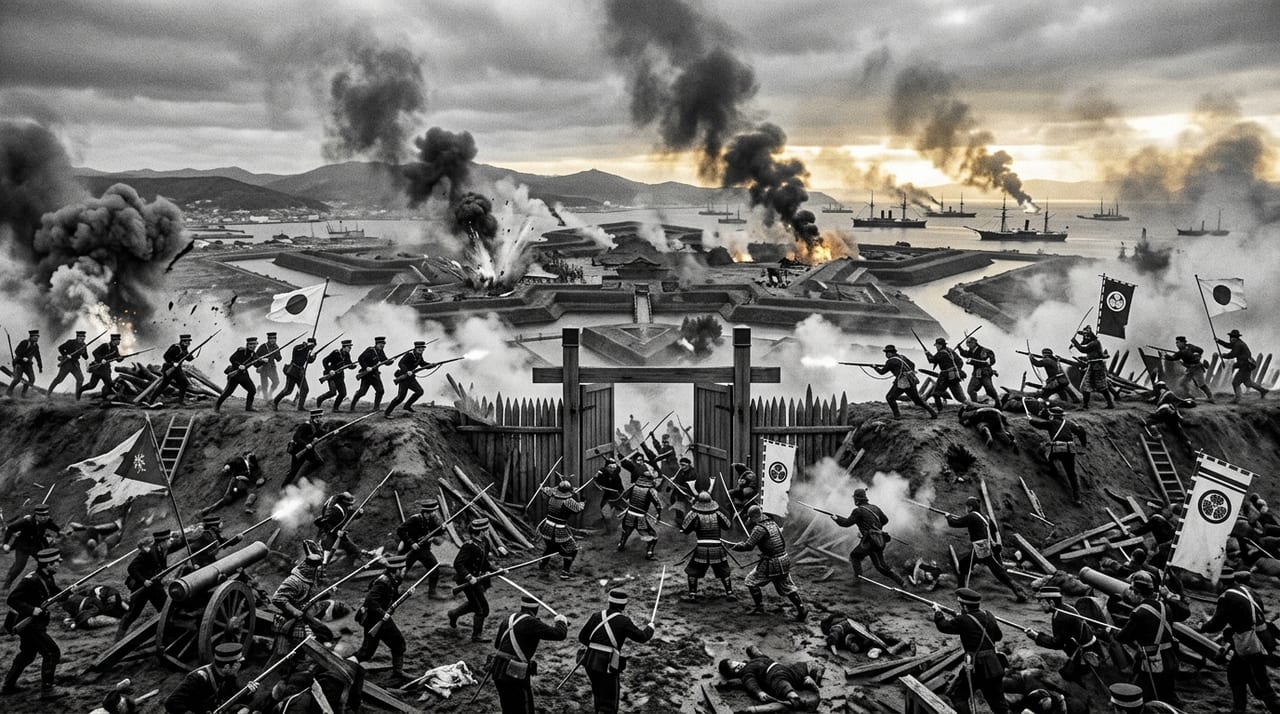
Resistance was swift and violent. In October 1876 alone, three uprisings erupted in rapid succession: the Shinpūren Rebellion (October 24) in Kumamoto, the Akizuki Rebellion (October 27) in Fukuoka, and the Hagi Rebellion (October 28) in Yamaguchi. The most extreme was the Shinpūren, led by Ōtaguro Tomoo and approximately 170 former Kumamoto domain warriors who attacked the Kumamoto garrison and castle, wrapping their swords in paper to avoid contact with Western-made weapons they considered spiritually impure. Though crushed within days, the symbolic charge of the uprising—samurai wielding traditional swords against a modern military state—resonated far beyond Kyushu.
The largest response came the following year: the Satsuma Rebellion of 1877, in which approximately 13,000 former Satsuma samurai under the nominal leadership of Saigō Takamori rose in what became the largest internal conflict of the Meiji era. After six months of fighting, the rebel force was annihilated and Saigō died by suicide on September 24, 1877, marking the effective end of organized samurai resistance to modernization.
The Haitōrei's impact on sword smiths was severe. With samurai no longer permitted to wear swords publicly, the primary market for new blades collapsed. Many smiths retrained as makers of practical cutting tools—kitchen knives, agricultural implements, carpenters' tools. Others sought survival through government-sponsored industrial exhibitions, where sword-making was repositioned as a form of fine craft. The Second National Industrial Exhibition of 1880 (Dai-ni Naikoku Kangyō Hakurankai) included sword and sword-fitting displays that helped introduce the concept of the sword as art object to a broader public.
Yet the Haitōrei's deepest historical legacy was paradoxical: by stripping the sword of its function as a weapon of social identity, it simultaneously launched the sword's transformation into art object and cultural heritage. Former samurai who could no longer wear their blades found themselves possessing heirlooms rather than tools. Economically devastated shizoku families sold ancestral swords to dealers, fueling a flourishing antique market in Tokyo, Osaka, and Kyoto. Western visitors—diplomats, collectors, scholars, and travelers arriving in Meiji Japan—purchased fine blades in considerable numbers, building collections that passed into the Boston Museum of Fine Arts, the British Museum, the Musée Guimet, and numerous private collections in Europe and North America.
The Meiji government's parallel investment in cultural institutions—including the establishment of the Imperial Museum (present-day Tokyo National Museum) in 1889 and the advocacy of Ernest Fenollosa and Okakura Tenshin for Japanese traditional art—helped reframe the sword as a pinnacle of Japanese aesthetic achievement rather than a relic of feudal oppression.
The Haitōrei of 1876, combined with the Chitsuroku Shobun, marks the critical hinge in the history of Japanese sword culture: the end of the sword as an instrument of class identity and martial practice, and the beginning of the sword's long second life as art object, cultural heritage, and symbol of Japanese civilization itself.