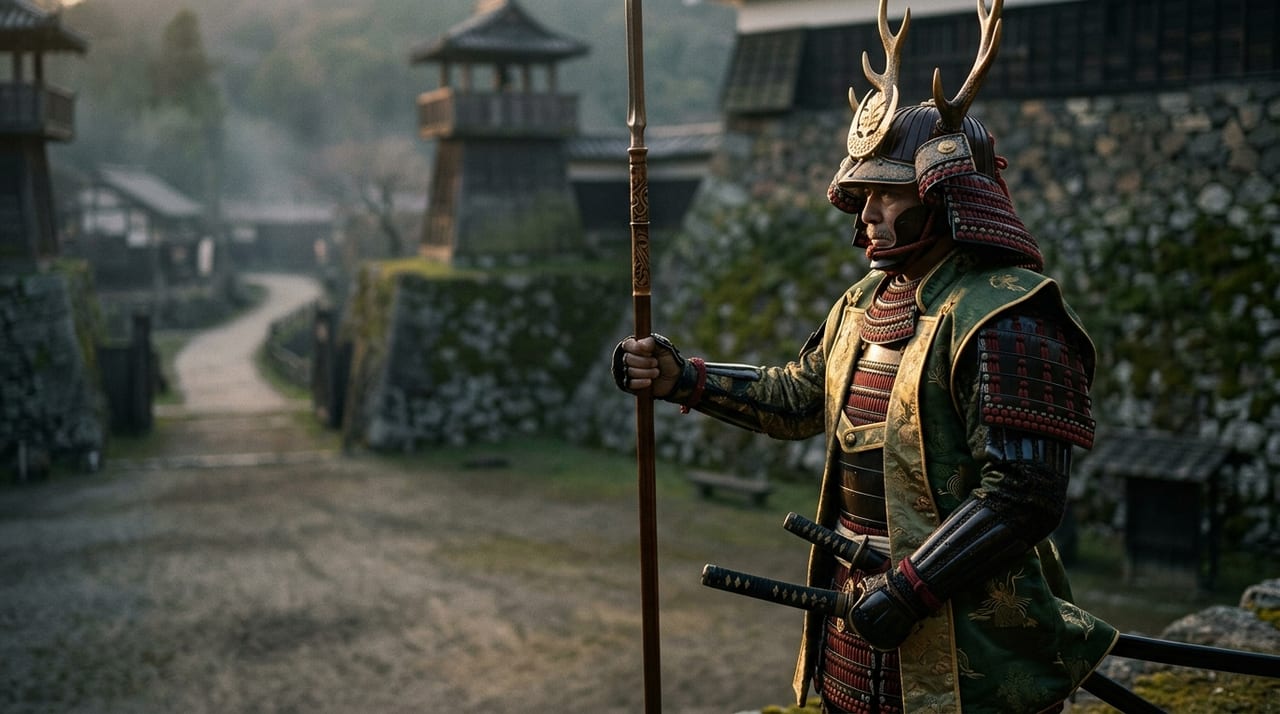
 * Image is for illustrative purposes only.
Takenaka Hanbei
竹中半兵衛
Military Strategist of Toyotomi Hideyoshi, Famed for Capturing Inabayama Castle
Description
Life and Origins
Takenaka Hanbei (real name Takenaka Shigeharu, 1544–1579) was a warrior of Mino Province, renowned as a peerless strategist who served Toyotomi Hideyoshi. Ranked together with Kuroda Kanbei (Yoshitaka) as the “Two Bei,” his wisdom and cunning gave rise to many anecdotes in later ages. He was based at Bodaisan Castle in Mino (present-day Tarui, Gifu Prefecture) and first served the Saito clan of Mino.
The Seizure of Inabayama Castle
What raised Hanbei’s name was his seizure of Inabayama Castle (later Gifu Castle) in 1564. To remonstrate against the misrule of his lord, Saito Tatsuoki, Hanbei is said to have led a small band of retainers and taken the Saito stronghold of Inabayama in a short time. This feat, capturing a formidable castle with few soldiers, has been handed down as an event emblematic of Hanbei’s strategic skill. Other accounts hold that he actually attacked together with the forces of his father-in-law, Andō Morinari. The castle was back in Tatsuoki's hands by around the 8th month of that year, but the affair made Hanbei’s name known throughout the realm.
As Hideyoshi’s Strategist
After the fall of the Saito, Hanbei spent time as a guest retainer of Azai Nagamasa, among other things, and from around 1570 (Genki 1) became a yoriki (attached commander) under Kinoshita Hideyoshi (later Toyotomi Hideyoshi), serving actively as his strategist. He is said to have supported Hideyoshi’s military plans, beginning with the Chūgoku campaign, and to have shown skill in tactical persuasion and battle formations. In 1578, when Kuroda Kanbei went to Arioka Castle to persuade Araki Murashige and was imprisoned there, Nobunaga, suspecting Kanbei of defecting, ordered the execution of Kanbei’s son and hostage, Shoju-maru (later Kuroda Nagamasa). Hanbei, however, is said to have secretly sheltered the boy and spared his life. After Kanbei’s innocence was established, this act was long remembered as a debt of gratitude owed by the Kuroda house.
Swords and Arms
Hanbei was a native of Mino, a major center of swords in the Mino tradition founded by Shizu Saburo Kaneuji. As a commander who directed battles himself, Hanbei is thought to have been familiar with the practical blades of Mino smiths. For Hanbei as a strategist, the true value lay in supporting his lord through tactics and wisdom rather than through martial prowess with sword and spear; the sword was borne merely as the outward tool of a samurai.
Later Reputation
In 1579, Hanbei fell ill in camp during the campaign against Miki Castle in Harima and died at his headquarters on Mount Hirai, aged 36. He is said to have suffered from consumption, a disease of the lungs. His remaining at the front despite his frail body was revered as proof of his loyalty to his lord, Hideyoshi. Likened to the Chinese master strategist Zhuge Kongming as “Hideyoshi’s famed strategist,” Hanbei became one of the byword figures of wise commanders in Japanese history, and the ruins of Bodaisan Castle and his grave still remain in Tarui today.