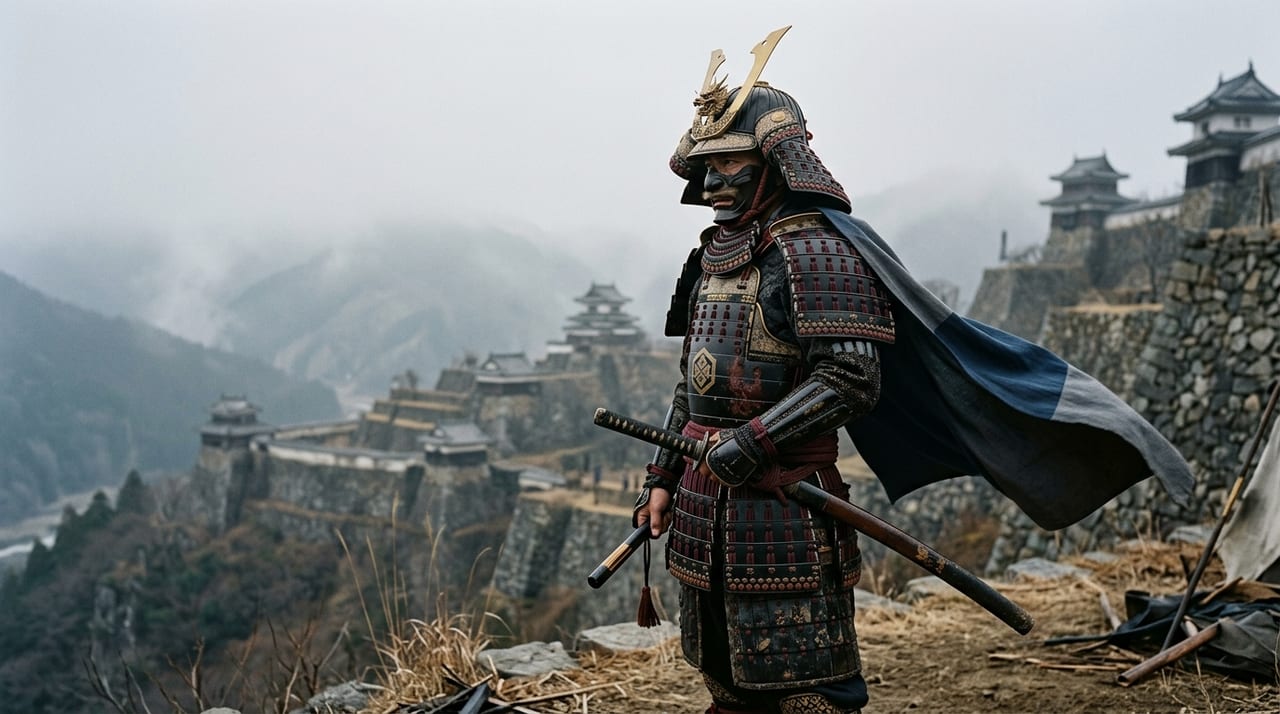
 * Image is for illustrative purposes only.
Ōmura Sumitada
大村純忠
Daimyo
Description
From the Arima to the Ōmura House
Ōmura Sumitada was born in 1533 (Tenbun 2) as the second son of Arima Harusumi of Hizen Province. Because his mother was a daughter of Ōmura Sumikore, he was adopted in 1538 as heir to his uncle Ōmura Sumisaki, and succeeded to the headship of the Ōmura house in 1550. He held the court titles of Minbu-no-taifu and later Tango-no-kami. The circumstances of his adoption would later become the seed of bitter conflict with Gotō Takaakira and others descended from the Ōmura bloodline.
Japan's First Christian Daimyo
In 1563 (Eiroku 6), Sumitada received baptism from the Jesuit father Cosme de Torres and took the Christian name Dom Bartolomeu. This is regarded as the first baptism of a daimyo in Japan, and it marks the starting point of Christian history in Kyushu. His faith was not merely personal: large-scale missionary work was carried out within his domain, and a great number of his subjects are said to have converted. At the same time, records also describe a forceful religious policy that included the destruction of Buddhist and Shinto establishments, the expulsion of monks, and persecution of those who refused conversion, so assessments of his rule remain divided.
Nanban Trade and the Opening of Nagasaki
The core of Sumitada's policy was to admit Portuguese ships into his territory in exchange for permitting Christian missionary work, and thereby to profit from the Nanban trade. In 1562 (Eiroku 5) he opened Yokoseura to Portuguese vessels, but the port was destroyed by fire within about a year. After an interval at Fukuda, he opened Nagasaki in 1571 (Genki 2), and it became the center of the Nanban trade thereafter. Imports centered on raw silk and silk textiles, and also included weapons such as firearms. The influx of guns changed the conduct of warfare in Kyushu, while Nanban culture — medicine, astronomy, music, and art — entered alongside the goods.
Internal Strife and Submission to the Ryūzōji
Sumitada's rule was under constant pressure from without and within. Gotō Takaakira, son of the elder brother whose line had been displaced by Sumitada's adoption, mounted repeated attacks, and Yokoseura was burned in the course of the fighting. In 1572 (Genki 3), Takaakira's forces made a surprise assault on Sumitada's seat at Sanjō Castle, but Sumitada held out with only a handful of men and drove them off — an episode transmitted as the "Sanjō Shichiki-gomori," the defense by seven horsemen. Around 1576–1577 he came under the pressure of Ryūzōji Takanobu, the dominant power in Hizen, and was reduced to near-vassalage; in 1584 he took the field on the Ryūzōji side at the Battle of Okitanawate.
The Donation of Nagasaki and the Tenshō Embassy
In 1580 (Tenshō 8), Sumitada donated Nagasaki and Mogi to the Jesuits as church territory. Since any neighboring power attacking Nagasaki would thereby make an enemy of Portugal, the donation was also a pragmatic device for protecting both the trading base and his own domain. Jesuit direct administration of Nagasaki continued until 1587. In 1582 he met the Visitor Alessandro Valignano and, together with Arima Harunobu and Ōtomo Sōrin, decided to dispatch a mission of young envoys to Rome. His own representative was his nephew Chijiwa Miguel.
Death and Historical Assessment
In the third month of 1587 (Tenshō 15) he joined Toyotomi Hideyoshi's pacification of Kyushu and was confirmed in his domains, but he died of illness on the eighteenth day of the fifth month (23 June). Hideyoshi issued his edict expelling the missionaries the following month, so Sumitada died without seeing his faith and his trade policy overturned at their foundations. He was succeeded by his heir Yoshiaki (Christian name Sancho). As the first daimyo in Japan to be baptized, and as the ruler who opened Nagasaki — early modern Japan's greatest international port — Sumitada holds a firm place in the history of Japan's foreign relations.