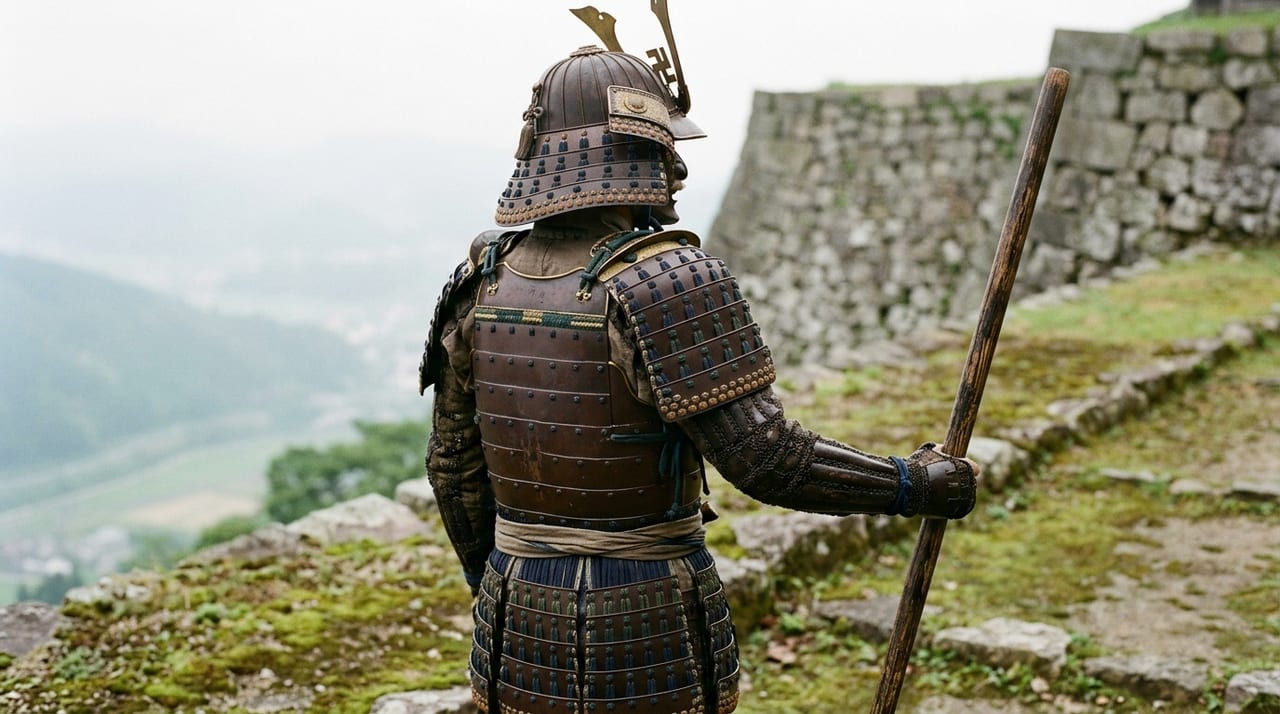
 * Image is for illustrative purposes only.
Musō Gonnosuke
夢想権之助
Founder of Shintō Musōryū Jōjutsu; martial artist who established the origins of modern Jōdō
Description
Musō Gonnosuke Katsuyoshi (dates of birth and death unknown; active in the first half of the 17th century) was a martial artist known as the founder of Shintō Musōryū Jōjutsu who established a martial arts system using a wooden staff known as the jō (杖). As the source of modern Jōdō, the art is still practiced worldwide today as a martial art recognized by the All Japan Kendo Federation.
Musō Gonnosuke studied swordsmanship under Sakurai Ōsumi-no-kami Yoshikatsu, and later, when he secluded himself at Mount Hōman (Hōmanzan) in Chikuzen Province (present-day Fukuoka Prefecture), he is said to have received the secret teachings of jōjutsu through a dream oracle (a divine message received in a dream). The school's name was initially Shindō Musō-ryū (真道夢想流), and later, after passing through Shintō Musō-ryū (新當夢想流), it came to be called Shintō Musōryū (神道夢想流). The jōjutsu that Musō Gonnosuke established is a technical system in which a 4 shaku 2 sun 1 bu (approx. 128 cm) wooden staff is used against an opponent armed with a sword, and it has its own distinctive forms (kata) that combine distance (maai), body movement (tai-sabaki), striking, and thrusting.
The greatest legend in Musō Gonnosuke's life concerns his match with Miyamoto Musashi. In the Kaijō Monogatari and Niten-ki, Musō Gonnosuke is said to have been defeated by Musashi. On the other hand, the oral transmission of Shintō Musōryū holds that after his defeat he prayed at Kamado Shrine on Mount Hōman, deepened his study of jōjutsu, and then faced Musashi again and finally defeated him (though, according to another account, the second match ended in a draw). This tradition is important as a symbolic expression of the Shintō Musōryū philosophy that a staff, a weapon close to empty-handed, can stand against a sword.
Shintō Musōryū was passed down in the Fukuoka Domain (Kuroda Domain) until the Meiji Restoration as one of the dangyō, the arresting techniques (torite-jutsu) learned mainly by lower-ranking samurai. From the Meiji era onward, Shiraishi Hanjirō and others opened the way for its nationwide spread, and in the Shōwa era, Shimizu Takaji and others, disciples of Shiraishi, joined the Dai Nippon Butoku Kai and advanced its full-scale nationwide spread. Shimizu moved to Tokyo and taught keijōjutsu (police staff techniques) at the Tokyo Metropolitan Police Department; in 1956, the All Japan Jōdō Federation joined the All Japan Kendo Federation, becoming the parent body of modern Jōdō (All Japan Kendo Federation Jōdō). Today, many practitioners in Japan and abroad continue to train in it, and it keeps developing on its own as a martial art that addresses the Japanese sword.
Notable Swords
- Jō of Shintō Musōryū authentic transmission (4 shaku 2 sun 1 bu)