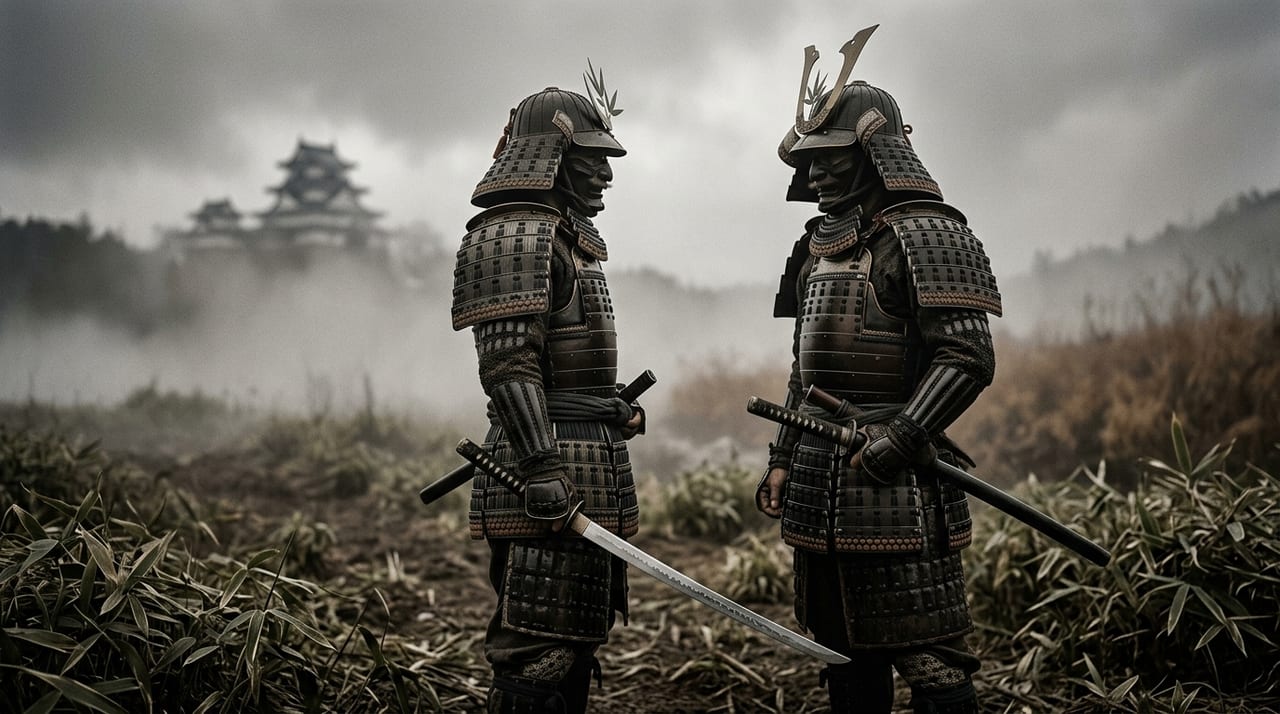
 * Image is for illustrative purposes only.
Momonoi Shunzō
桃井春蔵
The fourth Momonoi Shunzō, master of Kyōshin Meichi-ryū praised for his "dignity"
Description
Origins and Entry into the School
The fourth Momonoi Shunzō (1825-1885), personal name Naomasa, was born the second son of Tanaka Toyoaki, a samurai of the Numazu domain in Suruga Province. In 1838, at the age of fourteen, he entered the Edo dōjō known as the Shigakukan and began studying Kyōshin Meichi-ryū. He received full transmission at twenty-three and the inner transmission at twenty-five, and in 1852 became the adopted son-in-law of the third Momonoi Shunzō and succeeded him as the fourth holder of the name.
The Shigakukan and Kyōshin Meichi-ryū
Kyōshin Meichi-ryū was founded in 1773 when the first Momonoi Shunzō, Naoyoshi, opened the Shigakukan at Minami-Kayabachō in Nihonbashi. The dōjō later moved to Shijimi-gashi in Ōdomichō, Minami-Hatchōbori, and by the closing years of the Tokugawa era it flourished alongside Chiba Shūsaku's Genbukan (Hokushin Ittō-ryū) and Saitō Yakurō's Renpeikan (Shintō Munen-ryū) as one of the "three great dōjō of Bakumatsu Edo."
"Dignity from Momonoi, Technique from Chiba, Power from Saitō"
The saying that compares the three great dōjō, "dignity from Momonoi, technique from Chiba, power from Saitō," is widely known. The swordsmanship of the fourth Shunzō was judged supreme not in speed or brute strength but in the loftiness of bearing expressed through his stance and deportment, that is, in kurai or dignity. The phrase captures well the martial outlook of the age, in which the sword was seen not merely as a weapon but as a mirror of its wielder's character.
Disciples and the Loyalist Cause
In 1856 Takechi Hanpeita (Zuizan) came up from Tosa bringing Okada Izō and others and entered the school; recognising Takechi's ability, Shunzō promoted him to head student. Many samurai of Tosa and other loyalists of the Bakumatsu era frequented the Shigakukan, making it emblematic of an age in which the fencing hall served as a node of political connection.
Life after the Restoration
From 1868 he served as inspector and fencing instructor of the Naniwa Corps, functioning in effect as its commander. He later entered the service of Sakai Prefecture and became a priest of the Konda Hachiman Shrine. He died of cholera on 3 December 1885 at the age of sixty-one, and in 2005 was honoured with enshrinement in the Kendo Hall of Fame.