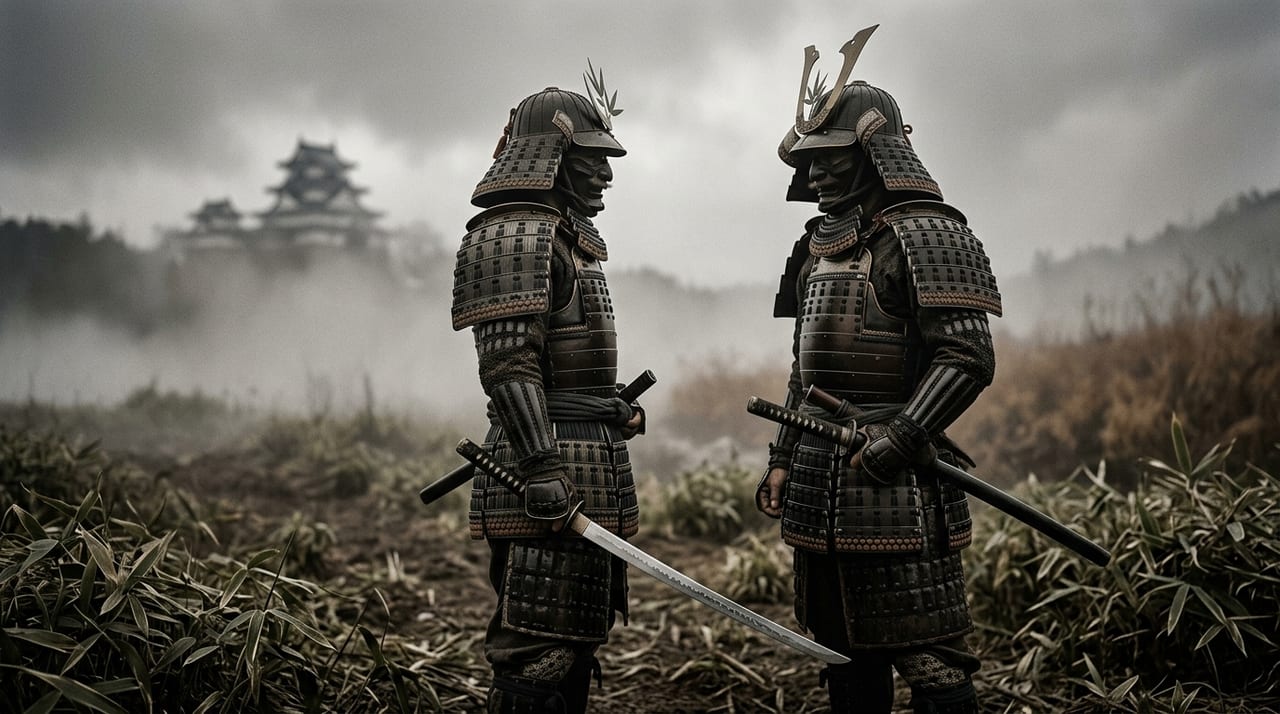
 * Image is for illustrative purposes only.
Kani Saizō
可児才蔵
Saizō of the Bamboo Grass at Sekigahara, Master Head-Taker and Master Spearman
Description
Kani Saizō (1554-1613) was a samurai commander known as “Sasa no Saizō” for his role at the Battle of Sekigahara, and he is also renowned as a master spearman and an expert at taking heads. His life was turbulent, as he moved from one lord to another many times, but his martial prowess was highly valued even in his own time.
Saizō was a native of Mino (Gifu), and he is said to have studied spearmanship under Hōzōin In'ei, the founder of Hōzōin-ryū spearmanship. In the course of his life, Saizō served many lords, including Shibata Katsuie, Akechi Mitsuhide, Maeda Toshiie, Oda Nobutaka, Toyotomi Hidetsugu, and Fukushima Masanori.
At the Battle of Sekigahara (1600), he served Fukushima Masanori and fought on the Eastern Army side. His military achievements in this battle were outstanding. In the main engagement he is said to have taken 17 enemy heads, and Tokugawa Ieyasu greatly praised him. Because he had so many heads that he could not carry them all, he had bamboo leaves placed in the mouths of the heads as markers, and at the post-battle head inspection he used them to prove which heads he had taken. The nickname “Sasa no Saizō” is said to derive from this bamboo, and it is said to have begun during the Kōshū campaign (conquest of Kai, 1582), when he was serving Mori Nagayoshi. This practical and rational method shows both his calm judgment on the battlefield and his sharp resourcefulness as a warrior.
Saizō's true strength lay in the spear, and his military achievements were praised as follows: he led the vanguard, crossed spears twenty-eight times, and took twenty heads, a feat unheard of in all ages.
After Sekigahara, Saizō continued to serve Fukushima Masanori, and when the Fukushima family was transferred to Aki Province, he spent his later years in Hiroshima. He died in Keichō 18 (1613), but it is said that his spirit did not decline until the end of his life. The anecdotes of “Sasa no Saizō” were passed down as tales of martial exploits throughout the Edo period, and today he remains one of the figures beloved by many fans of samurai commanders.
Related Warriors
別所長治
Late Sengoku PeriodBessho Nagaharu
Tragic Lord of Miki Castle · Valiant Warrior of Harima
柳生石舟斎
Late Sengoku PeriodYagyū Sekishūsai
Founder of Yagyū Shinkage-ryū, Sword Saint Who Perfected the Sword-Taking Technique
津軽為信
Late Sengoku PeriodTsugaru Tamenobu
Founder of Tsugaru Domain and Warlord of Ōshū Who Achieved Independence from the Nanbu Clan
森可成
Late Sengoku PeriodMori Yoshinari
Fierce General of Oda Nobunaga, Lord of Usayama Castle