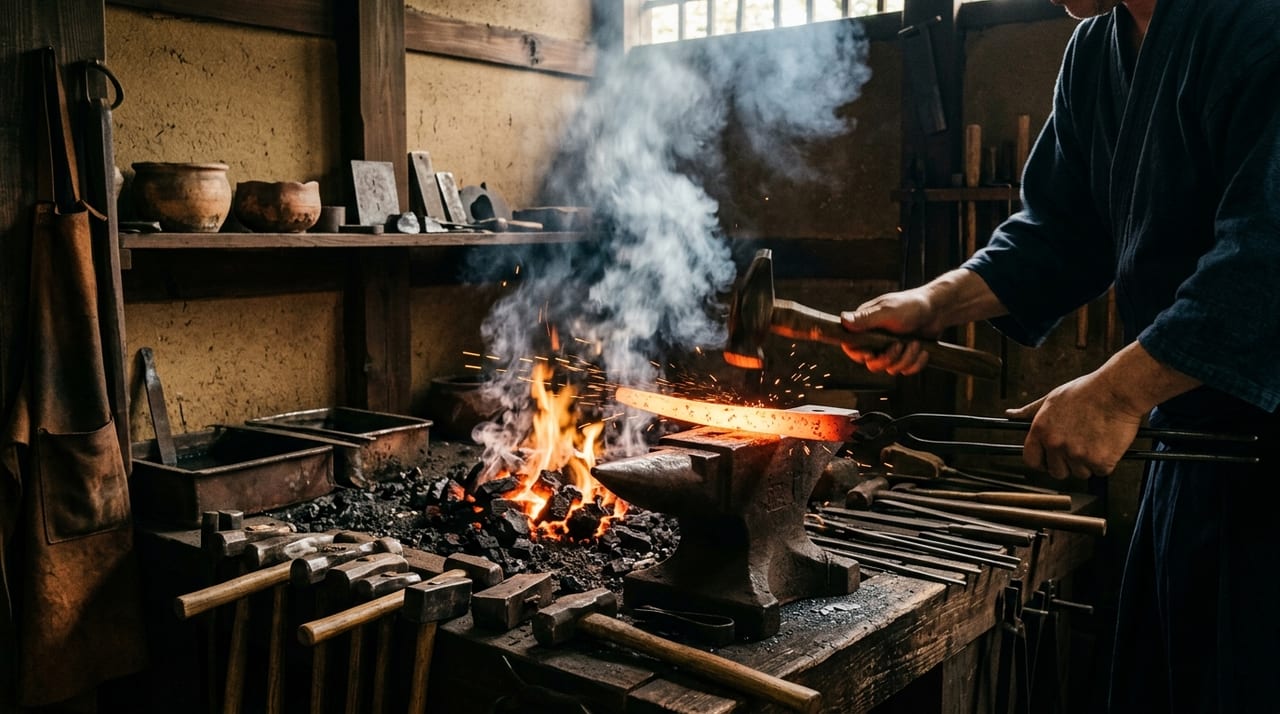
 * Image is for illustrative purposes only.
Ueta Sukesada
上田祐定
Description
Bizen Osafune's Modern Heir — Ueta Sukesada
Ueta Sukesada is a contemporary swordsmith based in Osafune-chō, Setouchi City, Okayama Prefecture, and is highly regarded at home and abroad as a smith who embodies in the present day the tradition of the historic forging ground "Bizen Osafune." Born in Kōchi Prefecture in 1947, he studied under the swordsmiths Imaizumi Toshimitsu and Kawachi Kunihira, and afterward established the "Bizen Osafune Nihontō Denshūjo" in Osafune-chō, where he also trains apprentices.
The place name Osafune holds a special significance in the history of the Japanese sword. From the mid-Kamakura period through the Muromachi period, Osafune (present-day Osafune-chō, Setouchi City) flourished as Japan's largest sword-producing center, and "Osafune-mono" circulated throughout the country. Celebrated master smiths who shine in the history of the Japanese sword, including Mitsutada, Nagamitsu, Kagemitsu, Kanemitsu, Morimitsu, and Yasumitsu, forged blades in this place. Ueta Sukesada continues to make swords in the present day in exactly this historic place, forging blades while bearing the weight that the name Osafune carries.
Deep Interest in Tamahagane and Ancient Iron-Making Techniques
What distinguishes Ueta Sukesada's swordmaking in particular is his deep interest in and research into tamahagane (jewel steel) and ancient iron-smelting techniques. While many contemporary swordsmiths use the tamahagane supplied by the NBTHK (Nihon Bijutsu Tōken Hozon Kyōkai), Ueta has independently researched and practiced small-scale tatara smelting using iron sand and charcoal, and has attempted to use tamahagane he smelted himself in his swordmaking.
This endeavor goes beyond mere technical interest and shows a philosophical stance that confronts the fundamental question, "What is the essence of the Japanese sword?" His deep involvement in the process, from smelting the raw iron to forging the blade, embodies Ueta's swordsmithing philosophy, which regards the Japanese sword not as a mere "product" but as a "consistent cultural practice."
Characteristics of His Swordmaking — The Essence of Bizen-den and Modern Interpretation
Ueta Sukesada's works, backed by the techniques refined in Osafune, the home ground of the Bizen-den tradition, revive the ancient Bizen-den style in the present day with a high degree of completeness. The jigane is a refined forging built mainly on itame, and works that display an appearance close to chōji-utsuri and Bizen-utsuri are also known; efforts to recreate the atmosphere of old Bizen blades are visible throughout.
The hamon is centered on chōji-midare, gunome, and gunome-chōji, with rich ashi and yō activity and a varied interior landscape. The nie and its workings are also excellent, and overall the finished pieces are reminiscent of the works of the celebrated masters who made blades in Osafune in the old-sword period. The shape is elegant, with a moderate curvature conscious of the old-sword style, and he has succeeded in recreating, with modern materials and techniques, the atmosphere of Osafune's famous blades from the Kamakura to Muromachi periods.
At the Bizen Osafune Nihontō Denshūjo, he has so far trained a dozen or so apprentices into swordsmiths, and he offers free public viewing of the forging sessions.
Relationship with the Bizen Osafune Sword Museum — A Hub for Cultural Outreach
Osafune-chō in Setouchi City, where Ueta Sukesada is active, is home to the Bizen Osafune Tōken Hakubutsukan (Bizen Osafune Sword Museum), which functions as a cultural hub addressing both the history of Osafune and the transmission of contemporary swordmaking. Ueta has set up his Denshūjo at a site about a five-minute walk from the museum, and he contributes to promoting Osafune's sword culture. Inside the museum, the Imaizumi Toshimitsu Swordsmith Memorial Hall recreates the workshop of Imaizumi Toshimitsu, under whom Ueta studied.
The weight that the name Osafune itself carries in the history of the Japanese sword, together with the presence of Ueta Sukesada, who continues to forge blades there in the present day, is one of the most compelling proofs that the tradition of the Japanese sword functions today as a living continuity.
TOUKENZA and Ueta Sukesada
TOUKENZA introduces Ueta Sukesada as a contemporary swordsmith who continues to forge blades in Bizen Osafune, the sacred ground of the Japanese sword. His deep involvement in the process, from research into tatara iron-smelting through to swordmaking, and his tireless pursuit of reviving the essence of Bizen-den in the present day, embody what it truly means for the Japanese sword tradition to be inherited. Ueta's works, forged while bearing the land and history of Osafune, have been covered by media in Japan and abroad as modern Japanese swords made from steel he produced himself from iron sand.
Famous Works
- katana (made from self-produced tatara steel)