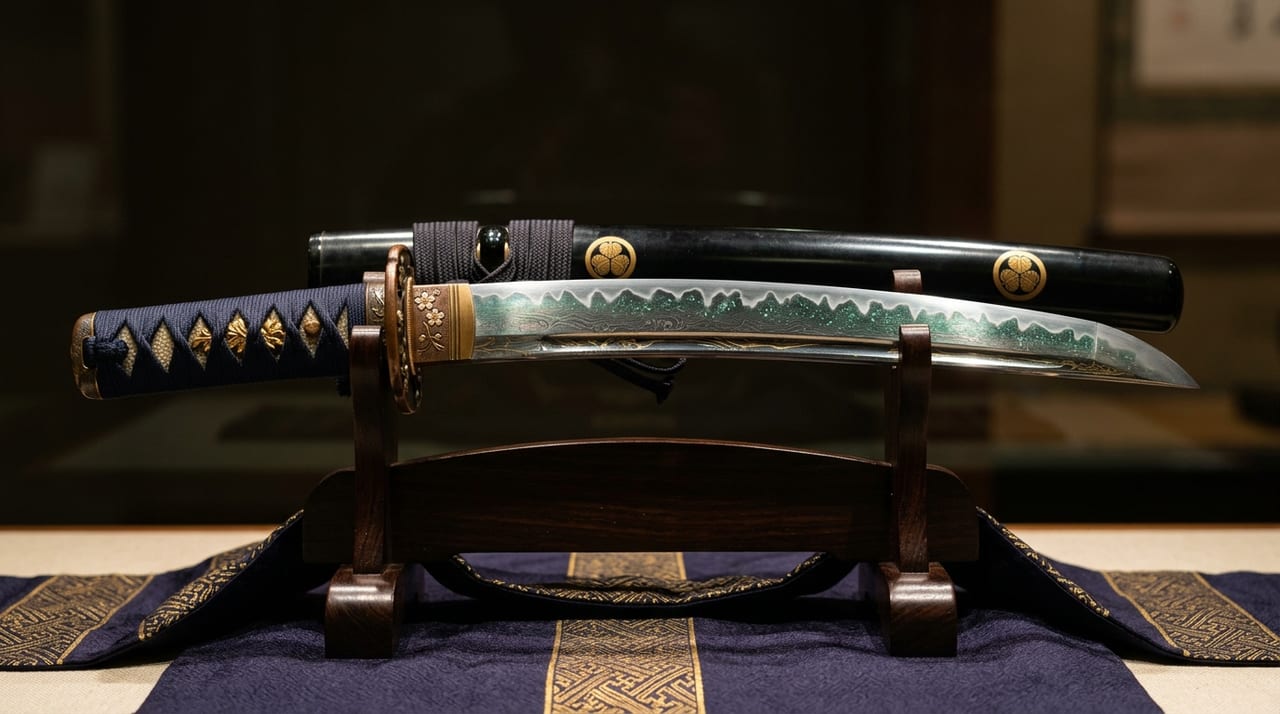
 * Image is for illustrative purposes only.
Tachi Signed Yasuie
太刀 銘 安家
Also known as: Yasuie; Ko-Hōki Yasuie
Description
Yasuie of the Ko-Hōki School
The tachi signed Yasuie was forged in the late Heian period by the swordsmith Yasuie, active in Hōki Province (present-day Tottori Prefecture). Yasuie is traditionally held to be the son of Yasutsuna, the smith who forged Dōjigiri Yasutsuna, one of the Tenka Goken, and the Ko-Hōki school Yasutsuna founded is said to have flourished into the early Kamakura period. Yet this blade is considered the only surviving work whose attribution to Yasuie's own hand is firmly established.
Workmanship
The blade shows a slightly narrow body with a pronounced koshizori curvature and an elegant, archaic stance. Its itame grain is tightly forged yet shows visible activity, and its subdued steel tone recalls old Bizen work, while displaying a more vigorous grain pattern considered distinctive of the Ko-Hōki tradition.
Designation and Present Location
It was designated an Important Cultural Property in April 1935 and elevated to National Treasure status on November 14, 1953. It is now in the collection of the Kyoto National Museum, owned by the National Institutes for Cultural Heritage.
Legends & Stories
Yasuie's father Yasutsuna is celebrated in legend as the smith who forged Dōjigiri Yasutsuna, said to have slain the demon Shuten-dōji of Mount Ōe. Yasuie is remembered as one of the few Ko-Hōki smiths to carry on that lineage's craft, and with only this single blade firmly attributed to him, it stands as a rare surviving testament to the bloodline of a legendary demon-slaying master.