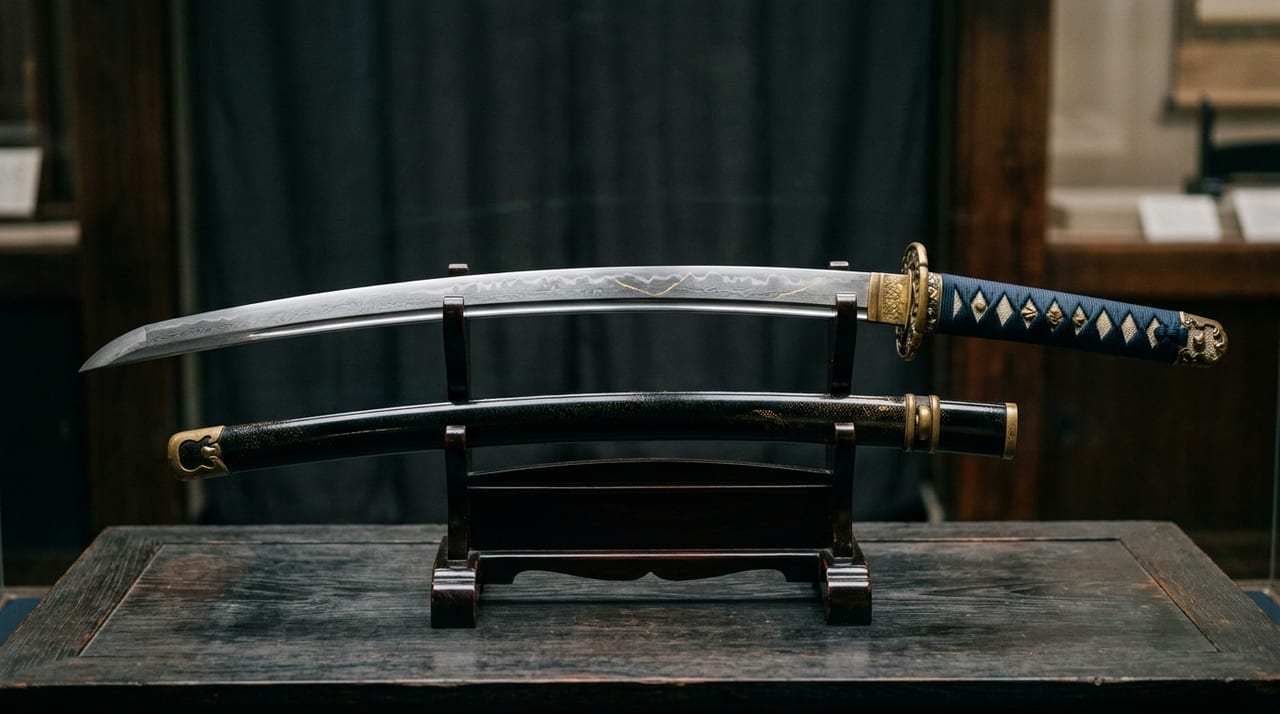
 * Image is for illustrative purposes only.
Tachi by Osafune Morikage
長船盛景の太刀
Also known as: Tachi signed Bizen no Kuni jū Osafune Morikage — Important Cultural Property, Nanbokuchō period
Description
Overview of Osafune Morikage's Tachi
Osafune Morikage (長船盛景) was a swordsmith active at Osafune in Bizen Province during the Nanboku-chō period. His signed tachi "Bizen Province Resident Osafune Morikage" is designated as an Important Cultural Property. Morikage belonged to a branch lineage of the Osafune school (also transmitted as the Ōmiya line), positioned within the genealogical succession of Sanenaga, Chikakage, Yoshikage, and Morikage. He is distinctive for forging tachi of grand proportions characteristic of the Nanboku-chō period—broad in width and robust in form—combined with a brilliant hamon founded on the chōji-midare pattern characteristic of the Osafune tradition. It should be noted that calling him "Ko-Bizen Morikage" is erroneous; Morikage was an Osafune smith of the Nanboku-chō period, not a Ko-Bizen smith of the late Heian and early Kamakura periods.
Style and Lineage
During the Nanboku-chō period, the Osafune school of Bizen transformed, departing from the refined tachi of the Kamakura period to produce large-scale swords with broad width and shallow depth. Morikage's tachi exemplify this period's aesthetic: the jigane displays itame with pronounced utsuri, and the hamon exhibits a forceful composition of interlocking gunome and chōji patterns. He was active contemporaneously with celebrated Osafune masters such as Kanemitsu and Nagayoshi, and is evaluated as a renowned smith who played a prominent role in Nanboku-chō Bizen.
Designation and Collection
The Important Cultural Property "Tachi, Signed 'Bizen Province Resident Osafune Morikage'" was designated in Shōwa 28 (1953) and is currently preserved in the Fukuyama Art Museum in Fukuyama City, Hiroshima Prefecture. Additionally, Morikage is known to have created another Important Cultural Property—"Great Naginata, Signed 'Bizen Province Osafune Resident Morikage / Jōji 6'"—which should be understood as distinct from the tachi.
Legends & Stories
Morikage belongs to a branch of the Osafune school — a lineage sometimes traced through the Ōmiya line, running Sanenaga, Chikakage, Yoshikage, Morikage — working in Bizen during the Nanbokuchō period. The signed tachi "Bizen no Kuni jū Osafune Morikage" was designated an Important Cultural Property in 1953 and is held by the Fukuyama Museum of Art in Hiroshima Prefecture. It shows the broad, powerful sugata characteristic of its period, with the flamboyant chōji-midare hamon of the Osafune tradition. A separate Morikage piece — the great naginata signed "Bishū Osafune jū Morikage / Jōji 6" — is also an Important Cultural Property and should not be confused with it. Calling this smith "Ko-Bizen Morikage" is a misnomer: the Ko-Bizen group belongs to the late Heian and early Kamakura periods, roughly two centuries before Morikage worked.