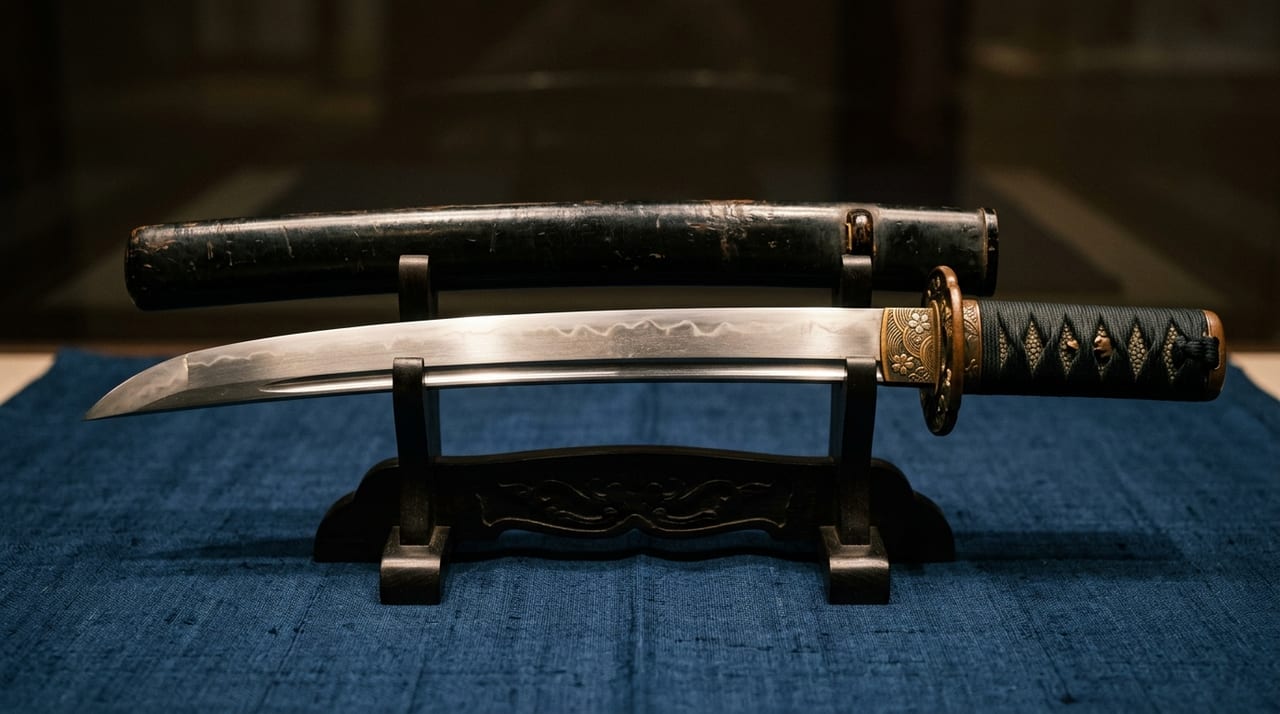
 * Image is for illustrative purposes only.
Tachi Signed Yamato Norinaga saku
太刀 銘 大和則長作
Also known as: Tachi by Shikkake Norinaga; formerly of Tanzan Shrine, presented to Emperor Meiji
Description
A Signed Work by the Founder of the Shikkake School
In Kamakura-period Yamato Province (present-day Nara Prefecture), five schools of swordsmithing arose — Senjuin, Taima, Shikkake, Hōshō and Tegai — known collectively as the Yamato Gokaden, or Five Schools of Yamato. All of them grew up serving the demand of the warrior-monks attached to the great temples and shrines of Nara. Norinaga, the maker of this blade, is regarded as the effective founder of the Shikkake school; works survive bearing dates corresponding to 1319 and 1340.
This tachi has a cutting edge of 73.3 cm. It shows the sturdy construction typical of the Yamato tradition, with a high shinogi ridge and a broad shinogi-ji. The hamon is based on suguha mixed with small gunome, with tobiyaki appearing in places. Among Yamato blades — made above all for hard use — it is highly regarded for the quality of both its steel and its temper line.
Provenance
The blade was originally transmitted at Tanzan Shrine in Yamato Province (Sakurai, Nara Prefecture). Records show that in 1885 the shrine presented it to Emperor Meiji. It later changed hands and is today held by the Kurokawa Institute of Ancient Cultures in Nishinomiya, Hyōgo Prefecture.
Designation
The blade is designated an Important Cultural Property in the crafts category. Signed works by Norinaga are limited in number, and among the Yamato Five Schools the Shikkake school has left particularly few surviving blades, so this tachi serves as one of the benchmark works for verifying the Yamato style.
Legends & Stories
Long kept at Tanzan Shrine in Yamato, this tachi is recorded as having been presented by the shrine to Emperor Meiji in 1885. Passing from an ancient shrine dedicated to Fujiwara no Kamatari into the hands of a modern emperor gives the blade a provenance all its own.
Related Famous Swords
太刀 銘 国行(当麻)
National TreasureTachi Signed Kuniyuki (Taima)
Kuniyuki (founder of the Taima school)
伏見貞宗
National TreasureFushimi Sadamune
Sadamune (Sōshū Sadamune)
沃懸地酢漿平文兵庫鎖太刀
National TreasureIkakeji Katabami Hyōmon Hyōgogusari Tachi
Unknown (unsigned)
薙刀 銘備前国長船住人長光造
National TreasureNaginata Signed Bizen-no-kuni Osafune-jūnin Nagamitsu Zō
Nagamitsu (Osafune, Bizen)