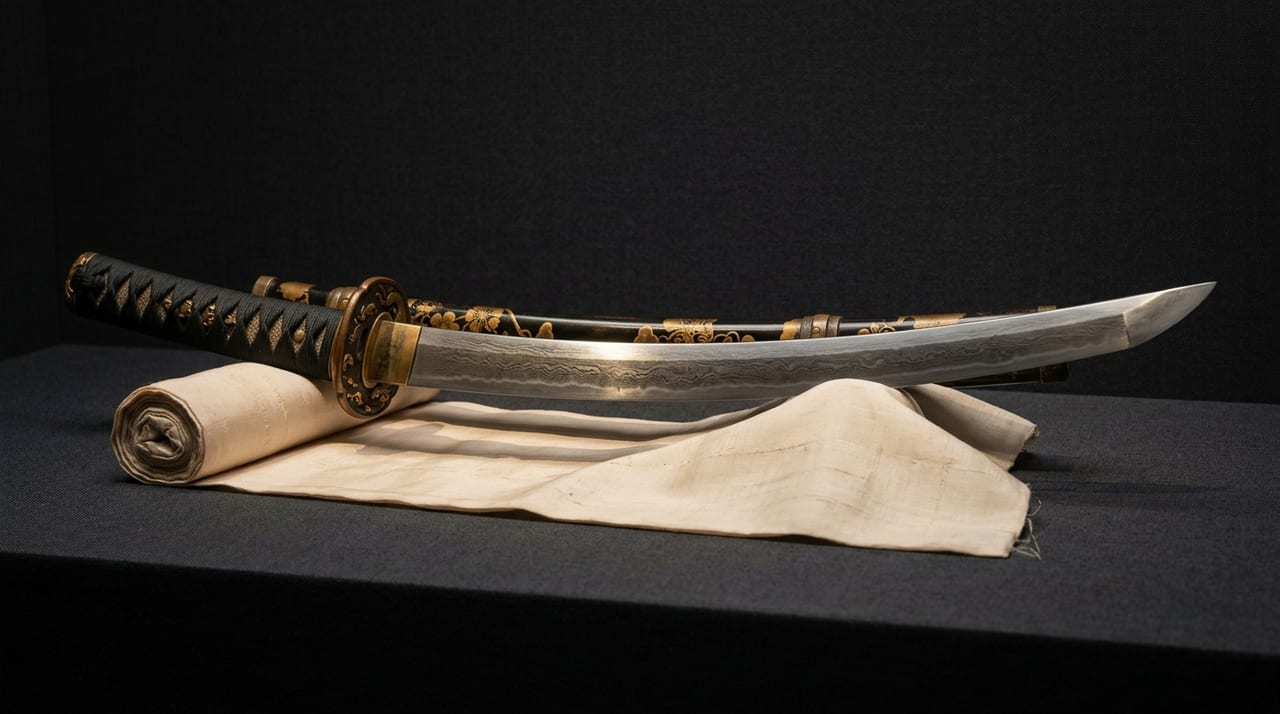
 * Image is for illustrative purposes only.
Tachi by Yamato Managa
大和真長の太刀
Also known as: Tachi by Managa (Yamato Tegai School, Famous Sword of Nara)
Description
Yamato Managa was a swordsmith of the late Kamakura period, representing the Shikkake school (one of the Yamato Five Schools: Tegai, Taima, Senjuin, Hōshō, and Shikkake) based in Yamato Province (modern Nara Prefecture). Working under the patronage of the great temples of Nara—Kōfuku-ji and Tōdai-ji—he produced numerous dedication swords for deities and Buddhas as well as presentation blades for warrior houses. Managa, alongside Norinaichi, is counted among the finest masters of the Shikkake school. The jigane of a Managa tachi displays the masame (straight grain) or itame-mixed masame characteristic of the Yamato tradition, with ji-nie lending a clean, refined finish. The hamon is based on a ko-nie deki suguha (straight temper line), interspersed with subtle ko-midare and sunagashi (sandy drift activities), and in the calm, settled style dwells the dignity and strength characteristic of the Yamato tradition. Some pieces retain a clear two-character 'Managa' signature on the tang, earning them high marks from connoisseurs. The spirituality of Yamato swordsmanship—nurtured through deep connections with Kōfuku-ji, Tōdai-ji, and Kasuga Grand Shrine—is deeply reflected in Managa's works, which preserve the dignity of dedication swords used in religious rites and warrior ceremonies. As an embodiment of the aesthetic of Yamato swordsmanship rooted in Nara, Japan's ancient religious capital, Managa is counted among the indispensable masters in the world of sword scholarship.
Legends & Stories
A legend surrounding Yamato Managa tells that a Shinto priest of Kasuga Grand Shrine commissioned him to 'forge a tachi to enshrine the spiritual power of the Kasuga Deity.' Managa is said to have established a special forge at the foot of Mount Kasuga and, forging the blade while offering prayers to the Kasuga Deity, produced a tachi whose edge emitted a pale blue light when illuminated by moonlight. This blade was enshrined at Kasuga Grand Shrine, and it is said that when the Ashikaga shogunate later sent an envoy requesting to receive it, the priest refused, declaring: 'A sword of the deity cannot be given to a mortal.' Another tradition preserved within the Tegai school holds that as Managa lay dying, he told his disciples: 'My swords were forged at the deity's bidding; the skill was granted by the divine.'—a phrase still quoted as testimony to the sacred origins of Yamato swordsmanship.
Related Famous Swords
太刀 銘 国行(当麻)
National TreasureTachi Signed Kuniyuki (Taima)
Kuniyuki (founder of the Taima school)
伏見貞宗
National TreasureFushimi Sadamune
Sadamune (Sōshū Sadamune)
太刀 銘 大和則長作
Important Cultural PropertyTachi Signed Yamato Norinaga saku
Norinaga (Yamato Shikkake school)
沃懸地酢漿平文兵庫鎖太刀
National TreasureIkakeji Katabami Hyōmon Hyōgogusari Tachi
Unknown (unsigned)