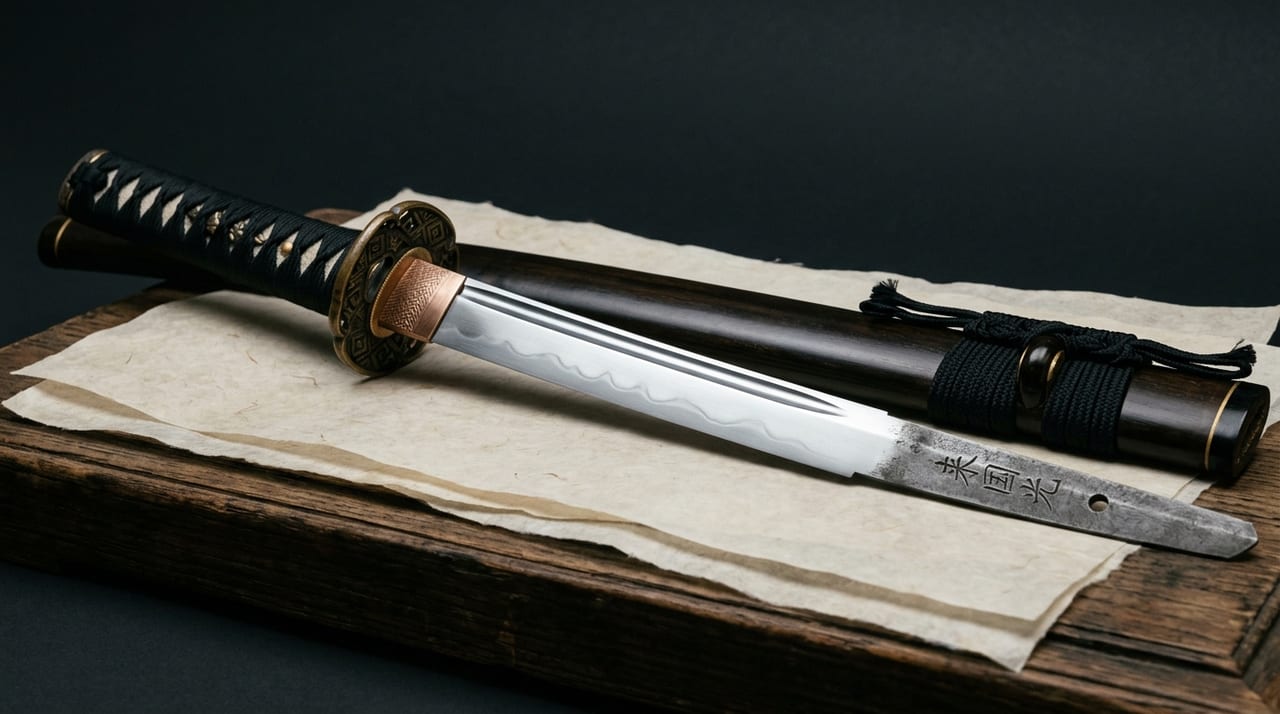
 * Image is for illustrative purposes only.
Torikai Kunitoshi
鳥養国俊
Also known as: Torikai Kunitoshi / The Niji Kunitoshi carried by Ishida Mitsunari
Description
A ko-dachi by the smith of the two-character signature
Torikai Kunitoshi is a work by the smith Kunitoshi, who was active in the Rai school of Yamashiro Province in the late Kamakura period. It is one of the representative works of the so-called Niji Kunitoshi, a name given because only the two characters "Kunitoshi" are carved on the tang. The blade measures 1 shaku 9 sun 9 bu (about 60 cm), a ko-dachi length, though the Tokugawa Art Museum classifies it as a tachi. It displays finely compacted ko-itame grain and a dignified suguha-based hamon with small irregularities, and it is listed as a meibutsu in the Kyōhō Meibutsu Chō.
The origin of the name and its priceless transmission
The name derives from its early owner, Torikai Sōkei, a local power and calligrapher of Settsu Province. It was then bought for 150 kan by Hosokawa Yūsai (Fujitaka), who was also known as a poet, and passed to his son Hosokawa Tadaoki. Tadaoki sold it to Ishida Mitsunari for the high price of 500 kan, a transaction that reflects the spirit of an age when the trade in famous blades served as both a display of friendship and of financial power among daimyo.
Lost at Sekigahara, passed to Ieyasu
Mitsunari wore this ko-dachi when he took part in the Battle of Sekigahara in 1600 (Keichō 5). After the defeat of the Western army and Mitsunari's execution, however, the sword disappeared. Later, Tomita Nobutaka, lord of Tsu Castle in Ise Province, found it and presented it to Tokugawa Ieyasu. In the eleventh month of Genna 4 (1618), it was passed to Tokugawa Yoshinao, founder of the Owari Tokugawa house, as part of Ieyasu's bequest, and thereafter it was transmitted as a treasure of the Owari Tokugawa family. On 24 September 1941 (Shōwa 16) it was certified as an Important Art Object, and it is now held by the Tokugawa Art Museum in Nagoya. The very history of passing through the hands of warlords on opposing sides forms the value of this single blade.
The Rai school and Kunitoshi
The smith Kunitoshi was active in the Rai school of Yamashiro Province in the late Kamakura period, and is said to have been a son of Kuniyuki, who is regarded as the de facto founder of the school. Known examples of Kunitoshi include tachi signed with only the two characters "Kunitoshi" and works signed "Rai Kunitoshi." The former are called Niji Kunitoshi and the latter Rai Kunitoshi, and the two are conventionally distinguished (there are theories that they are the same person and theories that they are different people). Among the two-character signed works, the Torikai Kunitoshi stands out for the reliability of its provenance.
Legends & Stories
A celebrated blade that vanished at Sekigahara
What makes the Torikai Kunitoshi memorable is above all its turbulent journey. Ishida Mitsunari, who had bought it from Hosokawa Tadaoki for 500 kan, wore it into battle at Sekigahara. When the Western army collapsed and Mitsunari was executed at Rokujō-gawara, the sword disappeared somewhere in the chaos of the decisive battle — only to be found later by Tomita Nobutaka, lord of Tsu Castle, and presented to the victor, Tokugawa Ieyasu.
Enshrining an enemy's sword
Ieyasu accepted it without rancour and left it as part of his bequest to Tokugawa Yoshinao of Owari. That a defeated rival's sword was not destroyed but preserved as a treasure of the senior Tokugawa branch says much about how the warrior class valued a blade's history as inseparable from the blade itself. Four centuries later, Mitsunari's sword is still kept and shown at the Tokugawa Art Museum in Nagoya.